


Vehicles are no longer just mechanical systems; they’re sophisticated cyber-physical ecosystems. With the rise of autonomous driving, connected car technologies, and real-time safety applications, reducing latency in automotive embedded communication networks has never been more critical. Whether it’s vehicle-to-vehicle (V2V) messaging, radar data transfer, or infotainment streaming, every millisecond of delay can make or break system performance.
If you’re an engineer, architect, or stakeholder working on vehicle communication systems, this blog will walk you through practical strategies to reduce latency while maintaining robustness, reliability, and scalability.
Understanding the Latency Challenge
Latency in automotive networks refers to the delay between when a message is sent and when it’s received and processed. Low latency is especially essential for safety-critical subsystems such as braking, collision avoidance, and adaptive cruise control. The embedded communication stack spans physical buses (CAN, FlexRay, Automotive Ethernet), middleware, and application processors; each layer introduces potential delays.
To design effective systems, many teams adopt best practices in embedded system design to minimize latency without sacrificing safety and compliance with automotive standards such as ISO 26262.
Strategies to Reduce Latency in Automotive Communication Networks
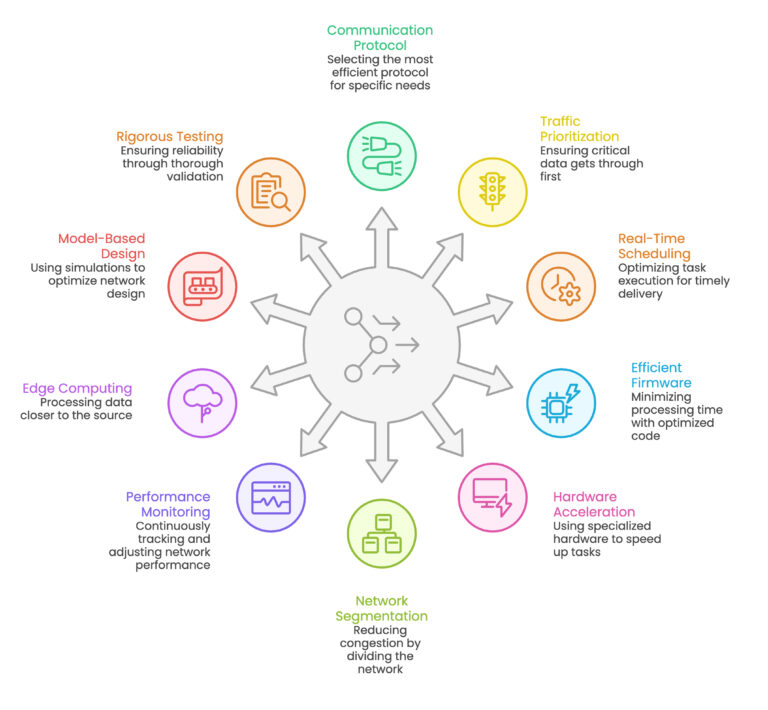
1. Choose the Right Communication Protocol
Different buses offer varied performance characteristics:
- CAN and CAN-FD: Widely used for control messages due to robustness, but limited in bandwidth.
- FlexRay: Offers deterministic timing and redundancy, suitable for safety-critical functions.
- Automotive Ethernet: Increasingly popular for high bandwidth and low latency, supporting ADAS, cameras, and infotainment.
Selecting the right mix and design topology based on use cases ensures that critical messages don’t queue behind lower-priority traffic.
2. Prioritize Traffic Using Quality of Service (QoS)
Not all data is created equal. In vehicle systems, some messages, like emergency brake signals, must take precedence over routine diagnostics or infotainment traffic.
Implement QoS mechanisms at the network and application layers to assign higher priority to time-sensitive packets. Protocols like Time-Sensitive Networking (TSN) help enforce priority and scheduling policies that reduce delays for critical traffic.
3. Optimize Scheduling for Real-Time Tasks
Communication latency isn’t just about the bus; it’s also about how tasks are scheduled on the processing units.
Real-time operating systems (RTOS) and schedulers can be tuned to ensure that high-priority tasks preempt lower-priority ones. Use techniques like:
- Rate-monotonic scheduling (RMS)
- Earliest deadline first (EDF)
These help ensure deterministic behavior in time-critical applications.
4. Minimize Processing Overheads with Efficient Firmware
Efficient firmware directly impacts communication latency, especially in systems with limited processing resources. Reducing overhead in interrupt processing, avoiding unnecessary polling loops, and optimizing message handling paths can shave off precious microseconds in data transmission and processing.
This is where expert designing embedded system teams can make a significant difference, by writing lean, efficient code tailored to the timing guarantees of your network.
5. Use Hardware Acceleration Where Possible
Many modern microcontrollers and SoCs include hardware support for communication stacks. For instance:
- Dedicated DMA engines to handle data transfers without CPU intervention
- Hardware timestamping for precise latency measurement
- Offload engines for protocol handling
Leverage these accelerators to reduce CPU load and latency, especially in high-throughput scenarios like Automotive Ethernet.
6. Segment Networks for Reduced Contention
Large automotive networks can introduce traffic congestion, especially in mixed-traffic environments. Network segmentation, such as separating control domains from infotainment or diagnostic domains, reduces contention and isolates high-priority traffic, ensuring more predictable latency performance.
Gateways can then bridge these segments without introducing unnecessary overhead for time-critical messages.
7. Monitor and Tune Network Performance
Latency reduction isn’t a one-time effort; it’s a continuous process. Use in-vehicle network analyzers and monitoring tools during development and testing phases to:
- Detect bottlenecks
- Measure jitter
- Analyze worst-case latencies
Tune configurations based on real-world usage patterns to achieve optimal performance.
8. Leverage Edge and Distributed Computing
Especially for V2X (Vehicle-to-Everything) communication and autonomous systems, offloading some processing to edge nodes, closer to sensors or actuators, can reduce round-trip delays to a central processor.
Distributed architectures coupled with smart task offloading ensure that time-critical decisions are made locally without waiting for central aggregation.
9. Adopt Model-Based Design and Simulation
Using model-based tools and simulators lets engineers simulate and validate system behavior before hardware deployment. These tools can identify potential latency hotspots early in the advanced design solution phase, allowing teams to optimize configurations and architectures sooner rather than later.
This proactive approach reduces costly iterations and improves performance predictability.
10. Ensure Rigorous Testing and Validation
Robust testing is crucial. Beyond unit testing, perform:
- Hardware-in-the-Loop (HIL) testing
- Software-in-the-Loop (SIL) analysis
- System-in-the-Loop (SysIL)
These methods simulate real-world conditions to measure and manage latency under stress conditions. Validation ensures that the network performs reliably across scenarios, including peak traffic and failover conditions.
Why Automotive OEMs Rely on Embedded Systems for Safety and Performance
Why Tessolve Excels in Automotive Latency Solutions
At Tessolve, we understand that reducing communication latency in automotive systems isn’t just about faster buses; it’s about holistic engineering. With over two decades of expertise, we deliver embedded system company services that span hardware design, firmware development, real-time software, and network protocols to accelerate high-performance automotive solutions.
Our team combines deep domain knowledge with state-of-the-art labs and tools to validate and optimize automotive communication networks, ensuring they meet stringent latency and safety requirements. From cutting-edge advanced design solution integration to on-vehicle testing and validation, Tessolve partners with OEMs and Tier-1 suppliers to bring reliable, low-latency systems to market quickly.
Whether you’re tackling V2X communication, autonomous driving stacks, or next-gen infotainment systems, our approach, rooted in rigorous engineering and real-world performance tuning, makes a tangible difference in your project’s success. As a trusted embedded system design provider, we help you stay ahead of the curve in an increasingly connected vehicle landscape.
Frequently Asked Questions (FAQs)
1. What causes high latency in automotive embedded networks?
High latency is usually caused by network congestion, inefficient scheduling, slow processors, poorly optimized firmware, or using the wrong communication protocol.
2. Is CAN still reliable for low-latency automotive communication?
Yes, CAN is still widely used, especially CAN-FD, but for high-bandwidth, ultra-low latency needs, Automotive Ethernet and TSN are becoming more preferred.
3. Can software optimization alone reduce latency, or is new hardware required?
In many cases, software optimization, better scheduling, and firmware tuning significantly reduce latency, but advanced applications may still need upgraded hardware.
4. How do engineers measure and verify latency in automotive systems?
They use in-vehicle analyzers, HIL/SIL testing, performance monitoring tools, real-time logs, and stress testing to evaluate latency under real conditions.


