


Automotive innovation today is driven as much by electronics as by engineering mechanics. Vehicles are expected to be safer, faster, more efficient, and increasingly intelligent, all at the same time. Behind this evolution lies a powerful foundation: embedded systems. From real-time braking decisions to intelligent power management, these systems quietly govern how a vehicle behaves in every situation.
This shift isn’t happening at the surface level. It’s happening deep inside vehicle electronics, shaped by disciplined embedded system design and architectures built specifically for automotive-grade safety and performance.
Why Embedded Systems Are Central to Automotive Safety and Performance
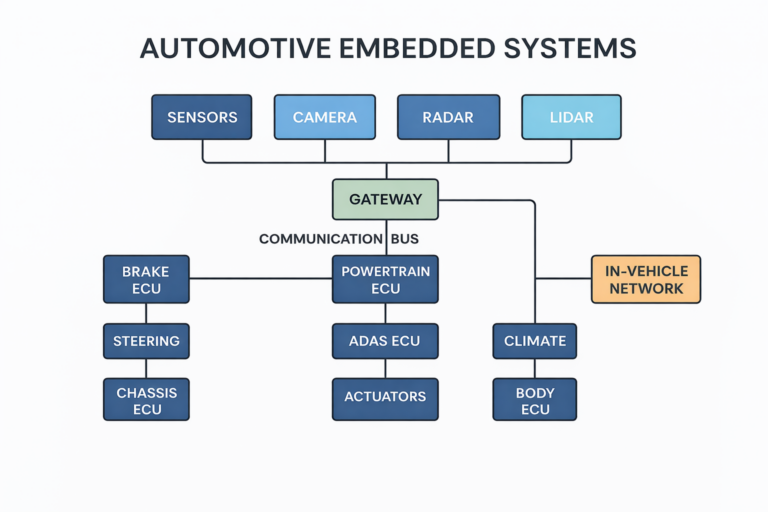
Automotive embedded systems form the vehicle’s decision-making backbone, managing how data flows from sensors to control units and finally into physical actions. Inputs from cameras, radar, LiDAR, and in-vehicle sensors are routed through communication buses to domain controllers and ECUs handling braking, powertrain, steering, ADAS, and body functions. This sensing-to-actuation flow is visualized in the accompanying infographic, highlighting how embedded components operate as a unified system.
These controllers process inputs in real time, execute control algorithms, and trigger precise responses within milliseconds. This tightly integrated architecture allows vehicles to react instantly to changing conditions, from emergency braking to stability control and energy optimization. OEMs rely on embedded systems because mechanical components alone cannot deliver the level of speed, coordination, and intelligence required, making embedded platforms essential for both safety and consistent performance.
The Key Advantages Embedded Systems Bring to Modern Vehicles
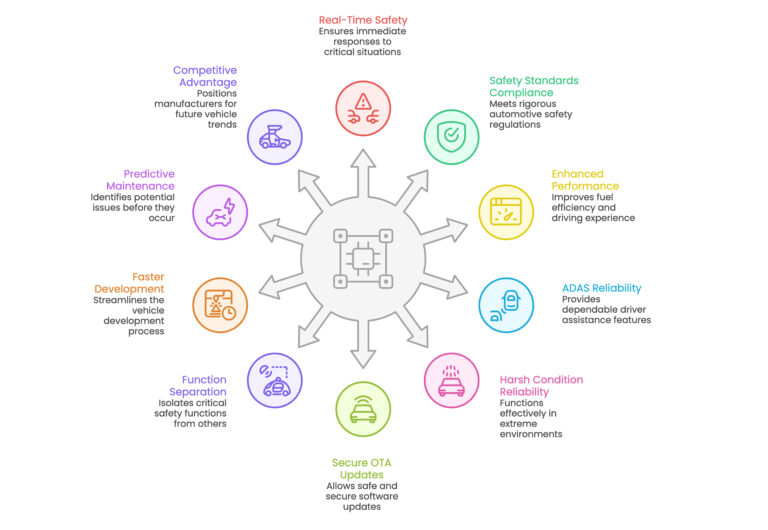
1. Real-Time Safety Responses With Zero Tolerance for Delay
Safety-critical functions like airbags, ABS, electronic stability control, and collision mitigation require deterministic, real-time responses. Embedded systems are engineered to react within milliseconds, ensuring consistent and predictable behavior even under extreme conditions.
This level of responsiveness is achieved through carefully structured software and hardware coordination, making safety one of the strongest reasons OEMs invest in robust designing embedded system frameworks.
2. Compliance With Automotive Functional Safety Standards
Global automotive regulations demand strict adherence to functional safety standards such as ISO 26262. Embedded platforms are developed with traceable requirements, fault monitoring, and redundancy mechanisms that help meet Automotive Safety Integrity Levels (ASIL).
OEMs depend on embedded architectures that support fault detection, isolation, and recovery, minimizing risk throughout the vehicle lifecycle.
3. Enhanced Vehicle Performance and Driving Efficiency
Performance today is measured in efficiency, responsiveness, and consistency. Embedded controllers optimize engine parameters, electric motor control, regenerative braking, and battery usage in real time.
This continuous optimization improves fuel economy, extends EV range, and delivers smoother acceleration, all without driver intervention. These benefits are only possible with tightly integrated control systems built on proven embedded system design practices.
4. Advanced Driver Assistance Systems (ADAS) Reliability
ADAS features rely on multiple sensors working together, including cameras, radar, ultrasonic sensors, and LiDAR. Embedded systems process this data in real time to support functions such as lane keeping, adaptive cruise control, and automatic emergency braking.
OEMs require an advanced design solution that balances computing performance, thermal limits, and safety isolation to ensure ADAS features operate reliably in every scenario.
5. High Reliability in Harsh Automotive Conditions
Vehicles face vibration, heat, cold, moisture, and electrical interference daily. Embedded systems are designed and validated to operate reliably under these conditions for years.
Automotive-grade components and software architectures ensure consistent operation, helping OEMs reduce field failures, recalls, and long-term maintenance costs.
6. Secure Over-the-Air (OTA) Updates Without Safety Risks
Modern vehicles receive frequent software updates. Embedded systems enable secure boot, encrypted communication, and rollback mechanisms that ensure updates never compromise safety-critical functions.
By carefully designing embedded system architectures, OEMs can introduce new features, patch vulnerabilities, and improve performance remotely, without physical recalls.
7. Clear Separation of Safety-Critical and Non-Critical Functions
Infotainment systems must never interfere with braking, steering, or powertrain controls. Embedded platforms enable domain separation through virtualization and controlled communication paths.
This architectural isolation allows OEMs to deliver feature-rich digital experiences while preserving safety integrity, a key advantage of any advanced design solution built for automotive environments.
8. Faster Development With Scalable Platforms
OEMs increasingly reuse embedded platforms across multiple vehicle models. Modular architectures allow software and hardware blocks to scale efficiently, reducing development time and cost.
This scalability helps manufacturers bring innovations to market faster while maintaining consistent safety and performance across product lines.
9. Built-In Diagnostics and Predictive Maintenance
Embedded systems continuously monitor component health and performance trends. Early detection of anomalies enables predictive maintenance, reducing breakdowns and improving customer satisfaction.
OEMs benefit from fewer warranty claims and better long-term vehicle reliability.
10. Competitive Advantage in the Software-Defined Vehicle Era
As vehicles become software-defined, embedded systems form the backbone of differentiation. OEMs increasingly rely on a trusted embedded system company that can deliver validated architectures, long-term support, and automotive-grade reliability.
Choosing the right engineering partner directly impacts speed to market, system robustness, and future scalability.
How Thermal Cycling Impacts Long-Term Automotive Electronics Reliability
Tessolve: Powering Automotive Safety and Performance Through Embedded Engineering
At Tessolve, we partner with global automotive OEMs as a trusted embedded system company, delivering end-to-end engineering from silicon to system validation. Our expertise spans semiconductor design, automotive embedded software, ADAS enablement, powertrain solutions, and large-scale test engineering. We help OEMs build safety-compliant, high-performance platforms through disciplined development, rigorous validation, and production-ready engineering frameworks. With advanced labs and deep automotive domain knowledge, Tessolve enables manufacturers to confidently deploy reliable, scalable embedded systems that meet today’s safety demands and tomorrow’s performance expectations.
Frequently Asked Questions (FAQs)
1. Why are embedded systems crucial for vehicle safety?
They enable real-time, deterministic responses for safety-critical functions like ABS and airbags, ensuring consistent, predictable behavior.
2. How do embedded systems ensure compliance with safety standards?
They are built with fault monitoring and redundancy, meeting functional safety standards like ISO 26262 and required ASIL levels.
3. What benefit do embedded systems offer for vehicle performance and efficiency?
They continuously optimize engine, motor, and battery parameters, which improves fuel economy, extends EV range, and ensures smoother driving.
4. Can infotainment systems interfere with essential driving controls?
No, advanced embedded architectures separate non-critical (infotainment) and safety-critical functions to preserve integrity.


