

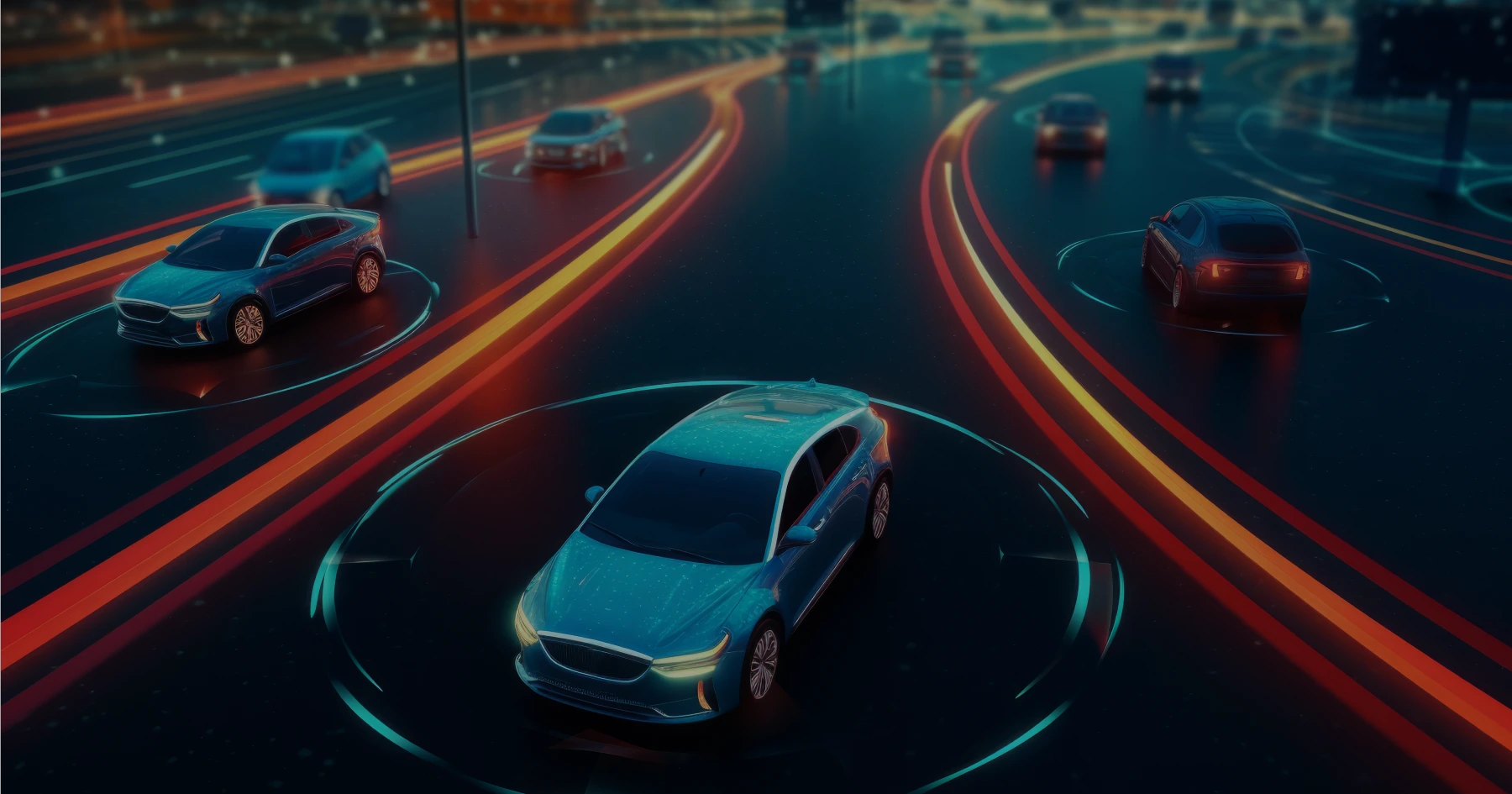
Not long ago, cars were mostly mechanical machines. Today, they’re intelligent, connected systems that continuously exchange information with their surroundings. From the moment a vehicle leaves the garage to the instant it interacts with city infrastructure or the power grid, Vehicle-to-Everything (V2X) communication is quietly at work. This evolution is being driven by smart embedded control, small yet powerful systems that sense, decide, and act in real time.
V2X is not just about connectivity; it’s about coordination. Vehicles now collaborate with roads, networks, and energy systems to make mobility safer, smoother, and more sustainable.
Understanding V2X: More Than Just Connected Cars
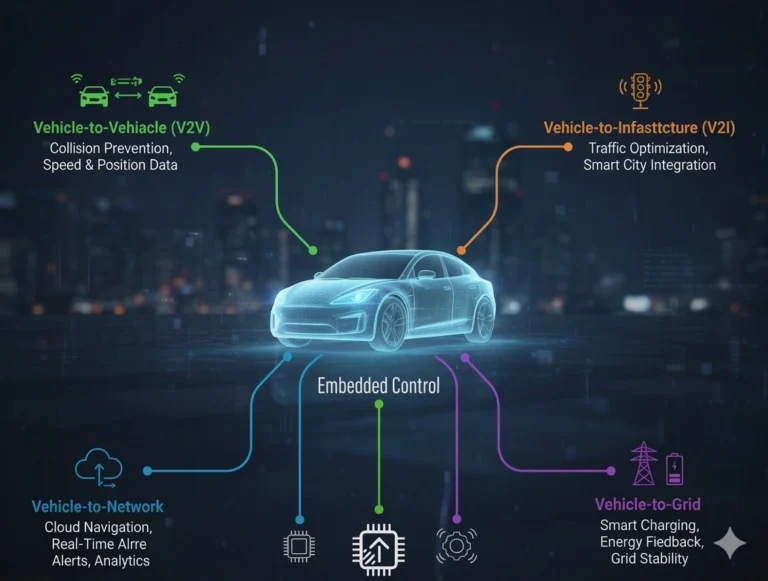
V2X is an umbrella term that covers several communication models:
- Vehicle-to-Vehicle (V2V): Cars exchange speed, position, and braking data to prevent collisions.
- Vehicle-to-Infrastructure (V2I): Traffic lights, toll booths, and road sensors communicate with vehicles to optimize traffic flow.
- Vehicle-to-Network (V2N): Vehicles connect to cloud platforms for navigation, alerts, and analytics.
- Vehicle-to-Grid (V2G): Electric vehicles interact with the power grid for intelligent charging and energy feedback.
Together, these interactions transform vehicles from isolated machines into active participants in a broader mobility and energy ecosystem. However, this seamless interaction isn’t just about the wireless signal; it’s about the intelligence orchestrating it. Behind every exchange of data lies a sophisticated layer of embedded control that translates raw information into safe, autonomous actions. As we visualize the V2X landscape below, it becomes clear that the vehicle is no longer just a mode of transport; it is a node in a massive, real-time digital network.
Embedded Control: The Intelligence Behind V2X
1. How Embedded Controllers Power Real-Time Decisions
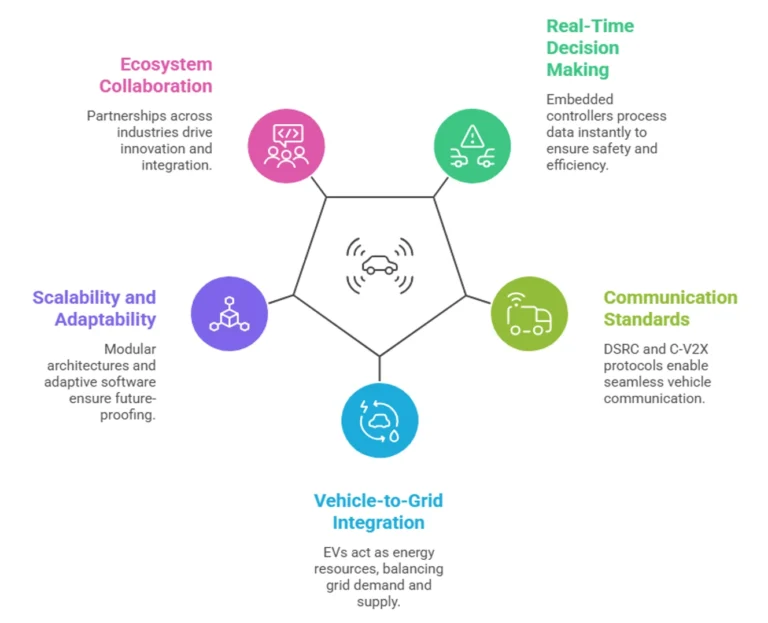
Every V2X interaction relies on embedded controllers that process vast amounts of data in milliseconds. These controllers integrate sensor inputs, wireless messages, and software logic to make immediate decisions, whether that’s slowing down for a sudden hazard or adjusting charging behavior based on grid demand.
This is where embedded system design becomes critical. Engineers must build systems that are fast, reliable, power-efficient, and safe enough for real-world driving. Unlike consumer electronics, automotive embedded systems must perform flawlessly under extreme temperatures, vibration, and continuous operation.
2. Real-Time Decisions on Real Roads
V2X systems don’t have the luxury of delay. A warning about a sudden brake ahead or a pedestrian crossing must be acted on instantly. Embedded control units handle this by running real-time operating systems and deterministic communication stacks that prioritize safety-critical tasks.
The challenge lies in balancing responsiveness with reliability. Embedded software must filter noise, validate incoming data, and decide whether to act, all in fractions of a second. This level of complexity demands careful planning when designing embedded system architectures for connected mobility.
3. Communication Standards Powering V2X
V2X communication is built on established and emerging standards such as DSRC and Cellular V2X (C-V2X). While DSRC focuses on short-range, low-latency communication, C-V2X leverages 4G and 5G networks to extend range and bandwidth.
Embedded platforms must support these protocols while ensuring cybersecurity, interoperability, and compliance with automotive regulations. Secure boot, encrypted communication, and over-the-air updates are no longer optional; they’re essential components of modern V2X systems.
4. Vehicle-to-Grid: Where Mobility Meets Energy
One of the most exciting extensions of V2X is Vehicle-to-Grid. Electric vehicles are no longer just energy consumers; they can also act as distributed energy resources. During peak demand, EVs can supply stored energy back to the grid, and during off-peak hours, they can charge intelligently.
Embedded control systems manage this two-way energy flow, protecting battery health while supporting grid stability. This requires precise control algorithms and an advanced design solution mindset that blends automotive engineering with power electronics and energy management.
5. Scaling from Prototype to Production
A V2X prototype may work perfectly in simulations, but real-world deployment introduces unpredictable variables such as weather, signal interference, mixed traffic, and human behavior. Scalable embedded platforms address this through modular architectures, extensive testing, and adaptive software updates.
By designing systems that can evolve with new standards and regulations, manufacturers can future-proof their vehicles and infrastructure investments.
6. Collaboration Across Ecosystems
V2X development sits at the intersection of automotive, telecom, infrastructure, and energy industries. Success depends on collaboration between OEMs, Tier-1 suppliers, software vendors, and system integrators. A capable embedded system company brings these disciplines together, ensuring seamless integration across hardware, software, and validation.
How Domain Controllers Are Reshaping Automotive Embedded Architectures
Tessolve: Driving Embedded Innovation for Connected Mobility
At Tessolve, we work at the heart of intelligent mobility, helping customers turn complex V2X concepts into reliable, production-ready systems. With deep expertise across embedded hardware, firmware, connectivity, and system validation, we support automotive OEMs and Tier-1s through every stage of development.
Our teams design and validate safety-critical embedded platforms, communication modules, and energy-aware control systems aligned with global automotive standards. Backed by advanced labs, silicon-to-system capabilities, and a strong focus on quality, Tessolve enables scalable, secure, and future-ready V2X solutions. From connected vehicles to grid-integrated mobility, we partner with innovators to shape what’s next, intelligently and reliably.
Frequently Asked Questions (FAQs)
- What is V2X communication in vehicles?
V2X enables vehicles to exchange real-time data with cars, infrastructure, networks, and energy grids for safer mobility.
- Why are embedded systems critical for V2X?
Embedded systems process sensor and communication data instantly, enabling fast, reliable decisions in safety-critical driving scenarios.
- How does Vehicle-to-Grid technology benefit smart cities?
V2G allows electric vehicles to balance grid demand by intelligently storing and supplying energy during peak usage periods.
- What challenges exist when deploying V2X systems at scale?
Ensuring low latency, cybersecurity, regulatory compliance, and real-world reliability remains the biggest deployment challenge.
- How does 5G improve the performance of V2X systems?
5G enables ultra-low latency and higher reliability, allowing vehicles to communicate faster and react more accurately in real time.


