


Cars aren’t just mechanical machines anymore; they are essentially high-powered computers on wheels. Between Advanced Driver Assistance Systems (ADAS), over-the-air software updates, and constant cloud connectivity, the digital infrastructure inside modern vehicles is being pushed to its absolute limits. This rapid evolution is also driving demand for advanced automotive software development across the industry.
Traditionally, automakers added new features by installing independent control units (ECUs), resulting in a complex and cumbersome wiring system. To address this issue, the automotive industry is shifting towards zonal architectures supported by centralized systems. This transformation is revolutionizing vehicle engineering, production, and updates throughout their lifespan.
Understanding Zonal Architecture in Modern Vehicles
Instead of grouping electronics by what they do (like infotainment or braking), a zonal architecture groups them by where they are physically located in the car. The vehicle gets mapped out into clear geographic territories, like the front bumper, the cabin, or the rear assembly. Each of these areas gets its own local hub, or zonal controller, to manage nearby sensors and switches.
These local hubs act as traffic cops, sorting the local data and sending it along a high-speed pathway straight to a central computer that handles the heavy processing. By shrinking the physical distance wires have to travel, automakers cut down on bulk while making the entire vehicle ecosystem way more flexible.
This ongoing shift from zonal vs domain architecture automotive ECU layouts is a major talking point for engineers right now, especially as manufacturers ditch fragmented hardware in favor of unified, software-defined platforms.
How Domain Controllers Are Reshaping Automotive Embedded Architectures
Why Automakers Are Moving Toward Centralized Computing
If you want a car to navigate city streets autonomously or run smart AI features, you need massive computing power. The old way of using dozens of isolated, low-power microcontrollers just doesn’t cut it.
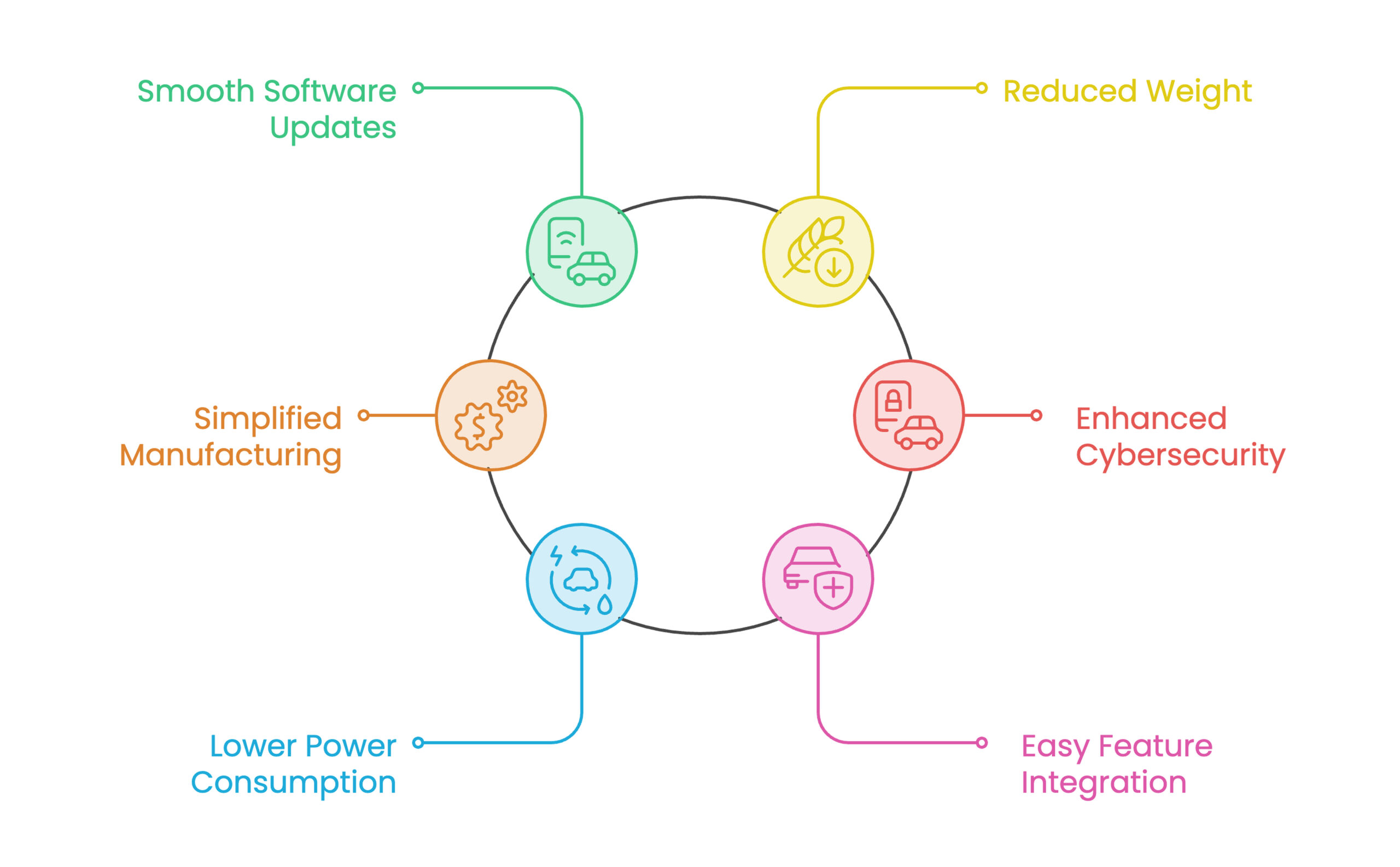
That is why a centralized vehicle compute platform design is becoming the new standard. Consolidating the car’s brainpower into a few high-performance processors brings some massive advantages:
- Software updates roll out smoothly without risking a system clash
- Stripping out miles of copper wiring drops the vehicle’s total weight
- Manufacturing gets simpler, saving serious production costs
- Cybersecurity is much easier to lock down at a single central point
- Power consumption drops, preserving battery life
- Adding new features down the line doesn’t require tearing apart the dashboard
Tesla really broke the mold by proving this centralized approach works, and now practically every major global automaker is racing to build its own version.
The Role of Automotive Ethernet in Zonal Systems
You can’t build a centralized brain without a lightning-fast nervous system. Old-school automotive networks (like CAN and LIN buses) are great for simple tasks, but they completely choke under the massive data floods coming from modern cameras, radar, and LiDAR setups.
Because vehicles depend so heavily on real-time data, manufacturers are aggressively managing an automotive Ethernet zonal architecture migration. Shifting to automotive Ethernet gives the vehicle network the massive bandwidth and ultra-low latency it needs to move heavy data streams instantly.
This high-speed network upgrade is absolutely crucial for self-driving platforms and next-generation electric vehicles that need to process and react to road data in milliseconds.
Software Becomes the Core of Vehicle Innovation
This shift is far more than a simple hardware reshuffle; it is an absolute software revolution. When you centralize a car’s processing power, you need an incredibly sophisticated software stack to keep everything running in harmony, managing everything from internal communications to over-the-air updates.
Because of this, the demand for specialized automotive software development has skyrocketed. Code now dictates how a car manages its battery life, stops in an emergency, or customizes the passenger experience.
Consequently, engineering teams focused on vehicle software development have become the primary drivers of automotive innovation, helping legacy brands transform their vehicles into smart, adaptable devices.
AUTOSAR Adaptive and Zonal Controllers
The classic software standards built for older cars weren’t meant to handle modern, high-performance computing. They were designed for simple, static modules that rarely changed.
To bridge this gap, engineers are relying heavily on AUTOSAR adaptive zonal controller design. Adaptive AUTOSAR is built specifically for complex computing environments, allowing the car to run dynamic applications, handle service-oriented communication, and safely pull down updates over the air.
By running this flexible framework on zonal controllers, the vehicle can balance multiple tasks at once while keeping an open, secure line of communication with the main central computer.
Embedded Engineering Challenges in Zonal Architectures
Shifting to a centralized system sounds great on paper, but it presents some massive hurdles for engineering teams. Putting all your eggs in fewer baskets means those systems cannot afford to fail.
Navigating this transition requires incredibly deep expertise in embedded system engineering to ensure the hardware and software mesh flawlessly. Engineers have to rebuild data paths from scratch, eliminate micro-delays in safety-critical systems, and ensure the entire network is completely secure against cyber threats.
Teams are also completely reinventing how power and cooling are distributed, making sure that if one component acts up, the central brain keeps the vehicle running safely.
EV Platforms Are Accelerating the Shift
Electric vehicles are adopting zonal layouts much faster than traditional internal combustion cars. Since EVs are built from scratch on clean “skateboard” platforms, they are perfect candidates for a streamlined digital architecture.
This is why automakers are focusing so much energy on the automotive embedded system redesign of EV platforms. Ditching heavy copper wiring harnesses directly lowers the weight of an EV, which instantly boosts its driving range and efficiency. Plus, it makes it much easier to optimize battery life and power distribution through clean code.
The future of electric mobility is completely tied to how well brands can blend software, electrification, and centralized computing into a single, cohesive package.
The Future of Automotive Engineering
We are living through one of the biggest technological shakeups the car industry has ever seen. Vehicles are transforming into sophisticated, data-driven computers, and zonal architecture is the foundation making that happen.
As the race toward true autonomous driving heats up, the need for advanced automotive software engineering services is only going to grow. The companies that know how to build secure, scalable software platforms and link them to centralized hardware are the ones that will define the next generation of transportation.
Tessolve: Driving the Future of Software-Defined Vehicles
At Tessolve, we help automotive companies navigate this massive structural shift with hands-on engineering expertise and scalable development solutions. Our teams specialize in semiconductor design, embedded hardware, automotive software integration, and high-performance computing platforms that power modern mobility.
Whether you are looking to build a centralized compute system, integrate zonal controllers, set up high-speed Ethernet frameworks, or validate safety-critical software, Tessolve supports OEMs and Tier-1 suppliers at every single turn. We bring the deep technical know-how needed to speed up development cycles and help you build smart, connected, and future-ready vehicles with total peace of mind.
Frequently Asked Questions (FAQs)
1. What is zonal architecture in modern vehicles?
Zonal architecture organizes vehicle electronics by physical zones instead of separate function-based electronic control units.
2. Why are automakers shifting toward centralized computing platforms?
Centralized platforms reduce wiring complexity, improve software integration, and support advanced connected and autonomous vehicle technologies.
3. How does Automotive Ethernet support zonal architectures?
Automotive Ethernet enables faster data communication, higher bandwidth, and low-latency connectivity between zonal controllers and centralized systems.
4. What are the advantages of zonal architecture for electric vehicles?
Zonal architectures reduce wiring weight, improve energy efficiency, simplify integration, and enhance scalability for EV platforms.
5. Why is software becoming critical in modern automotive systems?
Software controls connectivity, safety features, autonomous functions, updates, and intelligent vehicle operations in modern automotive platforms.


