

Modern embedded systems are no longer simple, single-purpose devices. From autonomous vehicles and industrial automation to AI-enabled edge devices, workloads have grown more complex, demanding, and real-time sensitive. Managing these workloads on a single processor often leads to performance blockages, high power consumption, and reliability issues.
This is where multi-core embedded architectures come in. By providing multiple processing cores on a single chip, these architectures allow tasks to run concurrently, improving efficiency, responsiveness, and scalability. At Tessolve, we specialize in helping companies design, integrate, and validate multi-core embedded systems, ensuring that modern devices meet the high expectations of today’s workloads.
What Does a Multi-Core Embedded Architecture Mean?
A multi-core embedded architecture is a processor design that integrates two or more independent cores within a single chip. Each core can execute instructions simultaneously, allowing for true parallel processing.
Unlike a single-core processor, which handles multiple tasks by rapidly switching between them (time slicing), multi-core architectures can dedicate cores to specific tasks, such as real-time control, networking, AI inference, or sensor data processing. This approach reduces latency, increases throughput, and allows embedded systems to meet stringent performance and reliability requirements.
Modern semiconductor engineering leverages multi-core designs to handle workloads that were once only feasible on high-end desktop or server processors. These designs are increasingly important for top semiconductor companies aiming to deliver efficient, high-performance embedded solutions.
Why Multi-Core Architectures Are Critical for Modern Workloads
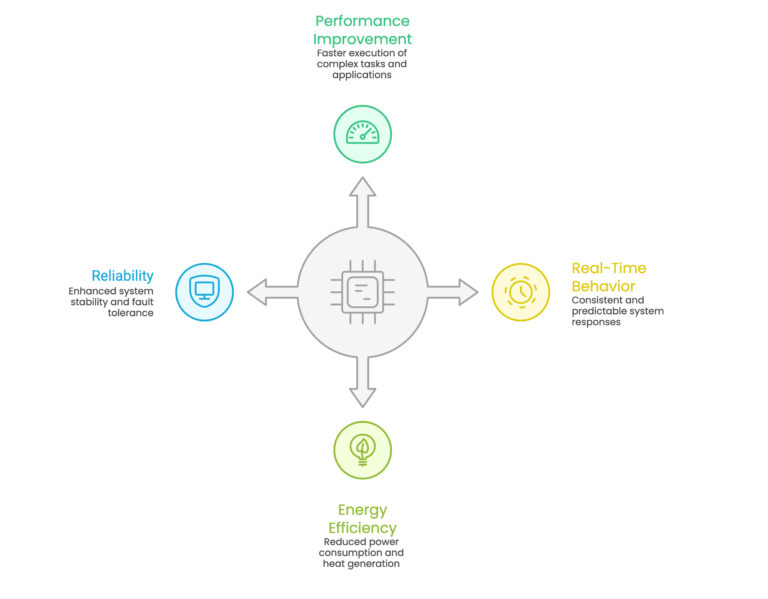
As embedded applications become more complex, relying on a single core can no longer guarantee the required performance. Multi-core architectures address these challenges by enabling true parallelism, better task management, and improved system efficiency.
1. Multi-Core Architectures Improve Performance
The primary benefit of multi-core designs is parallel task execution. By distributing tasks across multiple cores, embedded systems can:
- Run real-time control loops alongside non-critical tasks without interference.
- Handle complex computations like AI inference or video processing in parallel.
- Maintain higher throughput under heavy workload conditions.
For example, in an autonomous vehicle, one core may handle sensor fusion, another controls steering and braking systems, while a third manages communication with cloud services. This division ensures that critical tasks are not delayed by other system operations, leading to faster and more reliable performance.
2. Enhance Real-Time and Deterministic Behavior
Many embedded applications, such as industrial automation or automotive safety systems, require deterministic behavior, meaning tasks must complete within strict timing constraints.
Multi-core architectures allow developers to pin critical tasks to dedicated cores, ensuring:
- Real-time operations are unaffected by background processes.
- Reduced latency and predictable timing for control systems.
- Isolation of high-priority tasks from less critical functions.
This approach ensures that safety-critical operations remain reliable, even under high system load.
3. Multi-Core Architectures Bring to Energy Efficiency
Multi-core processors can also be more energy-efficient than single high-frequency cores. By distributing workloads across several lower-speed cores, the system can achieve the same or better performance with lower power consumption.
Benefits include:
- Reduced active power draw per core.
- Ability to shut down unused cores during low activity periods.
- Lower heat generation, reducing cooling requirements.
This is especially beneficial for battery-powered devices and applications with strict thermal constraints, such as IoT edge devices or medical instrumentation.
4. Improve Reliability and Redundancy
Multi-core systems can enhance system reliability by isolating critical tasks to dedicated cores. This ensures that a fault in one domain does not affect other operations.
- Safety-critical tasks, such as braking control in automotive systems, can operate independently.
- Non-critical or experimental functions can run on separate cores without impacting core functionality.
- Multi-core architectures enable fault tolerance and better overall system robustness.
This redundancy is vital for mission-critical applications, including aerospace, industrial robotics, and autonomous vehicles.
Where Multi-Core Embedded Architectures Provide Real-World Benefits
Multi-core architectures are increasingly used across various domains. Some key applications include:
1. Automotive Systems
Modern vehicles rely on multiple embedded systems for control, safety, infotainment, and communication. Multi-core processors allow:
- Real-time control loops to operate on dedicated cores
- Infotainment and communication stacks to run independently
- Enhanced reliability and performance in autonomous and assisted driving systems
2. Industrial Automation
In factories and industrial plants, embedded controllers must handle sensor data, robotics control, and networking simultaneously. Multi-core designs ensure:
- Smooth operation without delays or bottlenecks.
- Concurrent monitoring and control of multiple subsystems.
- Predictable response times for safety-critical processes.
3. Edge AI and High-Performance Computing
Embedded AI at the edge requires real-time data processing, inference, and connectivity. Multi-core systems:
- Assign cores for inference, preprocessing, and data streaming.
- Handle AI workloads locally without cloud dependency.
- Improve efficiency and latency in applications like smart cameras or autonomous drones.
4. Networking and Communication Systems
Embedded networking devices need to manage heavy protocol stacks, encryption, and cloud interactions. Multi-core architectures:
- Distribute packet processing across cores.
- Maintain high throughput even under heavy traffic.
- Improve energy efficiency and reduce thermal stress.
How Domain Controllers Are Reshaping Automotive Embedded Architectures
How Tessolve Embraces Multi-Core Embedded Architectures
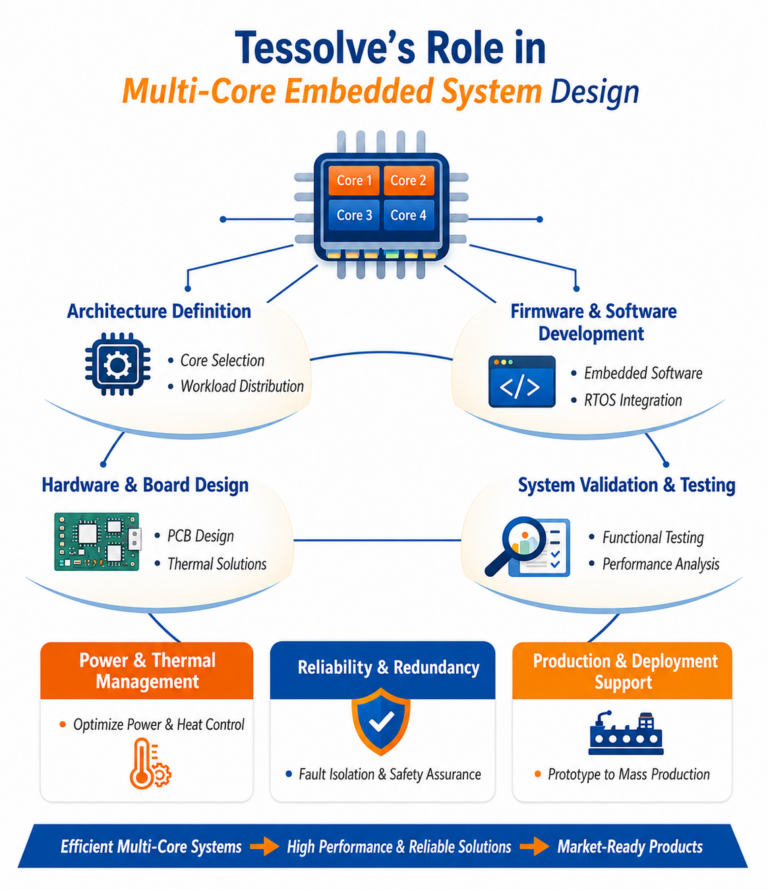
At Tessolve, we recognize that multi-core embedded architectures are critical for modern workloads. Our expertise spans the entire product lifecycle, enabling companies to leverage multi-core designs effectively:
- Architecture Definition: Selecting the right cores and workload distribution strategy.
- Integration & Validation: Ensuring hardware, firmware, and software work seamlessly.
- Performance Optimization: Balancing power, thermal efficiency, and processing throughout.
- Reliability Engineering: Isolating critical tasks and supporting redundancy for mission-critical applications.
To better understand Tessolve’s role in multi-core embedded system design and how these architectures deliver efficiency at scale, the following architecture provides a clear visual overview:
By working with top semiconductor companies and supporting multi-core embedded designs, we help clients bring high-performance, energy-efficient, and reliable embedded systems to market. Our cross-domain expertise in semiconductor engineering ensures that each design meets both current requirements and future scalability needs.
Frequently Asked Questions (FAQs)
1. Why are multi-core embedded architectures necessary?
They allow modern devices to run multiple, complex tasks concurrently, improving performance, responsiveness, and reliability compared to single-core processors.
2. Can multi-core systems improve energy efficiency?
Yes. Multi-core designs distribute workload across several cores, allowing lower power operation per core and reducing heat generation.
3. How do multi-core architectures support real-time applications?
They allow critical tasks to run on dedicated cores, providing deterministic timing and avoiding interference from non-critical workloads.
4. Are multi-core designs more complex to develop for?
They require careful task allocation and scheduling, but frameworks and real-time operating systems (RTOS) make development manageable while delivering significant performance benefits.


