

Digital twins are no longer a futuristic concept reserved for large manufacturing plants or smart cities. They are quickly becoming a practical, everyday tool for embedded engineers who need faster validation, fewer hardware surprises, and better overall system reliability. As embedded products grow more complex and timelines get tighter, testing purely on physical hardware is proving to be inefficient and risky.
This is where digital twins step in, offering virtual replicas that behave like real systems and help teams test smarter, not harder.
Understanding Digital Twins in the Embedded Context
A digital twin is a dynamic, software-based representation of a physical system that mirrors its behavior, states, and interactions. Unlike static simulations, digital twins evolve as conditions change, allowing engineers to test real-world scenarios in a controlled virtual environment.
In embedded development, a digital twin can replicate processors, peripherals, sensors, power behavior, and even environmental factors. This gives teams the ability to validate functionality, timing, and edge cases long before physical prototypes are ready.
Why Traditional Embedded Testing Is No Longer Enough
Embedded systems today are deeply interconnected. Firmware interacts with hardware, networks, cloud platforms, and user interfaces, often all at once. Relying solely on physical testing introduces several challenges:
- Limited access to early hardware
- High cost of multiple prototypes
- Difficulty reproducing intermittent failures
- Delays caused by hardware availability
- Risk of late-stage design changes
Digital twins help overcome these limitations by shifting testing earlier in the lifecycle and enabling parallel development.
The Solution: Shifting Testing Left with Digital Twins
Traditional testing methods often force software teams to wait for physical hardware, leading to a “sequential” bottleneck. As shown in the comparison below, Digital Twins allow for a modern, parallel approach.
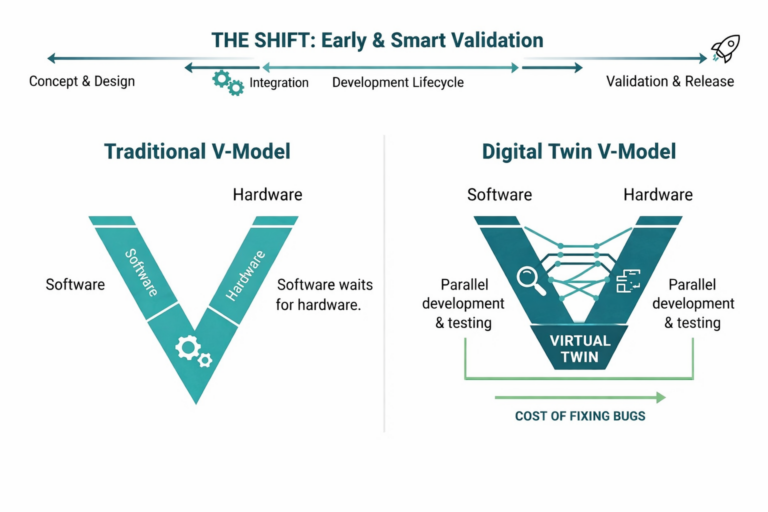
- Traditional V-Model: Software and hardware development are siloed, with software validation often delayed until physical prototypes are ready.
- Digital Twin V-Model: By using a Virtual Twin, engineering teams can perform parallel development and testing. This “Shift-Left” approach ensures that the cost of fixing bugs remains low by catching defects in the virtual stage rather than in late-stage hardware.
How Digital Twins Transform Embedded System Testing
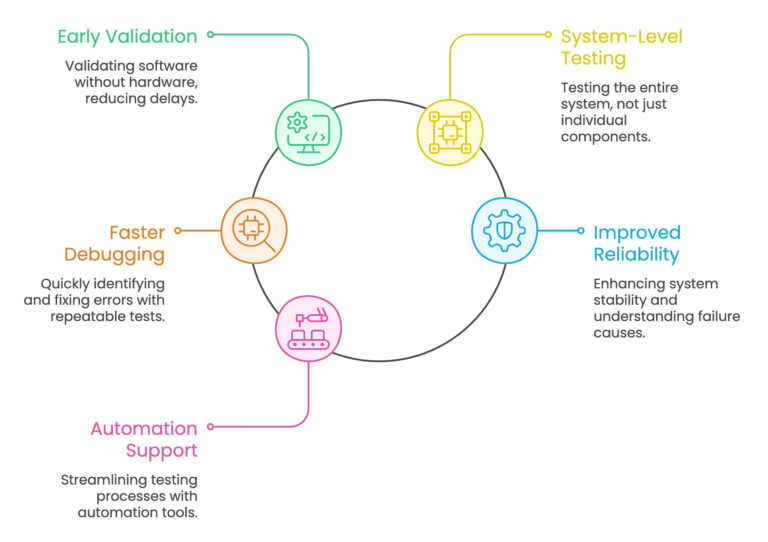
1. Early Software Validation Without Hardware Dependency
With a digital twin, developers can run firmware on virtual hardware models before silicon or boards are available. This is especially valuable during designing embedded system workflows, where early feedback can prevent architectural flaws from becoming costly mistakes later.
2. System-Level Testing Instead of Isolated Validation
Traditional tests often focus on individual components. Digital twins allow full system testing, firmware, hardware interactions, sensor inputs, and external signals, all working together. This system-level visibility significantly improves overall product quality.
3. Faster Debugging and Repeatable Test Scenarios
Some embedded issues only appear under rare timing conditions or environmental stress. Digital twins allow engineers to recreate these scenarios repeatedly, making debugging far more efficient and less dependent on chance.
4. Improved Reliability and Failure Analysis
By injecting faults virtually, such as voltage drops, sensor noise, or communication delays, teams can evaluate system robustness without risking hardware damage. This proactive approach strengthens reliability well before field deployment.
5. Better Support for Automation and CI/CD Pipelines
Digital twins integrate naturally with automated testing frameworks. Regression tests can run continuously in virtual environments, ensuring new firmware changes don’t break existing functionality. This approach aligns well with modern DevOps practices and advanced design solution strategies.
Key Use Cases of Digital Twins in Embedded Projects
- Pre-silicon software bring-up
- Virtual ECU (vECU) testing
- Hardware-in-the-loop (HIL) and software-in-the-loop (SIL) validation
- Power, thermal, and performance modeling
- Post-deployment failure analysis using real telemetry
Each of these use cases helps reduce dependency on physical hardware while improving test coverage and confidence.
Business Impact: Beyond Just Engineering Benefits
Digital twins don’t just help engineers; they impact the business as well:
- Reduced time-to-market
- Lower prototyping and rework costs
- Improved product reliability
- Faster certification cycles
- Stronger customer trust
For organizations investing heavily in embedded system design, these advantages can directly translate into competitive differentiation.
Challenges to Be Aware Of
While powerful, digital twins must be implemented thoughtfully. Poorly calibrated models can lead to false confidence. Successful adoption requires:
- Accurate modeling aligned with real hardware
- Regular validation against physical measurements
- Clear ownership of model updates
- Integration with existing test infrastructure
When done right, however, the long-term benefits far outweigh the initial effort.
Cross-Domain Integration: Linking Embedded Systems with Digital Twins
Tessolve: Driving Digital Twin–Led Embedded Testing
At Tessolve, we believe digital twins are most effective when combined with deep domain expertise and real-world validation experience. As an embedded system company with strong capabilities across silicon engineering, system validation, and test automation, we help organizations implement practical, production-ready digital twin strategies.
From embedded system design and firmware development to virtual ECU creation, HIL/SIL setups, and post-silicon validation, we support the entire product lifecycle. Our teams build digital twins that stay closely aligned with physical hardware, enabling reliable testing, faster debugging, and scalable automation. By blending proven lab infrastructure with simulation-driven workflows, Tessolve delivers robust advanced design solution frameworks that reduce risk and accelerate time-to-market for complex embedded products.
Frequently Asked Questions (FAQs)
1. What is the role of embedded systems in electric vehicles?
Embedded systems control power electronics, manage batteries, monitor safety, and optimize performance in real-time within EVs.
2. How do embedded system designs improve EV efficiency?
Smart embedded designs optimize motor control, reduce heat, and balance energy usage, extending battery life and driving range.
3. Why is testing important for EV power electronics?
Testing ensures reliability under thermal, electrical, and vibration stresses, preventing failures and enhancing vehicle safety and longevity.
4. How can an embedded system company help EV manufacturers?
They provide co-design, firmware, hardware testing, and system-level validation, accelerating development and ensuring functional safety compliance.


