

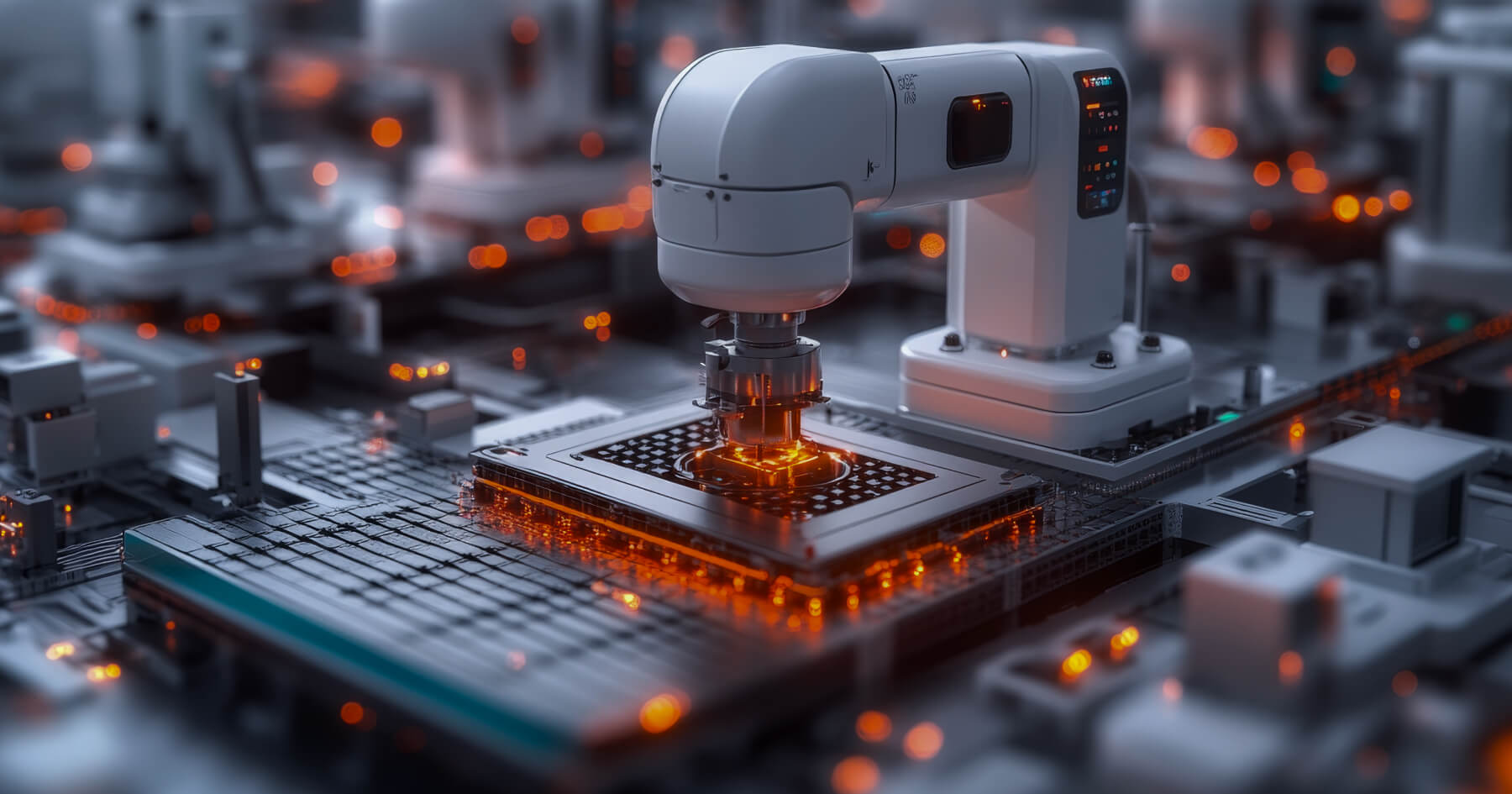
Industrial automation is moving beyond fixed instructions and programmed responses. Modern machines are increasingly expected to analyze data, recognize patterns, and respond to changing conditions in real time. This shift is being driven by Artificial Intelligence (AI), connected devices, sensors, and advanced embedded computing. As these technologies come together, embedded system design is becoming increasingly important for developing intelligent industrial equipment that can process information closer to where it is generated.
Embedded AI brings AI and machine learning capabilities directly into industrial devices such as cameras, controllers, gateways, sensors, robotic systems, and connected equipment. Instead of sending every piece of data to the cloud, these devices can analyze important information locally and respond immediately.
This makes embedded AI highly relevant to smart manufacturing, where speed, reliability, efficiency, and continuous monitoring are essential.
What Is Embedded AI?
Embedded AI refers to integrating AI and machine learning capabilities into embedded devices built for specific applications. Unlike conventional systems that follow predefined rules, AI-enabled devices can identify patterns, detect anomalies, classify information, and support decisions based on changing operating conditions.
For example, an industrial camera can use AI-based vision processing to identify product defects on a production line. Similarly, an embedded device can analyze machine sensor readings and detect unusual patterns that may indicate a developing fault.
This combination of local processing and intelligence allows industrial systems to become more responsive without relying entirely on remote computing infrastructure.
How Embedded AI Supports Industrial Automation
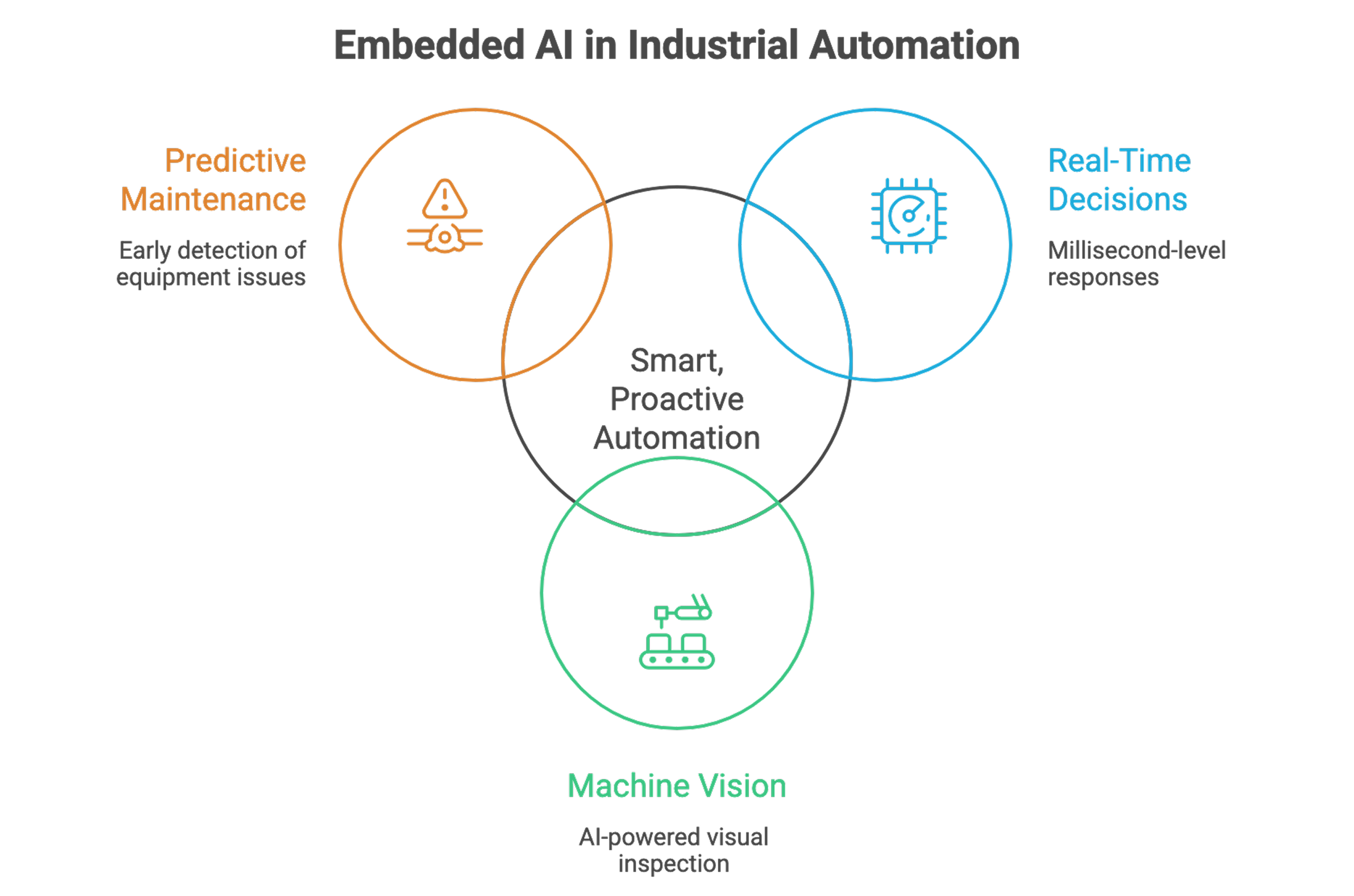
1. Real-Time Decision-Making
Industrial applications often require decisions within milliseconds. Cloud-based processing can introduce latency, especially when large amounts of data are continuously generated.
Embedded AI allows processing to happen closer to the machine. This supports faster responses in applications such as machine vision, robotic systems, automated inspection, and condition monitoring.
2. Predictive Maintenance
Unexpected equipment failures can disrupt production and increase maintenance costs. Embedded AI can analyse information from sensors measuring factors such as vibration, temperature, pressure, and electrical activity.
Machine learning models can identify unusual patterns and provide early indications of changing equipment behavior. Maintenance teams can then investigate potential problems before they result in major failures.
3. Intelligent Machine Vision
Machine vision is an important application of embedded AI in manufacturing. Industrial cameras generate substantial amounts of visual data, requiring suitable processing capabilities for real-time analysis.
AI-enabled embedded platforms can support image processing, object detection, classification, and quality inspection directly within industrial equipment. Tessolve’s embedded solutions include AI-driven vision processing capabilities using the Renesas RZ/V2H platform for applications such as industrial automation and real-time vision processing.
The Importance of Edge Processing
Embedded AI closely complements edge computing by moving selected processing tasks closer to the source of data. This can reduce latency, minimize unnecessary data transmission, and support applications where continuous cloud connectivity is not practical.
For manufacturers, this approach is useful when machines generate large volumes of sensor or image data. Immediate decisions can be handled locally, while only relevant information needs to be transferred to higher-level systems.
Five Reasons to Use System on Modules (SoM) in Embedded System Design
Tessolve also highlights edge computing as an important part of modern embedded engineering, where local processing can reduce dependence on cloud infrastructure.
Embedded Design Challenges in Smart Manufacturing
Developing an AI-enabled industrial product involves much more than adding a machine learning model. Hardware, software, connectivity, processing performance, thermal requirements, and application conditions must work together.
This is where embedded design becomes important. Engineers need to select suitable processors and accelerators while considering power consumption, performance, size, and reliability.
An experienced embedded systems company can bring hardware and software engineering together to create a more integrated development process. The design may also need to support interfaces and technologies such as Ethernet, wireless connectivity, PCIe, USB, and other industrial communication protocols.
AI, Connectivity, and Industrial Systems
Smart manufacturing depends on connected machines rather than isolated intelligent devices. Equipment needs to communicate with other machines, gateways, enterprise systems, and cloud platforms.
Embedded AI can work alongside these connectivity technologies to create a connected industrial environment. Sensors generate data, embedded processors analyze it, communication interfaces transfer relevant information, and higher-level systems use the resulting insights.
This also makes embedded system design important for managing processing capacity, communication reliability, software architecture, and system integration.
As AI workloads become more sophisticated, embedded design must also consider how machine learning models will run efficiently on the target hardware.
The Need for a Hardware-Software Balance
AI workloads can require significant computing resources, while industrial devices often operate under strict power, size, temperature, and reliability constraints.
This makes hardware-software co-design essential. An embedded systems company with expertise across both areas can evaluate the complete product architecture instead of focusing only on the AI model.
The right combination of processors, accelerators, memory, connectivity, operating systems, and application software can help manufacturers build intelligent devices that meet specific industrial requirements.
The Future of Embedded AI in Manufacturing
Embedded AI is expected to become increasingly important as industrial devices gain greater processing capabilities. AI-enabled cameras can perform sophisticated inspections, machines can analyze sensor information locally, and connected equipment can respond to operational changes with less dependence on remote infrastructure.
Advances in AI accelerators, System-on-Modules, evaluation platforms, and edge computing are also creating new possibilities for intelligent industrial products. As manufacturers adopt these technologies, embedded engineering will remain central to connecting AI capabilities with practical industrial applications.
Tessolve for Embedded AI and Industrial Automation
At Tessolve, we combine embedded engineering, semiconductor expertise, hardware development, and software capabilities to support intelligent industrial products.
- Embedded Product Engineering: We support embedded product development across system design, hardware, software, FPGA, and product engineering.
- Industrial Solutions: Our industrial capabilities cover computing, networking, sensors, industrial cameras, energy meters, and connected systems.
- AI-Ready Platforms: Our Renesas RZ/V2H-based solutions combine AI acceleration, real-time processing, and industrial connectivity for applications such as machine vision and automation.
- Hardware and Software Expertise: Our capabilities span embedded hardware, FPGA design, Linux, device drivers, middleware, testing, and validation for integrated product development.
FAQs
1. What is embedded AI in industrial automation?
Embedded AI integrates artificial intelligence into industrial devices, enabling real-time data processing, anomaly detection, and automated decision-making.
2. How does embedded AI improve smart manufacturing?
It enables faster decisions, predictive maintenance, intelligent inspection, and efficient machine monitoring by processing data closer to production equipment.
3. What are common applications of embedded AI?
Common applications include machine vision, predictive maintenance, robotic automation, quality inspection, condition monitoring, and intelligent energy management.
4. Why is edge computing important for embedded AI?
Edge computing enables local data processing, reducing latency, minimizing data transmission, and supporting faster responses in industrial environments.
5. What challenges arise when developing embedded AI systems?
Key challenges include processing requirements, power consumption, thermal management, hardware selection, software integration, connectivity, and system reliability.


