


Smart homes have advanced quickly over the past few years, but device compatibility remains a major challenge. Many smart devices still struggle to work smoothly with products from other brands. Users often need separate apps, extra hubs, or complex setup processes just to connect their devices. This creates frustration and limits the full potential of the Internet of Things (IoT).
That is where Matter 2.0 comes in. Developed by the Connectivity Standards Alliance (CSA), Matter 2.0 is designed to simplify communication between smart devices across different platforms and ecosystems. Its main goal is to make devices work together seamlessly, regardless of the manufacturer. As the IoT industry continues to grow, businesses are increasingly investing in advanced embedded solutions that support long-term interoperability, better connectivity, and smarter device integration.
Understanding Matter 2.0
Matter was originally introduced as a unified protocol designed to reduce fragmentation within smart home ecosystems. The first version already made significant improvements in compatibility between major platforms like Apple HomeKit, Amazon Alexa, Google Home, and Samsung SmartThings.
Matter 2.0 builds on this foundation by supporting more device categories and improving automation capabilities. The updated standard now includes support for appliances such as refrigerators, robotic vacuums, air purifiers, washing machines, and energy management devices.
This means consumers can create smarter and more connected environments without worrying about whether devices can communicate with one another.
For manufacturers, Matter 2.0 creates opportunities to simplify product development while reaching broader markets through universal compatibility.
Edge AI in Embedded Systems: Bringing AI Close to Devices
Why IoT Interoperability Matters
Interoperability is one of the most critical aspects of successful IoT ecosystems. Without standardized communication, connected devices operate in isolated environments, often requiring additional gateways or custom integrations.
Matter 2.0 solves this challenge by functioning as an application layer standard that works across multiple communication technologies, including Wi-Fi, Ethernet, and Thread. Instead of replacing existing wireless technologies, Matter creates a common language that devices can use to exchange information efficiently.
This shift is particularly important for businesses involved in embedded system design, where modern connected products must support secure communication, scalable firmware updates, and multi-platform integration.
As consumers increasingly expect plug-and-play experiences, interoperability is becoming a competitive necessity rather than an optional feature.
Matter 2.0 vs Traditional IoT Protocols
The rise of Matter has also sparked discussions around the Matter protocol vs Zigbee vs Z-Wave comparison. While these technologies share similarities, they serve different purposes within the IoT ecosystem.
Zigbee and Z-Wave are primarily wireless mesh networking protocols designed for low-power communication between connected devices. Matter, however, operates at the application layer and focuses mainly on interoperability between ecosystems.
In many cases, Matter can work over Thread networks, allowing devices to benefit from efficient mesh communication while still maintaining universal compatibility. This layered approach provides greater flexibility for manufacturers and users alike.
The growing adoption of Matter is also encouraging companies to rethink their embedded hardware design strategies to ensure devices can support secure connectivity, efficient networking, and long-term protocol compatibility.
Benefits of Matter 2.0 for Smart Homes
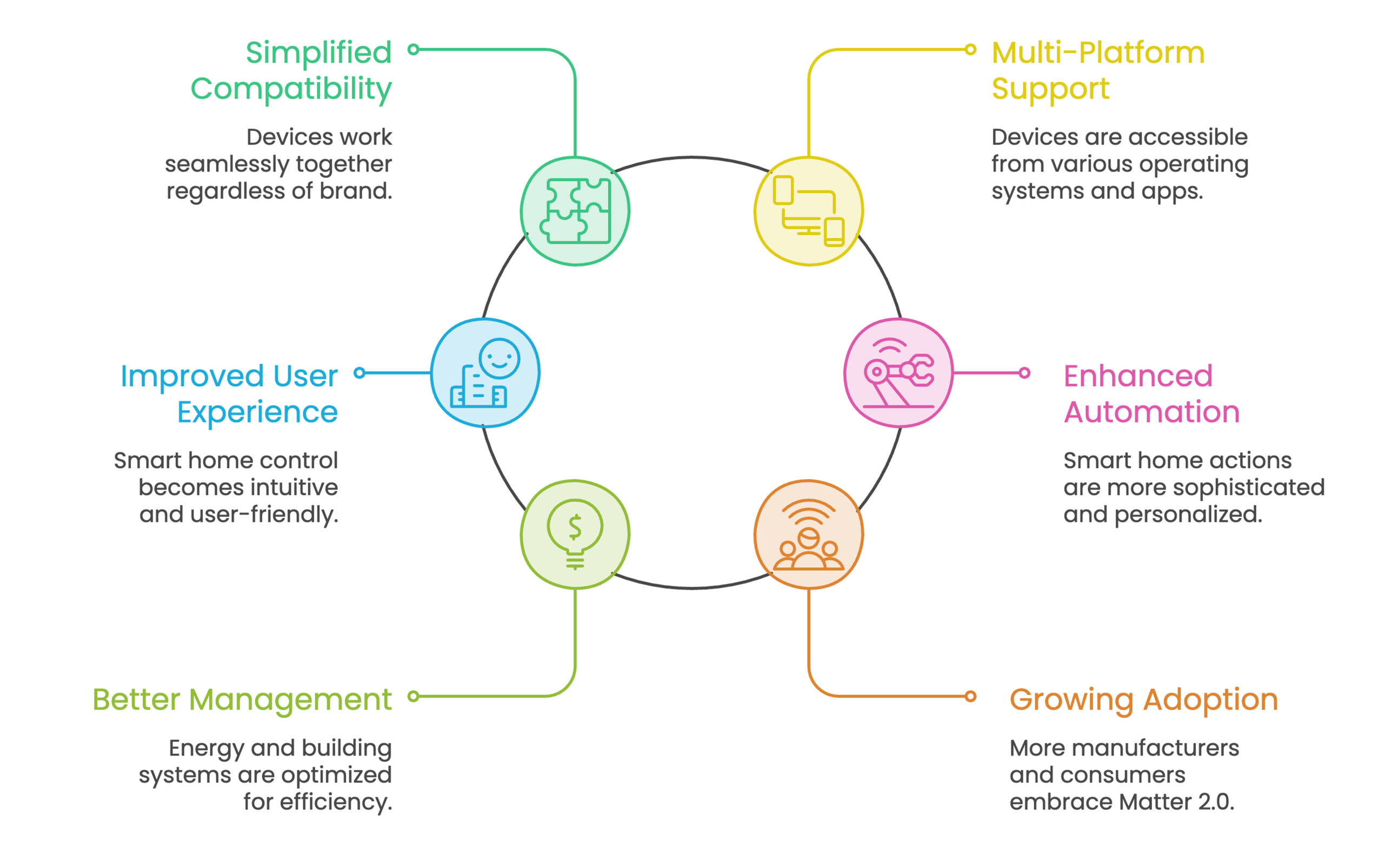
1. Simplified Device Compatibility
Matter 2.0 allows smart devices from different brands to work together without complicated integrations or additional hubs.
2. Multi-Platform Support
A Matter-certified device can operate across Apple, Google, Amazon, and Samsung ecosystems simultaneously, improving user convenience.
3. Improved User Experience
Consumers can set up and manage smart devices more easily without worrying about platform-specific limitations or compatibility issues.
4. Enhanced Smart Automation
Connected devices can communicate more effectively to create automated environments based on schedules, occupancy, and user preferences.
5. Better Energy and Building Management
In commercial environments, Matter 2.0 helps improve energy efficiency, remote monitoring, and smart building automation capabilities.
6. Growing Industry Adoption
Businesses and developers are increasingly exploring the Matter 2.0 IoT interoperability standard guide to understand future IoT integration requirements.
Challenges in Implementing Matter 2.0
1. Complex Engineering Requirements
Implementing Matter 2.0 requires careful planning, firmware optimization, and reliable system integration strategies.
2. Strict Security Standards
Manufacturers must support secure onboarding, encrypted communication, authentication protocols, and secure device management.
3. Need for Scalable Device Performance
Organizations are actively researching how to implement Matter 2.0 on embedded devices while maintaining performance and cost efficiency.
4. Firmware and Connectivity Optimization
Devices must support stable wireless communication, over-the-air updates, and long-term interoperability across ecosystems.
5. Certification and Compliance Challenges
Products need extensive validation testing to ensure reliable communication across supported platforms and ecosystems.
6. Importance of Standardized Certification
Companies are prioritizing smart home device certification, Matter 2.0, to ensure compatibility, reliability, and smoother market adoption.
How Tessolve Supports Matter-Ready IoT Development
At Tessolve, we understand that building future-ready IoT products requires more than simply adding connectivity features. Successful Matter adoption depends on robust engineering, secure architectures, optimized firmware, and scalable embedded system integration.
As Tessolve, we help businesses accelerate the development of Matter-compatible devices through advanced embedded engineering, validation services, hardware optimization, and system-level testing. Our expertise spans semiconductor engineering, IoT product development, firmware design, and interoperability testing across multiple industries.
With Matter 2.0 shaping the next generation of connected ecosystems, we work closely with organizations to develop secure, scalable, and high-performance smart devices that align with evolving industry standards and consumer expectations.
Frequently Asked Questions (FAQs)
1. What is Matter 2.0 in IoT?
Matter 2.0 is a universal connectivity standard that enables smart devices from different brands to communicate seamlessly.
2. How does Matter 2.0 improve smart home compatibility?
It allows devices across multiple ecosystems to work together without requiring separate hubs or complicated integrations.
3. Does Matter 2.0 replace Zigbee and Z-Wave completely?
No, Matter works alongside existing protocols while improving interoperability between different smart home ecosystems and devices.
4. Why is Matter 2.0 important for IoT manufacturers?
It simplifies device development, improves compatibility, and helps manufacturers reach broader smart home and IoT markets.
5. What challenges do companies face when implementing Matter 2.0?
Manufacturers must manage security, certification, firmware optimization, connectivity stability, and interoperability across multiple ecosystems.


