

The Internet of Things (IoT) is evolving rapidly. Instead of simply collecting and sending data to the cloud, today’s connected devices are becoming intelligent enough to process information where it is generated. This approach, known as edge analytics, is helping businesses reduce latency, improve efficiency, and lower bandwidth costs. Powered by low-power microcontrollers (MCUs), edge analytics is transforming industries ranging from healthcare to manufacturing, making IoT devices faster, smarter, and more reliable.
As IoT applications continue to grow, building an efficient embedded system has become essential for delivering real-time intelligence without compromising energy efficiency.
What Is Edge Analytics?
Edge analytics is the process of analyzing data directly on a device rather than sending all information to a cloud server. Instead of continuously transmitting raw sensor data, the device processes it locally and sends only meaningful insights or alerts.
For example, an industrial sensor can detect abnormal machine vibrations and immediately notify operators without uploading every data point. This reduces network traffic while enabling faster decision-making.
Why Edge Analytics Matters for Low-Power MCUs
Modern low-power MCUs have become far more capable than traditional microcontrollers. They now support advanced processing, AI inference, digital signal processing (DSP), and enhanced security features while maintaining low energy consumption.
This makes them ideal for applications that require instant responses, including wearable devices, smart home products, industrial automation, and environmental monitoring.
Edge analytics also offers several important advantages:
- Faster decisions: Data is processed instantly without waiting for cloud communication.
- Lower bandwidth usage: Only relevant information is transmitted, reducing communication costs.
- Improved privacy: Sensitive data remains on the device instead of constantly traveling across networks.
- Reliable performance: Devices continue operating even when internet connectivity is limited.
As IoT ecosystems expand, efficient embedded design becomes increasingly important to ensure these capabilities work seamlessly on resource-constrained hardware.
Low-Power SoC Chip Design: Strategies for Mobile and IoT Devices
Challenges of Scaling Edge Analytics
Although edge analytics offers significant benefits, implementing it on low-power MCUs comes with several challenges.
Limited Hardware Resources
Microcontrollers have limited memory, processing power, and storage compared to cloud servers. Developers must optimize software and algorithms to achieve maximum performance within these constraints.
Power Efficiency
Many IoT devices rely on batteries expected to last months or even years. Every processing task and wireless transmission consumes energy, making power optimization a top priority.
Security
As more data is processed at the edge, protecting devices becomes increasingly important. Secure boot, encrypted communication, and trusted firmware updates help safeguard IoT systems from cyber threats.
Techniques for Scaling Edge Analytics
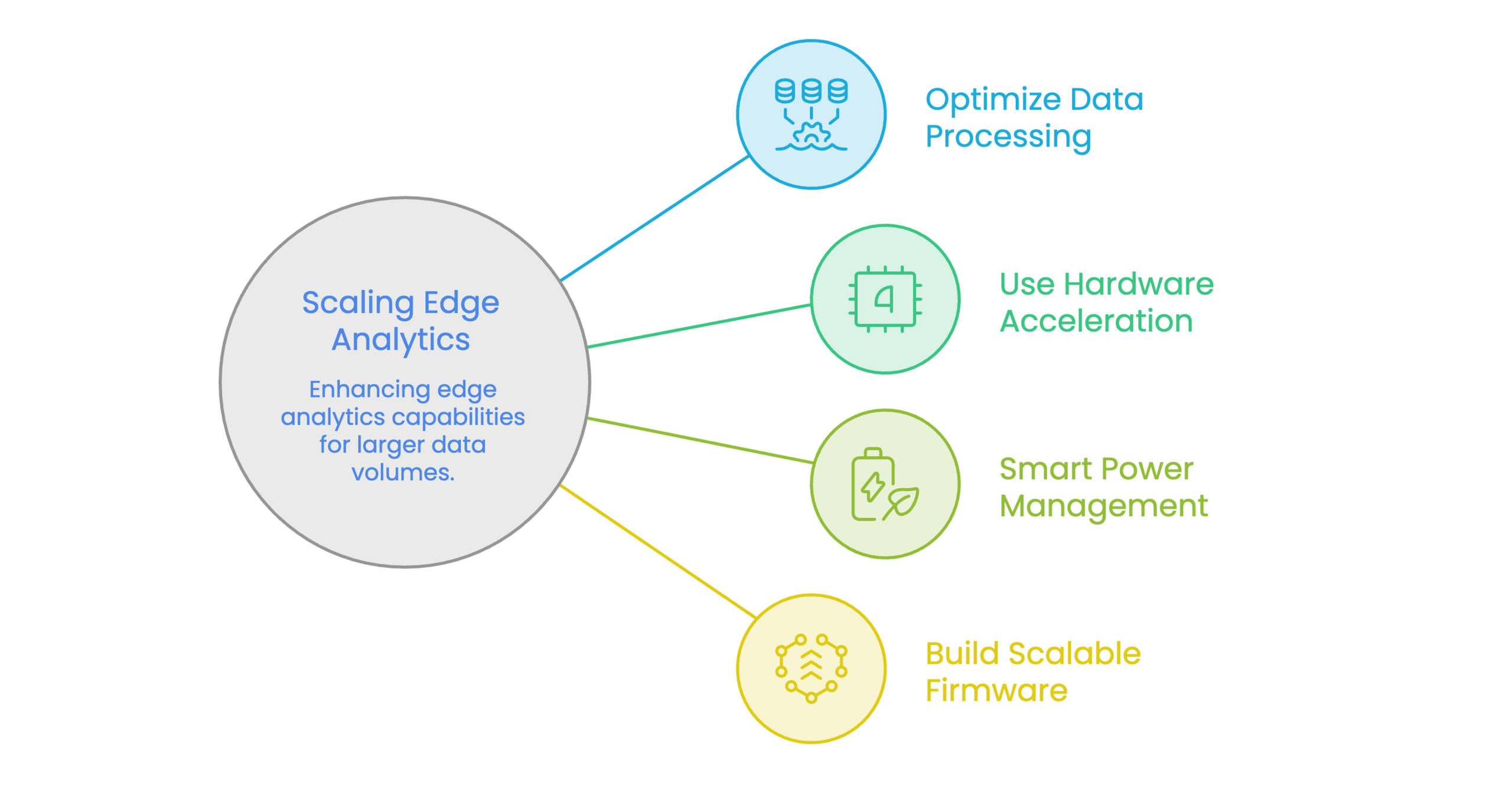
Successfully scaling edge analytics requires careful optimization of both hardware and software.
Optimize Data Processing
Filtering unnecessary sensor data before analysis reduces processor workload and conserves energy. Lightweight AI models and compressed machine learning algorithms further improve efficiency on low-power MCUs.
Use Hardware Acceleration
Many modern MCUs include built-in accelerators for cryptography, DSP, and AI inference. Using these specialized components improves performance while minimizing power consumption.
Smart Power Management
Sleep modes, event-driven processing, and dynamic power scaling help extend battery life without sacrificing responsiveness.
Build Scalable Firmware
A modular embedded system design allows developers to update features, improve security, and add functionality without redesigning the entire application, making IoT products easier to maintain over time.
Industries Benefiting from Edge Analytics
Healthcare
Wearable medical devices can monitor vital signs and detect abnormalities in real time, allowing quicker responses while protecting sensitive patient data.
Manufacturing
Industrial sensors analyze machine performance locally to identify early signs of equipment failure, helping reduce downtime and maintenance costs.
Smart Agriculture
Connected sensors monitor soil conditions, irrigation, and weather directly in the field, enabling faster decisions while reducing network usage.
Automotive
Modern vehicles rely on edge analytics for driver assistance systems, predictive diagnostics, battery management, and other real-time functions that require immediate processing.
The Future of Low-Power Edge Intelligence
The next generation of IoT devices will become increasingly autonomous. Instead of acting as simple data collectors, they will perform intelligent decision-making independently.
Future MCUs will likely include larger AI accelerators, stronger cybersecurity capabilities, lower energy consumption, and better wireless integration. Advances in semiconductor technology will further improve performance while maintaining ultra-low power requirements.
Combined with improvements in TinyML frameworks, advanced development tools, and optimized firmware, edge analytics will become standard across billions of connected devices worldwide.
Why Tessolve Is Your Trusted Partner for Intelligent Embedded Solutions
At Tessolve, we specialize in building intelligent embedded solutions that power the next generation of connected devices. Our expertise spans hardware design, firmware development, silicon engineering, validation, testing, and complete product engineering services. We help businesses develop secure, scalable, and high-performance IoT products that maximize the capabilities of low-power MCUs and edge analytics. Whether you’re creating smart industrial systems, automotive electronics, healthcare devices, or consumer IoT products, our experienced engineering teams work closely with you to accelerate development, optimize performance, and deliver reliable products that are ready for tomorrow’s connected world.
FAQs
1. What is edge analytics in IoT?
Edge analytics processes data directly on IoT devices, enabling faster decisions, lower latency, reduced bandwidth usage, and improved reliability without constant cloud connectivity.
2. Why are low-power MCUs important for edge analytics?
Low-power MCUs deliver efficient local data processing while consuming minimal energy, making them ideal for battery-powered IoT devices and real-time applications.
3. What challenges do developers face when implementing edge analytics?
Developers must optimize memory usage, processing performance, power consumption, security, and firmware efficiency to achieve reliable analytics on resource-constrained devices.
4. Which industries benefit the most from edge analytics?
Healthcare, manufacturing, automotive, agriculture, and smart city applications benefit from faster processing, lower network dependence, and real-time decision-making capabilities.
5. How does edge analytics improve IoT device performance?
By processing data locally, edge analytics reduces communication delays, minimizes cloud dependency, enhances privacy, and enables quicker responses to changing conditions.


