


In aerospace engineering, reliability is not just a benchmark; it’s a non-negotiable mandate. Aircraft systems operate in complex, high-risk environments where even the smallest software glitch can have critical consequences. Whether it’s avionics control, engine monitoring, flight navigation, cockpit display systems, satellite payload controls, or autonomous flight modules, aerospace embedded software must deliver precision, consistency, and absolute predictability. This demand drives organizations to adopt mature engineering practices, structured development methodologies, and continuous verification approaches built on strong foundations of embedded system design to ensure that performance and safety coexist seamlessly.
If you are an aerospace engineer, program leader, or system architect, understanding the right strategies for building reliable embedded aerospace software is essential, not only to meet certification standards but to ensure the highest levels of operational trust and mission success.
Understanding Why Reliability Matters So Deeply
Unlike consumer electronics or even typical industrial systems, aerospace software cannot afford unforeseen crashes, inconsistent timing responses, or undefined system behavior. Aerospace applications deal with real-time control, sensor fusion, mission operations, environmental uncertainty, and human safety. Systems may need to run continuously for years, withstand radiation exposure, temperature extremes, vibrations, and electromagnetic interference, while remaining fully deterministic.
Teams working on designing embedded system solutions must therefore ensure resilience against hardware faults, software defects, cybersecurity threats, and integration complexities. Reliability in aerospace is built through disciplined processes, thoughtful architecture, and relentless validation, right from concept to deployment.
Core Strategies for Building High-Reliability Aerospace Embedded Software
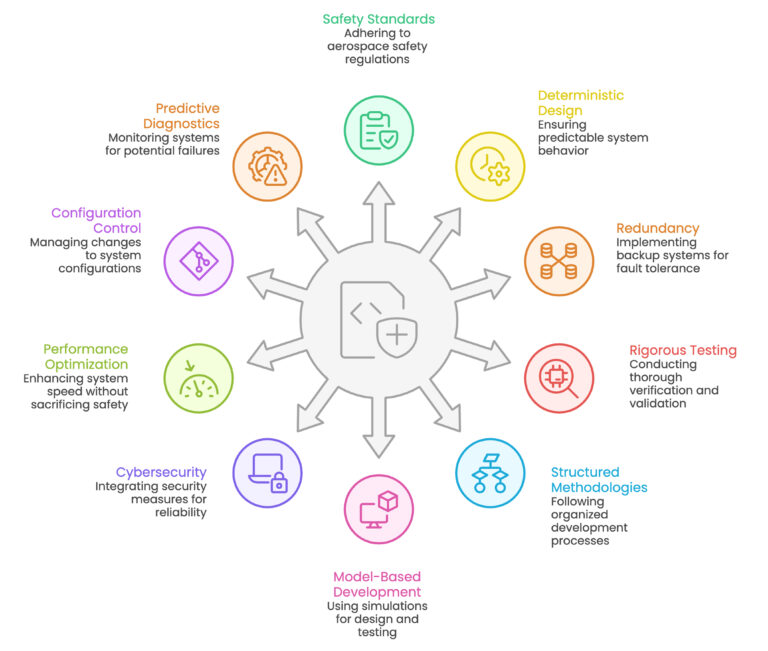
1. Start with Aerospace Safety Standards as the Foundation
Aerospace reliability begins with strict adherence to globally recognized safety standards:
- DO-178C (software), DO-254 (hardware), and ARP 4754 (system development) define safety expectations.
- Treat standards as structural design pillars, not compliance hurdles.
- Enable stronger requirement traceability and structured documentation.
- Support disciplined verification and certification readiness.
- Prevent last-minute fixes, risks, and costly rework.
2. Build Deterministic Real-Time Architectural Designs
Reliable aerospace performance depends on strictly controlled, predictable real-time software behavior:
- Determinism ensures every critical task executes within guaranteed time limits.
- Use certified RTOS platforms optimized for aerospace reliability.
- Implement clear task prioritization and predictable scheduling models.
- Minimize jitter, bound execution paths, and optimize interrupt handling.
- Ensure real-time consistency for avionics communication and control systems.
3. Engineer Redundancy and Fault Tolerance as Core Capabilities
Aerospace systems must continue functioning even when things go wrong. Reliability engineering, therefore, requires robust redundancy mechanisms, failover strategies, watchdog timers, graceful degradation, health monitoring, and system-level isolation so that localized failures never escalate into systemic failures. Intelligent redundancy ensures that aircraft maintain operational control and passenger safety even under unexpected failures.
4. Leverage Rigorous Verification, Validation, and Testing Discipline
High-reliability aerospace embedded software demands extensive, layered testing approaches. Unit testing validates logic at the smallest level; Software-in-the-Loop (SIL) enables algorithm-level verification; Hardware-in-the-Loop (HIL) simulates real-world behavior environments; structural coverage testing ensures nothing remains unverified; stress and robustness testing validate performance under extreme loads. Continuous verification greatly reduces hidden risks before deployment.
5. Adopt Structured Development Methodologies
Disciplined engineering models ensure clarity, traceability, and reliability throughout aerospace development:
- The V-Model and refined waterfall lifecycles strengthen structured engineering discipline.
- Ensure clear documentation and stronger requirement traceability.
- Maintain validation alignment at every development phase.
- Improve predictability and reduce uncertainty in safety-critical environments.
- Support smoother certification and compliance readiness with well-governed processes.
6. Embrace Model-Based Development and Simulation
Early virtual validation helps detect risks sooner and strengthens overall aerospace software reliability:
- Enables testing before physical hardware is available.
- Simulates timing responses and architecture behavior with high accuracy.
- Validates system logic and safety attributes effectively.
- Identifies defects early, reducing costly late-stage failures.
- Enhances maturity, confidence, and readiness before integration phases.
7. Integrate Cybersecurity as a Reliability Requirement
As aircraft become increasingly connected through onboard connectivity, satellite networking, ground communications, and data platforms, cybersecurity becomes inseparable from reliability. Secure boot processes, encryption, strong authentication, intrusion monitoring, and secure coding practices are critical to protecting mission systems and ensuring trusted operational behavior.
8. Optimize System Performance Without Compromising Safety
Aerospace systems work within strict compute, power, and memory constraints. Efficient code execution, resource prioritization, scheduling optimization, and selective hardware acceleration all help sustain performance. Organizations working like an embedded system company must ensure performance improvements never come at the cost of safety, predictability, or certification readiness.
9. Maintain Strong Configuration and Change Control Discipline
Even minor software changes can introduce significant risk in aerospace environments. This is why strict configuration management, controlled versioning, formal approval workflows, and complete documentation traceability are essential components of successful long-term aerospace program management. Effective lifecycle governance is a defining trait of successful embedded system design initiatives.
10. Enable Predictive Diagnostics and Continuous Monitoring
Modern aerospace platforms benefit from intelligent monitoring frameworks. System health analytics, anomaly prediction engines, fault logging, and predictive diagnostic models can detect potential failures early. This not only improves safety but also supports maintenance optimization and mission readiness.
Embedded Systems for Mission-Critical Applications: Safety and Reliability
Tessolve: Your Trusted Partner for Aerospace-Grade Embedded Reliability
At Tessolve, we combine deep aerospace expertise, advanced engineering practices, and world-class validation infrastructure to help organizations build mission-critical embedded software with absolute confidence. As a globally trusted embedded system company, we deliver DO-178C compliant development, real-time software engineering, system design, silicon engineering, verification and validation, and robust integration capabilities. Our multidisciplinary engineering teams, state-of-the-art labs, and proven delivery frameworks enable aerospace manufacturers to achieve superior reliability, certification readiness, and long-term lifecycle stability. From concept architecture through deployment and sustained support, Tessolve proudly partners with aerospace innovators to create reliable, high-performance embedded systems built to fly with confidence.
Frequently Asked Questions (FAQs)
1. What makes aerospace embedded software different from other industries?
It requires extreme reliability, strict safety certification, deterministic performance, and compliance with standards like DO-178C and DO-254.
2. Why is determinism so important in aerospace systems?
Determinism guarantees predictable execution timing, ensuring safety-critical tasks operate reliably without delays, preventing instability or mission risks.
3. How does redundancy improve aerospace software reliability?
Redundancy ensures continuous operation during failures using backup systems, failover mechanisms, and fault-tolerant architectures to maintain safety.
4. What role do testing and validation play in aerospace embedded software?
Testing identifies hidden defects early, validates performance, ensures compliance, and strengthens confidence before deployment in mission-critical environments.


