


As embedded systems continue to evolve across industries such as IoT, healthcare, industrial automation, and smart infrastructure, the demand for low-power and maintenance-free devices is growing rapidly. Traditional battery-powered designs often introduce limitations such as periodic maintenance, environmental concerns, and size constraints. This has led to increased interest in battery-free systems powered by energy harvesting.
Energy harvesting enables embedded devices to convert ambient sources such as light, heat, vibration, and RF signals into usable power. Designing these systems requires balancing energy availability, consumption, and operational reliability.
Achieving this balance demands expertise in designing embedded hardware, efficient power management strategies, and a scalable embedded solution approach. With the support of an experienced embedded system company, organizations can build sustainable and intelligent battery-free embedded devices.
Understanding Energy Harvesting in Embedded Systems
Energy harvesting refers to the process of capturing small amounts of energy from the environment and converting it into electrical power for embedded devices. Unlike traditional power sources, harvested energy is often intermittent and limited, making efficient system design critical.
Common energy sources include solar energy, thermal gradients, mechanical vibrations, and ambient radio frequency signals. Each source has unique characteristics in terms of power density, availability, and reliability. For example, solar energy provides relatively higher power but depends on lighting conditions, while vibration-based harvesting depends on environmental motion.
Designing systems that operate reliably on harvested energy requires an integrated approach. Engineers must consider power generation, energy storage, consumption patterns, and system duty cycles. A well-planned embedded solution ensures that all these elements work together to support continuous or near-continuous operation.
Key Energy Harvesting Sources and Their Characteristics
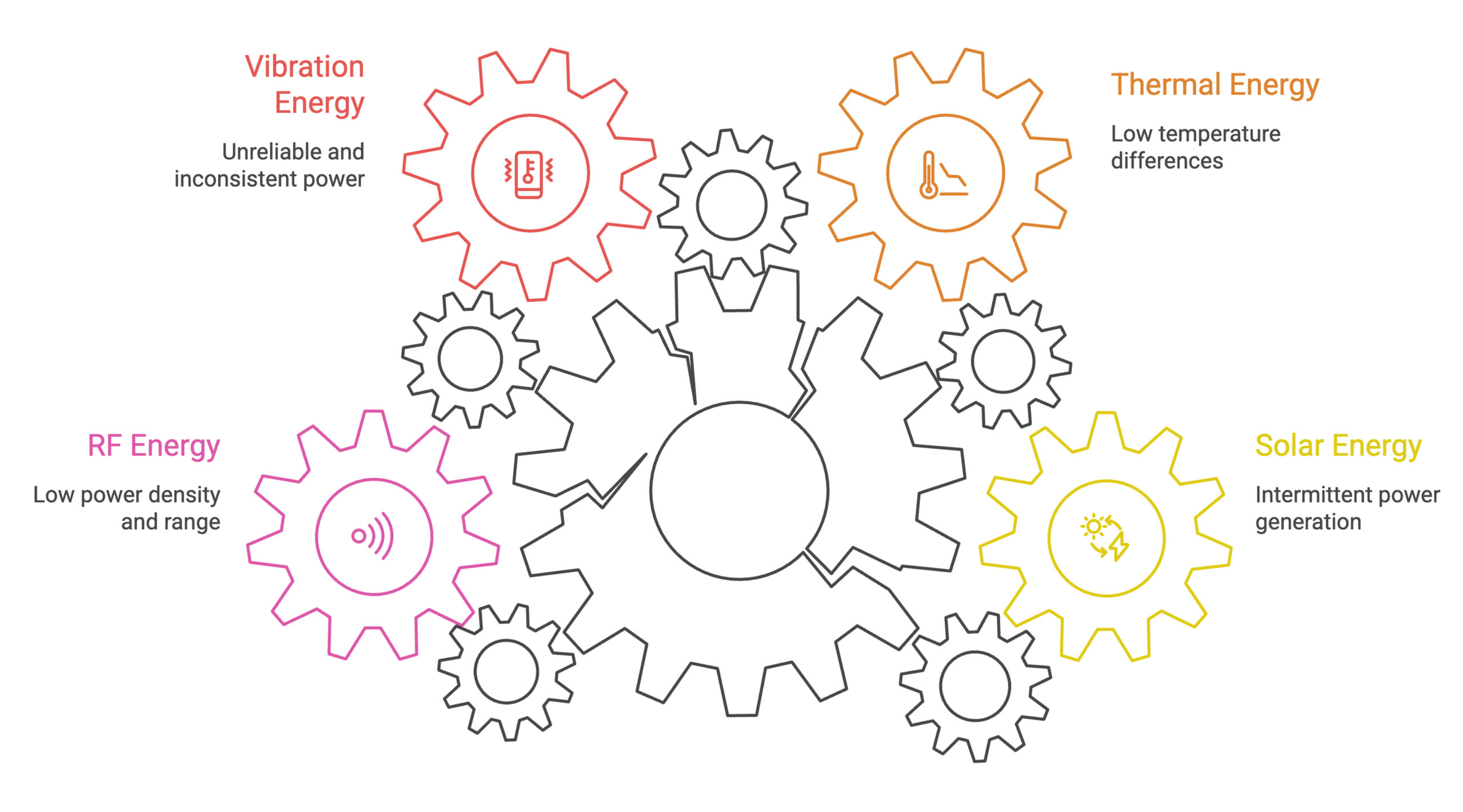
Battery-free embedded systems rely on different types of energy sources depending on the application environment. Understanding these sources is essential for selecting the right strategy.
1. Solar Energy Harvesting
Solar energy is one of the most widely used sources due to its relatively high energy density.
- Suitable for outdoor and indoor applications
- High power output in well-lit environments
- Requires efficient power conversion circuits
- Performance depends on light availability
2. Thermal Energy Harvesting
Thermal energy harvesting uses temperature differences to generate power through thermoelectric generators.
- Suitable for industrial and automotive environments
- Works where temperature gradients exist
- Low to moderate power output
- Requires stable thermal conditions
3. Vibration and Motion Energy
Mechanical energy from vibrations or movement can be converted into electrical energy using piezoelectric or electromagnetic systems.
- Ideal for industrial machinery and wearable devices
- Dependent on motion frequency and intensity
- Requires mechanical coupling design
- Intermittent energy generation
4. Radio Frequency Energy Harvesting
RF harvesting captures energy from ambient electromagnetic signals.
- Useful in low-power wireless applications
- Very low energy availability
- Requires efficient rectification circuits
- Suitable for ultra-low-power systems
Core Design Principles for Battery-Free Embedded Systems
Designing battery-free systems requires a fundamentally different approach compared to traditional embedded designs. The focus shifts from maximizing performance to optimizing energy efficiency and reliability.
One of the most important principles is energy-aware system design. Engineers must design systems that operate within the constraints of available energy. This includes selecting low-power components, optimizing firmware, and managing energy consumption dynamically.
Another key principle is energy storage and buffering. Since energy harvesting sources are often inconsistent, temporary storage elements such as supercapacitors or small rechargeable batteries are used to stabilize power supply.
Effective designing of embedded hardware involves integrating energy harvesting modules, storage components, and power management circuits into a cohesive system. A robust embedded solution ensures that the device can operate reliably even under fluctuating energy conditions.
Power Management Strategies in Energy Harvesting Systems
Power management plays a critical role in battery-free design. Efficient power conversion and distribution ensure that the harvested energy is utilized effectively.
Engineers must implement power management integrated circuits (PMICs) that regulate voltage, manage energy storage, and control power flow. These circuits help maximize energy efficiency and ensure stable system operation.
Designing Embedded Hardware for Energy Efficiency
Hardware design is one of the most critical aspects of battery-free systems. Every component must be selected and optimized for low power consumption.
Microcontrollers with ultra-low-power modes are commonly used in energy harvesting systems. These devices can operate with minimal energy and wake up only when needed. Sensors and communication modules must also be chosen based on their energy efficiency.
Circuit design must minimize energy losses. This includes optimizing voltage regulators, reducing leakage currents, and ensuring efficient signal routing. Engineers must also carefully design the interface between energy harvesting modules and system components.
Effective designing embedded hardware ensures that the system can operate within strict energy constraints while maintaining functionality and performance.
Dynamic power management is also essential. Systems must adapt their operation based on available energy levels. For example, a device may reduce its activity or enter low-power modes when energy is limited.
Working with an experienced embedded system company ensures that power management strategies are optimized for specific applications, enabling reliable performance and extended device lifetimes.
Communication Strategies for Battery-Free Devices
Communication is one of the most energy-intensive operations in embedded systems. In battery-free designs, it must be carefully optimized.
Low-power communication protocols such as Bluetooth Low Energy (BLE), Zigbee, or LoRa are commonly used. These protocols are designed to minimize energy consumption while maintaining reliable connectivity.
Data transmission strategies must also be optimized. Instead of continuous communication, devices may transmit data periodically or only when certain conditions are met. This reduces energy consumption and extends system operation.
A well-structured embedded solution integrates communication strategies with power management and system design to ensure efficient and reliable operation.
System-Level Optimization for Energy Harvesting
Battery-free systems require optimization at the system level to ensure efficient operation. This includes balancing energy generation, storage, and consumption.
Systems must adapt to varying energy conditions through intelligent algorithms that adjust sensing, processing, and transmission behavior based on available power.
System-level optimization also involves integrating hardware and software components effectively. By combining efficient hardware design with optimized firmware, engineers can maximize system performance within energy constraints.
Collaboration with an experienced embedded system company helps ensure that all aspects of system design are aligned to achieve optimal performance.
Challenges in Battery-Free Embedded Design
While energy harvesting offers significant benefits, it also introduces several challenges. One of the primary challenges is the variability of energy sources. Unlike batteries, harvested energy is not always available, making system reliability a concern.
Another challenge is limited power availability. Designers must ensure that the system operates efficiently within strict energy budgets. This requires careful component selection and optimization.
Integration complexity is also a major factor. Combining energy harvesting modules, storage systems, and embedded electronics requires precise engineering and testing.
Addressing these challenges requires advanced expertise in designing embedded hardware and a comprehensive embedded solution approach.
Applications of Battery-Free Embedded Systems
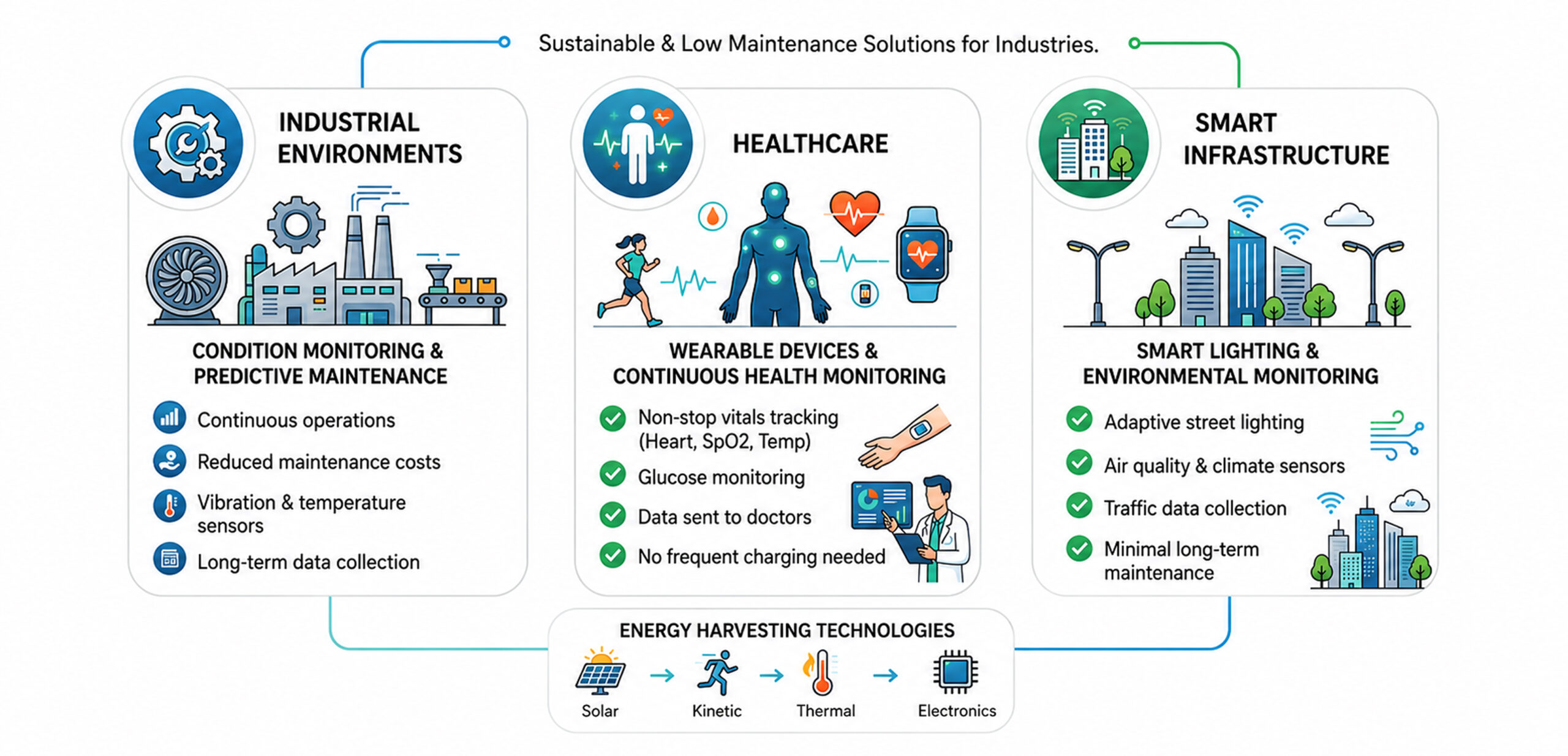
Battery-free embedded systems are being adopted across various industries due to their sustainability and low maintenance requirements.
In industrial environments, energy harvesting devices are used for condition monitoring and predictive maintenance. These systems can operate without battery replacement, reducing operational costs.
In healthcare, wearable devices use energy harvesting to power sensors and monitoring systems. This enables continuous health monitoring without frequent charging.
Smart infrastructure applications, such as smart lighting and environmental monitoring, also benefit from battery-free designs. These systems support long-term deployment with minimal maintenance.
Advancing Battery-Free Innovation with Embedded Expertise
As industries move toward sustainable and maintenance-free solutions, battery-free embedded systems are becoming increasingly important. Developing these systems requires a deep understanding of energy harvesting technologies, power management, and system integration.
Tessolve provides comprehensive expertise in building advanced embedded platforms that support energy-efficient and battery-free designs. With strong capabilities in designing embedded hardware, Tessolve enables the development of systems that operate reliably under constrained energy conditions.
As a trusted embedded system company, Tessolve offers end-to-end embedded solution capabilities, including system architecture design, hardware development, firmware optimization, and validation. By combining engineering expertise with structured design methodologies, Tessolve helps organizations develop innovative and sustainable embedded systems powered by energy harvesting.
Intermittent Computing for Energy-Harvested Devices: Sustaining Embedded Operations
Energy Storage Options in Battery-Free Embedded Systems
While energy harvesting provides the primary power source, energy storage plays a crucial role in ensuring stable and reliable system operation. Since harvested energy is often intermittent, storage elements act as buffers that maintain continuity during low-energy conditions.
Supercapacitors are commonly used for their fast charging and long lifecycle, while thin-film rechargeable batteries may be used when higher energy density is needed. Storage selection depends on application and energy requirements.
Effective integration of storage components is a key aspect of designing embedded hardware. Engineers must ensure minimal energy loss during charging and discharging while maintaining voltage stability across the system. A well-architected embedded solution ensures that energy storage complements harvesting and consumption seamlessly.
Firmware Optimization for Ultra-Low Power Operation
In battery-free systems, firmware plays a critical role in managing energy consumption. Unlike traditional systems, where performance may be prioritized, energy harvesting systems require firmware that dynamically adapts to available power.
Engineers design firmware to operate in ultra-low-power modes, waking the system only when necessary. Task scheduling, interrupt handling, and power state transitions must be optimized to reduce energy usage. Event-driven architectures are often preferred over continuous processing models.
Additionally, firmware must monitor energy levels and adjust system behavior accordingly. For example, non-critical tasks may be delayed or skipped during low-energy conditions. Collaborating with an experienced embedded system company ensures that firmware is tightly integrated with hardware design, enabling efficient and reliable operation.
Design Trade-Offs in Energy Harvesting Embedded Systems
Designing battery-free systems involves several trade-offs that must be carefully evaluated. One of the primary trade-offs is between performance and energy consumption. Higher performance often requires more power, which may not be sustainable in energy harvesting environments.
Another trade-off involves system responsiveness versus energy efficiency. Continuous operation provides faster response times but consumes more energy, while intermittent operation conserves power but may introduce delays.
Size and cost constraints must also be balanced, as adding storage or advanced power management can impoveimprove reliability while increasing system complexity and cost.
Frequently Asked Questions (FAQs)
1. What is energy harvesting in embedded systems?
Energy harvesting in embedded systems refers to capturing energy from ambient sources such as light, heat, vibration, or radio frequency signals and converting it into electrical power. This approach enables battery-free operation, reduces maintenance, and supports sustainable device deployment across various industrial, healthcare, and IoT applications.
2. Why is battery-free design important for embedded devices?
Battery-free design eliminates the need for regular battery replacement, reducing maintenance costs and environmental impact. It also enables smaller device sizes and longer operational lifetimes. This is especially important for remote or hard-to-access applications where replacing batteries is difficult or impractical over extended periods.
3. What are the main challenges in energy harvesting system design?
Key challenges include inconsistent energy availability, limited power output, and integration complexity. Designers must ensure efficient energy storage, low-power operation, and reliable system performance. Balancing energy generation and consumption while maintaining functionality requires careful planning and optimized hardware and firmware design strategies.
4. How does designing embedded hardware impact battery-free systems?
Designing embedded hardware is critical in minimizing power consumption and maximizing efficiency. Component selection, circuit design, and power management directly affect system performance. Efficient hardware design ensures that the system can operate within limited energy budgets while maintaining reliability and supporting the required functionality.
5. What role does firmware play in energy harvesting devices?
Firmware controls how the system uses energy, making it essential for optimizing performance. It manages power modes, schedules tasks, and adapts system behavior based on available energy. Efficient firmware design helps extend operation time, reduces energy waste, and ensures reliable functionality under varying energy conditions.


