

Modern vehicles rely heavily on electronics to deliver safety, performance, and intelligence. From braking and steering to powertrain control and advanced driver assistance, microcontrollers sit at the core of these critical functions. As vehicles become increasingly software-driven, ensuring the safety of automotive MCUs (Microcontroller Units) is no longer optional. It is a foundational requirement that influences every stage of product development.
Safety mechanisms in automotive MCUs are not added at the final stages of development. They are carefully planned from the concept phase, designed into hardware and software architectures, validated through rigorous testing, and monitored throughout production. This structured approach ensures that electronic systems behave predictably even when faults occur.
At Tessolve, our experience in advanced design solution delivery and embedded system solution development supports automotive teams across this entire lifecycle, helping translate safety concepts into production-ready systems.
Why Safety Is Central to Automotive MCU Design
Automotive MCUs operate in environments where failures can directly impact human safety. Unlike consumer electronics, vehicles must continue operating safely even when components malfunction. This requirement is defined under functional safety standards such as ISO 26262.
Functional safety focuses on identifying risks, analysing potential hazards, and implementing mechanisms that either prevent failures or ensure safe operation when failures occur. Automotive MCUs are therefore designed not just for performance, but for predictable and controlled behaviour under fault conditions.
Safety considerations influence:
- Hardware architecture choices
- Software design decisions
- Verification and validation strategies
- Manufacturing and production testing processes
This makes safety a system-level responsibility rather than a single feature.
Safety by Design: The Concept Phase of Automotive MCUs
The safety journey begins during the concept phase, where engineers identify vehicle functions and assess their potential impact if failures occur. This process, known as hazard analysis and risk assessment, helps define the Automotive Safety Integrity Level (ASIL) for each function.
Based on the ASIL classification, safety goals are created. These goals guide how the MCU and its surrounding system must behave under both normal and faulty conditions. At this stage, architectural decisions are made that influence the entire product lifecycle.
Key concept-phase safety considerations include:
- Defining safety requirements for critical vehicle functions
- Selecting MCU architectures capable of supporting safety mechanisms
- Planning fault detection and fault reaction strategies
- Establishing verification and validation expectations early
These early decisions reduce redesign risks later in development and ensure alignment with safety standards.
Hardware Safety Mechanisms in Automotive MCUs
Hardware-level safety mechanisms form the foundation of reliable automotive MCU operation. These mechanisms continuously monitor internal operations and detect faults before they escalate into unsafe behaviour.
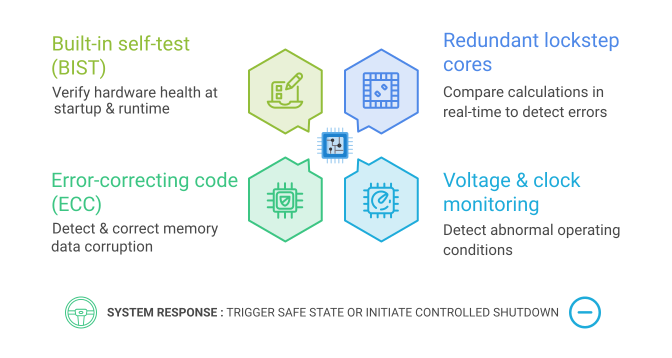
Common hardware safety mechanisms include:
- Redundant CPU cores operating in lockstep to detect computation errors
- Error-correcting code protection for memory to identify and correct data corruption
- Clock and voltage monitoring circuits to detect abnormal operating conditions
- Built-in self-test logic to verify hardware health at startup and runtime
These features allow the MCU to detect both random hardware faults and systematic design issues. When a fault is detected, the system can initiate a safe response, such as transitioning to a safe state or triggering a controlled shutdown.
Tessolve supports teams designing embedded hardware by validating these mechanisms at the system level, ensuring that hardware safety features function as intended within real automotive environments. The following infographic illustrates how these key hardware safety mechanisms interact to maintain system integrity:
Software Safety Mechanisms and Runtime Monitoring
While hardware mechanisms detect many faults, software plays a crucial role in managing safety during runtime. Embedded software in automotive MCUs is responsible for monitoring system health, managing faults, and ensuring safe operation under dynamic conditions.
Software safety mechanisms typically include:
- Watchdog timers to detect software execution failures
- Memory protection units to isolate critical tasks
- Diagnostic routines to monitor data integrity and communication
- Fault handling logic to initiate safe system responses
Software also ensures that safety mechanisms operate continuously, not just during startup. This is especially important for long vehicle lifetimes and changing operating conditions.
Through its embedded system solution offerings, Tessolve supports software integration, validation, and safety-focused testing to ensure robust MCU behaviour throughout vehicle operation.
Safety Validation and Verification Across Development Stages
Safety mechanisms must be verified and validated at multiple stages to ensure compliance and real-world reliability. Validation activities start early and continue through design, integration, and production.
Key validation stages include:
- Pre-silicon verification to validate safety logic before hardware fabrication
- Post-silicon validation to confirm real hardware behaviour
- System-level testing under fault injection scenarios
- Compliance documentation aligned with ISO 26262 requirements
This multi-layered approach ensures that safety is not assumed but demonstrated through evidence. Validation also helps uncover integration issues that may not be visible at individual component levels.
High-Reliability Testing for Mission-Critical Aerospace & Automotive Electronics
Tessolve’s engineering teams assist in system-level validation and performance optimisation, helping automotive companies confidently move from design to production.
From Development to Production: Ensuring Safety at Scale
Production introduces new challenges for safety assurance. Automotive MCUs must be manufactured, tested, and deployed consistently across high volumes while maintaining safety guarantees.
Production-level safety practices include:
- Manufacturing tests to detect latent hardware defects
- End-of-line diagnostics to verify system integrity
- Traceability of safety requirements throughout production
- Continuous improvement through field feedback and data analysis
These processes ensure that safety mechanisms function reliably not just in the lab, but across millions of vehicles operating in real-world conditions.
How Safety Mechanisms Support Future Automotive Architectures
As vehicles adopt centralized computing, domain controllers, and software-defined architectures, the role of MCU safety becomes even more critical. A single MCU may now control multiple vehicle functions, increasing the impact of potential faults.
Safety mechanisms enable this transition by:
- Supporting higher integration without compromising reliability
- Allowing scalable system designs with predictable behaviour
- Enabling compliance with evolving automotive safety standards
This makes safety mechanisms a key enabler for next-generation automotive innovation.
Why Partner with Tessolve for Automotive MCU Safety Engineering
Tessolve works closely with automotive and semiconductor companies to support safety-focused development from concept to production. Our expertise spans advanced design solution delivery, system-level validation, and embedded software integration.
We help teams:
- Align MCU designs with functional safety requirements
- Validate hardware and software safety mechanisms
- Optimize system performance while maintaining safety margins
By combining deep engineering expertise with a practical understanding of automotive safety standards, Tessolve enables reliable, production-ready embedded systems for modern vehicles.
FAQs
1. What are safety mechanisms in automotive MCUs?
They are hardware and software features that detect faults and ensure safe operation under failure conditions.
2. Why is ISO 26262 important for MCU safety?
It defines functional safety requirements for automotive electronic systems and guides safety implementation and validation.
3. Are hardware safety mechanisms alone sufficient?
No, software safety mechanisms are equally important for runtime monitoring and fault management.
4. When should safety be considered in MCU development?
Safety must be addressed from the concept phase and maintained through design, validation, and production.
5. How does Tessolve support automotive MCU safety?
Tessolve provides embedded system solution expertise across validation, integration, and safety-focused engineering.


