

Artificial intelligence is no longer limited to powerful cloud servers or high-end computing platforms. Today, AI models are running efficiently on microcontrollers with minimal memory and processing power, thanks to TinyML. From predictive maintenance in industrial equipment to gesture recognition in wearables and voice activation in smart home devices, TinyML is enabling intelligent applications on resource-constrained hardware. This evolution is also driving innovation in embedded system design, where AI capabilities must fit within strict hardware limitations.
Deploying neural networks on bare-metal microcontrollers, however, involves far more than exporting a trained model. Engineers must optimize memory, processing cycles, and power consumption, making INT8 quantization one of the most effective ways to reduce model size while preserving accuracy. Effective TinyML deployment also requires careful coordination between model architecture, firmware, and hardware capabilities.
In this article, we’ll explore how INT8 quantization works, why it matters for bare-metal TinyML deployment, the optimization techniques that deliver the best results, and the engineering practices that enable successful deployment.
Understanding TinyML in Bare-Metal Systems
TinyML refers to running machine learning inference on extremely resource-limited hardware such as Cortex-M microcontrollers, RISC-V MCUs, DSP-enabled processors, and other low-power embedded processors. This approach makes machine learning on microcontrollers practical for applications that require local processing without relying on cloud infrastructure.
Unlike Linux-based edge devices, bare-metal systems operate without a traditional operating system. Developers directly control the processor, peripherals, and memory, allowing maximum efficiency and deterministic execution.
Typical hardware constraints include:
- RAM ranging from 16 KB to 512 KB
- Flash memory between 128 KB and 2 MB
- Clock frequencies below 200 MHz
- Strict power budgets for battery-powered devices
- Real-time response requirements
These limitations require engineers to rethink traditional machine learning deployment strategies.
Why INT8 Quantization Matters
Most neural networks are trained using 32-bit floating-point numbers (FP32). Although FP32 offers excellent precision, it consumes substantial memory and computational resources.
INT8 quantization converts floating-point weights and activations into 8-bit integers. This significantly reduces both memory usage and computational complexity.
The benefits include:
- Up to 75% reduction in model size
- Faster inference execution
- Lower power consumption
- Better cache utilization
- Improved compatibility with MCU instruction sets
For bare-metal TinyML applications, these improvements often determine whether a model can run on the hardware at all. This makes TinyML quantization an important step in preparing neural networks for resource-constrained devices.
How INT8 Quantization Works
Instead of storing decimal values, quantization maps floating-point numbers into integer representations using a scale factor and zero-point.
The conversion generally follows:
Integer Value = Real Value / Scale + Zero Point
During inference, integer arithmetic replaces floating-point operations. Modern microcontrollers often include SIMD instructions or DSP extensions that accelerate INT8 multiplication and accumulation.
This allows inference to complete much faster while consuming significantly less energy. Effective MCU AI inference depends on selecting suitable quantization parameters and ensuring that the target processor supports the required operations efficiently.
Types of Quantization
Different quantization strategies offer varying balances between simplicity and accuracy.
1. Post-Training Quantization (PTQ)
This method converts a fully trained FP32 model into INT8 without retraining.
Advantages include:
- Fast deployment
- Minimal engineering effort
- Suitable for many CNN models
- Excellent for rapid prototyping
However, accuracy may decline for sensitive networks.
2. Quantization-Aware Training (QAT)
QAT simulates quantization during training.
The model learns to compensate for precision loss before deployment.
Advantages include:
- Higher inference accuracy
- Better handling of difficult datasets
- Improved robustness
- Preferred for production deployments
Although QAT requires longer training time, it often delivers superior performance.
3. Dynamic Quantization
Dynamic quantization converts weights before inference, while activations are quantized during execution.
It is commonly used on larger processors but is generally less suitable for bare-metal TinyML due to increased runtime overhead.
Memory Optimization Beyond Quantization
INT8 quantization is only one component of memory optimization.
Successful TinyML deployments also include:
1. Tensor Memory Reuse
- Intermediate tensors often occupy more memory than model weights.
- Memory planners reuse buffers whenever tensor lifetimes do not overlap.
- This dramatically reduces RAM consumption.
2. Fusion
Multiple operations can be combined into a single optimized kernel.
For example:
- Convolution
- Batch normalization
- Activation
May execute as one operation instead of three.
Benefits include:
- Lower memory access
- Faster execution
- Reduced instruction count
3. Weight Compression
Some applications combine INT8 quantization with:
- Sparse encoding
- Huffman coding
- Run-length encoding
Although decompression introduces overhead, flash usage decreases considerably.
Optimizing for Bare-Metal Deployment
Unlike embedded Linux, bare-metal deployment requires careful optimization across the entire software stack. Effective embedded AI optimization helps balance inference speed, memory usage, and power consumption without compromising system reliability.
Efficient Memory Allocation
Dynamic memory allocation is often avoided. Instead, developers allocate all buffers statically during compile time. Benefits include:
- Predictable behavior
- No heap fragmentation
- Easier debugging
- Deterministic latency
This is a common practice in embedded system development where reliability is essential.
Kernel Optimization
Most execution time is spent inside matrix multiplication and convolution kernels. Optimizations include:
- Loop unrolling
- SIMD instructions
- DSP intrinsics
- Cache-aware scheduling
CMSIS-NN is a popular library providing highly optimized INT8 kernels for ARM Cortex-M processors.
Layer Selection
Some neural network layers are more hardware-friendly than others. Efficient operators include:
- Depthwise convolution
- Pointwise convolution
- ReLU activation
- Average pooling
Expensive operators should be minimized whenever possible.
Reduce Model Complexity
Larger models rarely produce proportional improvements on microcontrollers. Engineers often simplify architectures by:
- Reducing channel count
- Removing redundant layers
- Lowering input resolution
- Pruning insignificant weights
Smaller models generally offer better deployment efficiency.
Choosing the Right Neural Network
Not every architecture is suitable for TinyML. Popular lightweight models include:
- MobileNet: Depthwise separable convolutions significantly reduce computation.
- EfficientNet Lite: Balances accuracy with computational efficiency.
- TinyNAS: Automatically searches for hardware-friendly architectures.
- DS-CNN: Widely used for keyword spotting.
- Tiny Transformer Variants: Modern attention mechanisms are increasingly optimized for deployment on microcontrollers.
Selecting the right architecture reduces later optimization effort and makes machine learning on microcontrollers more practical for real-world applications.
Calibration: The Key to Accurate Quantization
Calibration determines how floating-point ranges map into integer values. Poor calibration often leads to severe degradation in accuracy. Common calibration datasets include:
- Validation images
- Real sensor data
- Representative production samples
Using representative inputs greatly improves inference quality.
Measuring Quantization Accuracy
Successful deployment involves evaluating more than model accuracy. Important metrics include:
|
Metric |
Importance |
|
Accuracy |
Prediction quality |
|
Latency |
Response time |
|
RAM usage |
Runtime memory |
|
Flash usage |
Storage footprint |
|
Power consumption |
Battery life |
|
CPU utilization |
Processing efficiency |
Optimizing one metric often affects another, making balanced evaluation essential. These measurements also help assess MCU AI inference performance under realistic operating conditions.
Common Challenges in INT8 Deployment
1. Accuracy Loss
Certain layers are highly sensitive to reduced precision. Solutions include:
- QAT
- Mixed precision
- Better calibration
- Layer-specific quantization
2. Operations
- Not every framework supports INT8 implementations for every operator.
- Developers may need custom kernels.
3. Numerical Overflow
- Accumulating many INT8 values can overflow.
- Proper accumulator widths and scaling prevent this issue.
4. Memory Fragmentation
- Dynamic allocation increases unpredictability.
- Static allocation remains the preferred solution.
Popular TinyML Frameworks
Several frameworks simplify INT8 deployment.
TensorFlow Lite Micro
- Extensive hardware support
- Active ecosystem
- Optimized kernels
microTVM
- Enables automatic compiler optimization for multiple hardware targets.
Edge Impulse
- Offers end-to-end TinyML development with integrated deployment tools.
Best Practices for Successful INT8 Deployment
Experienced TinyML teams typically follow these recommendations:
- Design with deployment constraints from the beginning.
- Use representative calibration datasets.
- Benchmark continuously instead of waiting until project completion.
- Minimize unnecessary preprocessing.
- Profile memory after every optimization.
- Optimize operators before modifying hardware.
- Validate inference using real-world sensor inputs.
- Document every optimization for future maintenance.
Following these practices helps avoid expensive redesign cycles and improves TinyML deployment reliability.
Hardware Considerations
The processor itself significantly influences TinyML performance.
Features that improve inference include:
- DSP instruction support
- SIMD acceleration
- Dedicated AI accelerators
- Fast SRAM
- Low-power sleep modes
Matching software optimization with hardware capabilities delivers the greatest benefits. This is a key consideration in bare-metal AI, where developers have direct control over processor resources and execution.
Security Considerations
Edge AI models often process sensitive data. Security should not be overlooked during deployment. Recommended practices include:
- Secure boot
- Firmware authentication
- Encrypted model storage
- Memory protection
- Debug interface locking
- Secure OTA updates
These safeguards help prevent model theft and unauthorized firmware modifications.
The Future of INT8 TinyML
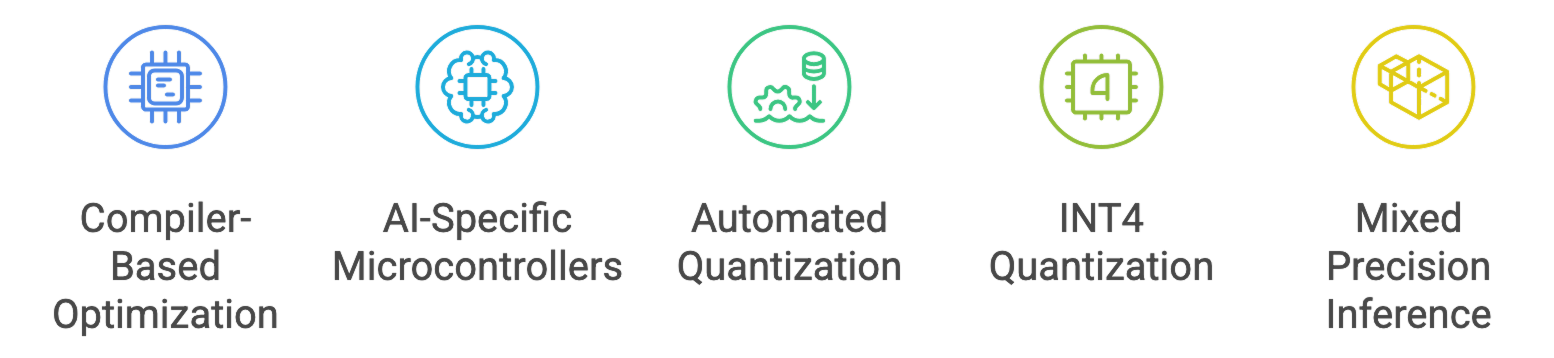
INT8 remains the dominant deployment format today, but innovation continues at a rapid pace. Emerging trends include:
Mixed Precision Inference
- Critical layers may retain higher precision, while the rest of the network uses INT8.
INT4 Quantization
- Four-bit inference promises even greater memory savings for ultra-small devices.
Automated Quantization
- Machine learning compilers increasingly automate optimization decisions, simplifying embedded AI optimization across different hardware platforms.
AI-Specific Microcontrollers
- New generations of processors integrate dedicated neural processing units that accelerate INT8 operations while minimizing energy consumption.
Compiler-Based Optimization
- Modern compiler pipelines automatically optimize scheduling, memory allocation, and operator fusion for target hardware, reducing manual engineering effort.
As these technologies mature, deploying sophisticated AI models on tiny devices will become faster, easier, and more efficient.
Real-World Applications of INT8 TinyML
The benefits of optimized INT8 deployment extend across numerous industries.
In healthcare, wearable devices continuously monitor heart rate, motion, and other vital signs while operating for extended periods on small batteries. Industrial environments use TinyML to detect equipment faults, identify vibration anomalies, and enable predictive maintenance without relying on cloud connectivity. Smart agriculture benefits from low-power environmental sensors that analyze soil moisture, temperature, and crop conditions directly in the field.
Consumer electronics also leverage INT8 optimization in voice assistants, gesture recognition, and smart appliances that respond instantly while preserving user privacy. Automotive systems leverage TinyML for cabin monitoring, driver assistance, and predictive diagnostics, where deterministic execution is critical. Achieving these demanding requirements depends on robust embedded design practices that align hardware capabilities with optimized machine learning models.
Engineering Workflow for Reliable TinyML Deployment
A successful TinyML project involves much more than model training. The process begins with selecting the right dataset and creating an architecture that fits hardware limitations. Developers then apply pruning, quantization, calibration, and benchmarking before integrating the optimized model into firmware.
Continuous testing ensures that inference remains accurate under real operating conditions, including varying temperatures, voltage fluctuations, and noisy sensor inputs. Memory usage, execution latency, and energy consumption should be measured throughout development rather than only at the final stage.
This structured workflow reflects modern embedded system design methodologies, where software optimization, hardware constraints, and validation activities progress together instead of being handled independently. Early collaboration among AI engineers, firmware developers, and hardware designers significantly reduces deployment risks and shortens product development cycles.
From Concept to Prototype: The Complete Embedded System Design Process
Why Partner with Tessolve for Edge AI and TinyML Solutions
As Edge AI applications become increasingly sophisticated, organizations need an engineering partner that understands both advanced machine learning and product-ready embedded platforms. At Tessolve, we combine expertise across silicon engineering, AI optimization, and embedded systems services to help businesses accelerate innovation from concept to deployment.
- Our multidisciplinary engineering teams optimize AI models for memory, latency, and power efficiency on resource-constrained microcontrollers.
- We deliver end-to-end support spanning hardware design, firmware development, validation, and production-ready Edge AI deployment.
- Leveraging proven expertise in embedded systems, semiconductor engineering, and intelligent edge solutions, we help customers build reliable, scalable, and high-performance products.
- From model optimization and bare-metal implementation to complete embedded design workflows and advanced embedded system design, our engineers ensure every solution is tailored to real-world deployment challenges.
- Whether you’re developing next-generation industrial automation, automotive electronics, healthcare devices, or consumer IoT products, Tessolve provides the engineering excellence needed to transform innovative AI concepts into commercially successful embedded solutions.
FAQs
1. What is INT8 quantization in TinyML?
INT8 quantization converts 32-bit values into 8-bit integers. It reduces model size, speeds up inference, lowers power consumption, and helps AI models run efficiently on microcontrollers.
2. Why is bare-metal deployment important for TinyML?
Bare-metal deployment removes operating system overhead. It offers faster execution, lower latency, predictable performance, and better control over memory and processor resources.
3. Does INT8 quantization affect model accuracy?
Yes, a small accuracy drop is possible. However, proper calibration and quantization-aware training help maintain accuracy while improving model efficiency and reducing memory usage.
4. Which industries use TinyML the most?
TinyML is widely used in healthcare, automotive, industrial automation, agriculture, wearables, and smart home devices. It enables fast, low-power AI processing at the edge.
5. What hardware is best for TinyML applications?
Microcontrollers with DSP instructions, SIMD support, fast SRAM, and AI acceleration provide better TinyML performance. They improve inference speed while reducing energy consumption.
6. How can Tessolve support TinyML development?
Tessolve offers expertise in embedded engineering, AI optimization, hardware design, firmware development, and testing. It helps businesses build reliable and production-ready TinyML solutions.


