


In the world of Industrial IoT, “good enough” hardware doesn’t exist. Whether it’s a predictive maintenance sensor inside a high-heat furnace or an edge AI gateway managing a global logistics network, the demands are brutal. These systems must process massive amounts of data locally, communicate in real time, and last for a decade or more, all while drawing power from limited sources. At the heart of this revolution is the System-on-Module (SoM).
A custom SoM isn’t just a component; it is the brain of the operation, integrating processors, memory, and power management into a singular, ruggedized footprint. However, the engineering challenge is a classic paradox: How do you deliver enough “horsepower” for advanced edge analytics without hitting thermal limits or draining power budgets? Success lies in the delicate art of balancing performance, reliability, and scalability.
Let’s explore how custom SoM design helps organizations build high-performing Industrial IoT devices while keeping power consumption under control.
Understanding System-on-Module (SoM)
A System-on-Module is essentially a compact computing board that contains the critical components of a system, such as a processor, RAM, storage, and connectivity interfaces. Instead of designing a full embedded system from scratch, developers integrate the SoM onto a carrier board that handles application-specific peripherals.
This modular approach simplifies development and accelerates product launches. It also allows engineers to upgrade computing capability in the future without redesigning the entire hardware platform.
For Industrial IoT devices that must operate continuously in demanding environments, SoMs offer reliability, compactness, and flexibility.
Why Industrial IoT Needs Custom SoM Solutions
Off-the-shelf SoMs are useful for prototypes and general applications, but Industrial IoT often requires tailored hardware. Factors such as environmental conditions, specialized connectivity, and long lifecycle requirements make customization necessary.
Custom SoM design allows engineers to optimize:
- Processing performance for edge analytics and AI
- Power consumption for remote or battery-powered devices
- Connectivity for industrial protocols and networks
- Thermal management for harsh environments
- Hardware security for critical infrastructure
These factors are central to embedded system design, especially when devices must run continuously with minimal maintenance.
Balancing Performance and Power Efficiency
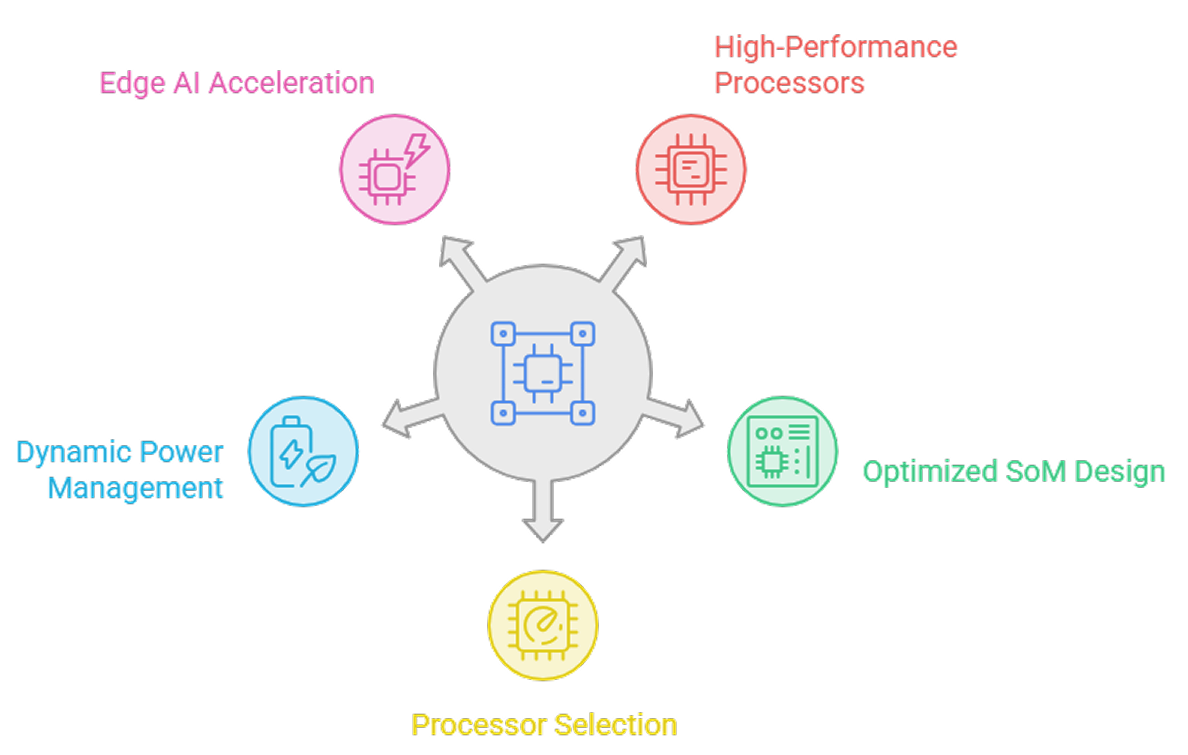
One of the biggest challenges in Industrial IoT hardware is balancing processing power with energy efficiency.
High-performance processors allow devices to perform advanced analytics, machine vision, and AI inference directly at the edge. However, they also increase energy consumption and heat generation.
A well-optimized SoM carefully balances these trade-offs by selecting the right architecture, memory configuration, and power management strategies.
Key design considerations include:
Processor selection
Choosing a processor with the right performance-per-watt ratio is crucial. ARM-based SoCs are commonly used because they deliver strong processing capabilities with lower power consumption.
Dynamic power management
Modern SoMs use techniques like dynamic voltage scaling and sleep states to reduce energy usage when workloads are low.
Edge AI acceleration
AI accelerators or NPUs allow advanced processing without significantly increasing power consumption.
These considerations play a crucial role when designing embedded system platforms intended for long-term deployment.
Designing for Industrial Reliability
Industrial environments introduce unique challenges for embedded devices. Temperature fluctuations, electrical noise, vibration, and humidity can all impact system reliability.
A custom SoM must therefore be designed with durability in mind. This includes selecting industrial-grade components, ensuring robust PCB layouts, and implementing proper shielding for electromagnetic interference.
Thermal design is another critical factor. Efficient heat dissipation ensures that processors operate within safe temperature limits, preventing performance degradation or hardware failure.
Engineers also perform extensive validation testing, including thermal stress tests and environmental simulations, to guarantee reliable operation over extended periods.
Connectivity: The Backbone of Industrial IoT
Industrial IoT devices must communicate with machines, gateways, and cloud platforms. Custom SoMs support a wide range of communication interfaces, including Ethernet, CAN, SPI, I2C, and industrial fieldbus protocols.
Wireless connectivity options such as Wi-Fi, Bluetooth, and cellular networks are also becoming common in Industrial IoT systems.
A flexible connectivity architecture ensures compatibility with both legacy industrial infrastructure and modern cloud-based platforms. This adaptability allows organizations to scale their IoT ecosystems without replacing existing hardware.
Connectivity optimization is often part of a broader advanced design solution, where hardware, firmware, and network architecture work together to deliver reliable data exchange.
Connecting Billions: The Role of Embedded Systems in Global IoT Growth
Accelerating Product Development with Modular Architecture
Another major advantage of custom SoM platforms is faster product development. Since the core processing unit is already integrated into the module, engineers can focus on application-specific functionality.
This modular architecture offers several benefits:
- Reduced development time
- Lower engineering costs
- Simplified certification processes
- Easier product upgrades
For companies building multiple IoT products, a shared SoM platform allows them to reuse hardware designs across different devices.
This approach significantly reduces design complexity while maintaining flexibility for future innovation.
Security Considerations in Industrial IoT
Security has become a top priority for Industrial IoT deployments. A compromised device can disrupt operations or expose sensitive data.
Modern SoM designs integrate hardware-level security features such as secure boot, encryption engines, and trusted execution environments. These features protect devices from unauthorized access and firmware tampering.
Additionally, remote update capabilities ensure that devices can receive security patches throughout their operational lifecycle.
When implemented properly, these measures create a resilient platform that protects both the device and the broader industrial network.
The Role of an Embedded Engineering Partner
Designing a custom SoM requires expertise in semiconductor architecture, PCB design, firmware development, and system validation. Many organizations, therefore, collaborate with specialized engineering partners.
A trusted embedded system company can guide the development process from concept to production. Their experience helps optimize component selection, improve system reliability, and accelerate time to market.
By leveraging expert engineering support, businesses can focus on product innovation while ensuring their hardware platform meets industry standards and performance goals.
Tessolve: Powering Custom SoM Innovation for Industrial IoT
At Tessolve, we specialize in delivering end-to-end embedded engineering solutions that help organizations build high-performance Industrial IoT devices. With over two decades of experience in semiconductor and product engineering, our teams support the complete development lifecycle, from architecture definition and SoM design to testing and manufacturing readiness.
Our expertise includes custom System-on-Module development, embedded hardware and software engineering, FPGA integration, and system validation. We collaborate closely with customers to deliver scalable solutions that optimize both performance and power efficiency.
By combining deep domain knowledge with a proven advanced design solution methodology, Tessolve enables faster innovation and reliable product deployment across automotive, industrial, and IoT markets.
FAQs
1. What is a System-on-Module (SoM) in Industrial IoT?
A System-on-Module is a compact computing module integrating a processor, memory, and connectivity, serving as the core of embedded Industrial IoT devices.
2. Why choose a custom SoM instead of an off-the-shelf module?
Custom SoMs optimize performance, power consumption, connectivity, and reliability for specific Industrial IoT applications and long product lifecycles.
3. How does a SoM help reduce development time?
A SoM separates the processing core from the carrier board, allowing engineers to focus on application-specific hardware and faster product development.
4. What factors influence power efficiency in SoM design?
Processor architecture, dynamic power management, memory configuration, and AI accelerators significantly influence power efficiency in Industrial IoT systems.
5. Which industries commonly use custom SoM solutions?
Industries like manufacturing, energy, transportation, healthcare, and smart infrastructure widely use custom SoM solutions for reliable Industrial IoT deployments.


