

Is traditional telematics enough to support today’s connected and intelligent vehicles? Not quite. As automotive systems evolve, vehicles are no longer just data-generating machines but real-time decision-making platforms. While telematics has played a key role in tracking and diagnostics, it often falls short when it comes to processing and acting on data instantly.
Modern vehicles demand faster insights and seamless connectivity. This shift requires real-time analytics at the edge, where platforms like TERA transform raw vehicle data into actionable insights.
Achieving this level of intelligence depends on a strong embedded system design and a structured approach to designing embedded system architectures that support performance and scalability.
From Telematics to Intelligent Vehicle Analytics
Telematics has long been the foundation of connected vehicle systems, enabling features such as GPS tracking, remote diagnostics, and fleet management. These systems primarily focus on collecting and transmitting data to centralized platforms for analysis. While effective for monitoring, this approach introduces latency and limits real-time responsiveness.
As vehicles become more complex, the need for immediate data processing has grown significantly. Real-time vehicle analytics shifts the focus from data transmission to in-vehicle intelligence. Instead of waiting for cloud-based analysis, vehicles can process data locally and respond instantly. This evolution is driven by advancements in embedded system design, where computing capabilities are integrated directly into the vehicle architecture to support faster and more efficient decision-making.
How TERA Enables Real-Time Vehicle Analytics
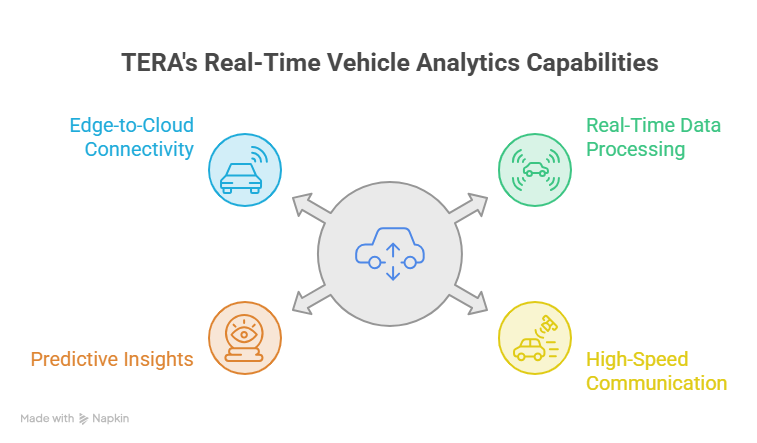
TERA goes beyond traditional telematics by enabling real-time data processing, intelligent decision-making, and seamless connectivity within the vehicle ecosystem. It acts as an edge platform that transforms how vehicle data is collected, processed, and utilized. Let’s explore the key capabilities that make this possible.
How TERA Transforms Vehicle Management with Smart Connectivity and Intelligence
1. Real-Time Data Processing at the Edge
TERA processes data directly within the vehicle, minimizing reliance on cloud systems and enabling faster response times. Analyzing data at the source ensures real-time decision-making for safety, performance, and system efficiency without delays caused by external processing.
- Immediate analysis of sensor data for faster system-level insights
- Reduced latency for time-critical operations and safety functions
- Efficient data filtering and aggregation before transmission
- Faster decision-making within the system without cloud dependency
2. High-Speed In-Vehicle Communication
Efficient communication between vehicle components is critical for real-time analytics. TERA enables high-speed data exchange across systems, ensuring seamless interaction between sensors and control units, which improves synchronization, responsiveness, and overall vehicle system performance.
- Integration with vehicle communication networks such as CAN (Controller Area Network)
- Real-time signal sharing across electronic control units
- Support for multiple sensor inputs with synchronized processing
- Improved responsiveness through faster data transfer mechanisms
3. Predictive Insights and Diagnostics
TERA enables advanced analytics that go beyond traditional diagnostics by identifying patterns in vehicle data. This allows systems to detect potential issues early and support predictive maintenance, improving reliability and reducing unexpected failures.
- Early fault detection using continuous monitoring and pattern analysis
- Predictive maintenance capabilities to prevent system failures
- Vehicle performance analysis using real-time and historical data
- Data-driven decision support for improved operational efficiency
4. Seamless Edge-to-Cloud Connectivity
While enabling edge intelligence, TERA also maintains continuous connectivity with cloud platforms. This allows extended analytics, remote monitoring, and system updates, ensuring that vehicle data can be leveraged for long-term insights and performance improvements.
- Secure wireless data transmission between the vehicle and the cloud
- Remote diagnostics and real-time monitoring capabilities
- Over-the-air updates for continuous system improvements
- Scalable data integration for advanced analytics and insights
Architectural Considerations for Real-Time Analytics Platforms
Building platforms like TERA requires a well-planned system architecture that supports high-speed data processing and seamless integration. The ability to handle multiple data streams from sensors, control units, and communication interfaces is critical for ensuring real-time performance.
A strong architecture combines processing power, efficient data pipelines, and reliable communication frameworks. By focusing on scalability and modularity, engineers can create platforms that adapt to evolving automotive requirements.
Driving Advanced Vehicle Intelligence with Tessolve
Tessolve brings extensive expertise in developing intelligent embedded platforms like TERA that power next-generation automotive solutions. With a strong foundation in embedded system design, Tessolve enables the creation of scalable and high-performance systems that support real-time vehicle analytics.
As an experienced embedded system company, Tessolve offers comprehensive capabilities across system architecture, hardware development, firmware integration, and validation. By leveraging an advanced design solution approach and a structured methodology for designing embedded system platforms, Tessolve helps organizations move beyond traditional telematics and build smarter, more connected vehicle ecosystems.
FAQs
1. What is the difference between telematics and real-time vehicle analytics?
Telematics focuses on collecting and transmitting vehicle data for remote monitoring. Real-time vehicle analytics processes data instantly within the vehicle, enabling faster decisions, predictive insights, and improved system performance without relying entirely on external systems.
2. How does TERA improve vehicle performance?
TERA enables real-time data processing, high-speed communication, and predictive analytics. This allows vehicles to respond quickly to changing conditions, detect issues early, and optimize performance through data-driven insights and intelligent system behavior.
3. Why is real-time data processing important in vehicles?
Real-time processing allows vehicles to act instantly on critical data, improving safety, responsiveness, and efficiency. It reduces latency and ensures that important decisions are made without delays caused by cloud-based processing.
4. What role does embedded system design play in TERA?
Embedded system design ensures that hardware and software components work together efficiently to process data, manage communication, and support real-time analytics. It forms the foundation for building reliable and scalable vehicle intelligence platforms.
5. How can an embedded system company support vehicle analytics development?
An embedded system company provides expertise in system architecture, hardware design, firmware development, and integration. This helps organizations build robust platforms that support real-time analytics, improve performance, and enable innovation in connected vehicle technologies.


