

Artificial intelligence is moving from cloud servers into increasingly compact embedded devices. AI accelerators are making this possible by providing dedicated hardware for machine learning workloads while keeping power consumption, latency, and system size within practical limits. From intelligent cameras and industrial controllers to automotive and connected devices, these accelerators are changing how embedded products process data.
For an embedded system company, designing such products involves more than selecting an accelerator. Hardware architecture, memory bandwidth, thermal behavior, software support, model performance, and validation all need to work together. A well-planned embedded system design approach is therefore essential for turning AI capabilities into reliable real-world products.
What Are AI Accelerators in Embedded Systems?
AI accelerators are specialized hardware components designed to execute AI and machine learning operations more efficiently than general-purpose processors alone. Depending on the platform, acceleration can be provided through GPUs, NPUs, DSPs, dedicated AI engines, or FPGA-based architectures.
These accelerators are particularly useful for workloads involving neural networks, image processing, object detection, speech processing, and other computationally intensive tasks.
Instead of using a CPU for every operation, an embedded system can assign suitable workloads to dedicated acceleration hardware. This can improve processing efficiency while allowing the CPU to handle operating system tasks, application logic, connectivity, and control functions.
Key Design Considerations for AI Accelerators
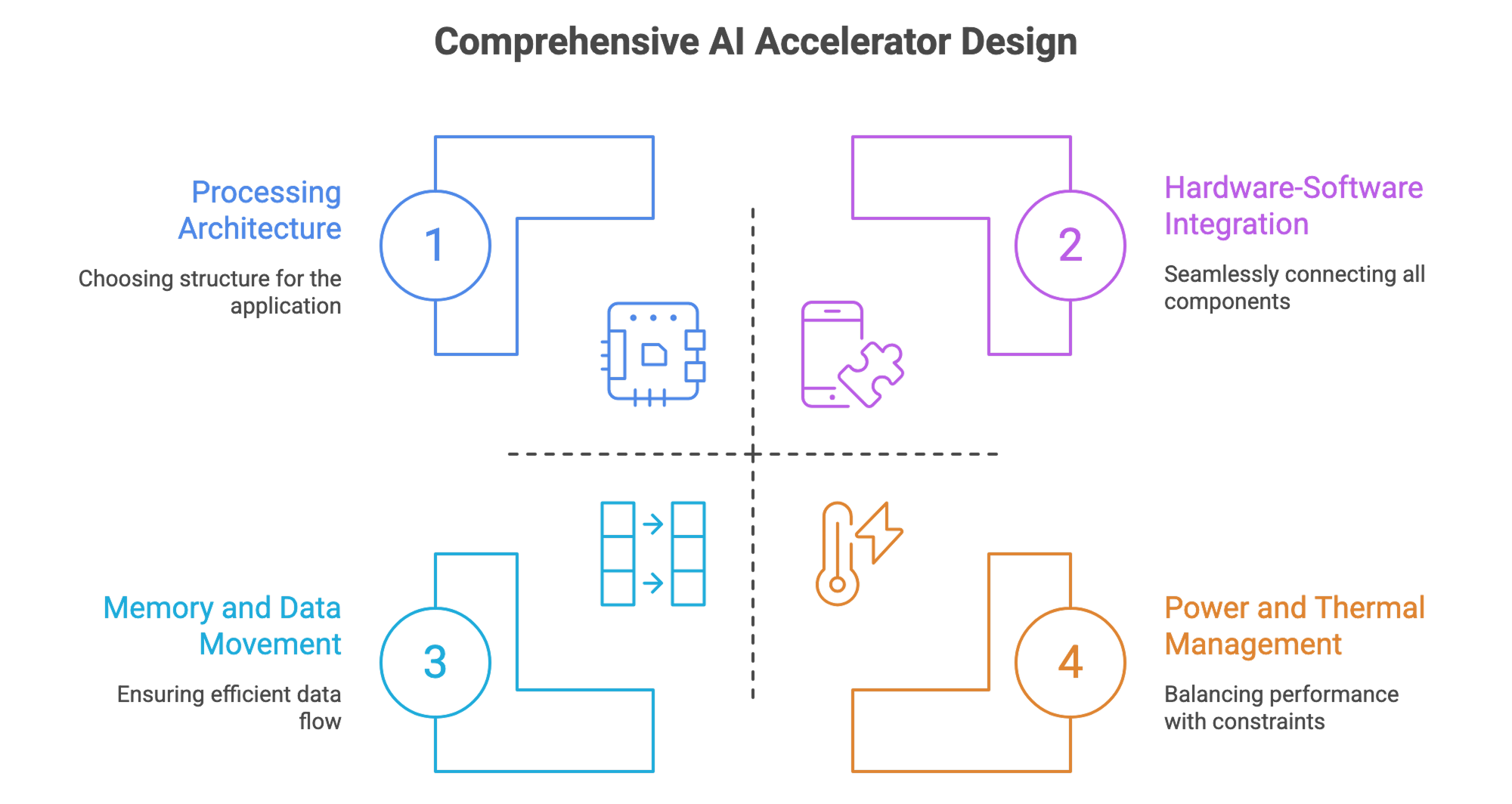
1. Selecting the Right Processing Architecture
The first decision is determining what type of accelerator fits the application. An industrial vision device, for example, may have very different requirements from a low-power IoT product.
Engineers need to consider AI model complexity, required throughput, latency, supported frameworks, memory requirements, and power limitations. The accelerator should provide enough performance for the intended workload without unnecessarily increasing system complexity or cost.
This makes embedded design an architectural exercise rather than simply a component-selection task.
2. Memory and Data Movement
AI acceleration depends heavily on efficient data movement. Neural networks can involve large numbers of parameters and frequent movement of input, intermediate, and output data.
Even a powerful accelerator can become inefficient if memory bandwidth is inadequate. Engineers therefore need to evaluate memory architecture, cache behavior, bandwidth, storage, and data-transfer paths during embedded system design.
Reducing unnecessary movement between the processor, accelerator, and memory can also help control power consumption and improve overall responsiveness.
3. Power and Thermal Management
Embedded products frequently operate under strict power and thermal constraints. This becomes especially important when AI workloads run continuously.
Higher processing performance can generate additional heat and increase power consumption. Engineers must therefore balance acceleration performance with thermal design, power-management strategies, and the physical limitations of the target product.
For battery-powered or compact products, this balance can directly influence the feasibility of the AI application.
4. Hardware-Software Integration
An AI accelerator does not operate independently. It needs drivers, firmware, middleware, operating-system support, development tools, and application-level integration.
A strong embedded system company must therefore consider hardware and software together from the beginning. The software stack needs to communicate effectively with the accelerator and provide a practical path for deploying and updating AI models.
Tessolve’s embedded software capabilities include embedded development, firmware, Board Support Package development, testing, validation, automation, and related software engineering services.
AI Model Optimization Matters
An accelerator’s capabilities are only useful when the AI model can run efficiently on it. Models may need optimization through techniques such as quantization, pruning, or architecture-specific compilation.
Engineers also need to consider supported data types and operations. A model that performs well during development may behave differently after optimization for an embedded target.
This makes close coordination between model development, hardware architecture, and embedded design important throughout the development cycle.
Validation Challenges for AI-Enabled Embedded Systems
AI accelerators introduce another major challenge: proving that the complete system works as expected.
Traditional validation checks whether hardware and software perform defined functions correctly. AI-enabled systems add another layer because model accuracy, accelerator behavior, performance, and real-world inputs must also be considered.
Functional and Performance Validation
Validation needs to confirm that the accelerator executes supported operations correctly and that the complete system achieves its required performance.
This can involve checking processing latency, throughput, memory behavior, power consumption, thermal performance, and interactions between the CPU, accelerator, memory, and peripherals.
Tessolve’s post-silicon validation capabilities include functional validation, power and performance characterization, system-level testing, debugging, regression testing, and hardware-software co-validation. Its validation expertise also covers processing units including CPUs, GPUs, and NPUs.
Pre-Silicon and FPGA Validation
Finding architectural problems before silicon is available can significantly reduce development risk. FPGA-based prototyping and emulation provide opportunities to evaluate hardware behavior and software integration earlier.
Scalable FPGA Prototyping for AI SoCs: Handling Massive Parallelism and Bandwidth
Tessolve provides FPGA-based emulation, partitioning, ASIC-to-FPGA and FPGA-to-ASIC conversion, custom board development, and FPGA validation.
Hardware-Software Co-Validation
AI systems depend on close interaction between hardware and software. A hardware accelerator may function correctly in isolation but still encounter issues when integrated with drivers, firmware, operating systems, memory, and application software.
Co-validation helps identify these integration problems earlier. It also provides a clearer view of system behavior under realistic workloads and operating conditions.
Security, Reliability, and Real-World Conditions
AI-enabled embedded devices may operate continuously in environments where reliability is critical. Validation therefore needs to extend beyond basic functional testing.
Engineers may need to examine different operating conditions, workload variations, thermal states, power conditions, and communication scenarios. For semiconductor devices, Tessolve also provides DFT services including scan insertion, ATPG, memory BIST, boundary scan, fault coverage analysis, and post-silicon debug support.
A comprehensive validation strategy helps connect accelerator-level testing with complete system behavior.
Building AI-Ready Embedded Products with Tessolve
At Tessolve, we bring together embedded hardware, software, FPGA, semiconductor design, and validation capabilities to support AI-enabled products.
- Embedded Engineering: We provide system design, embedded hardware development, FPGA design, PCB capabilities, system software, and product validation.
- AI and Edge Capabilities: Our portfolio includes EdgeAI solutions and engineering capabilities for intelligent embedded systems.
- Validation Expertise: We support pre-silicon, post-silicon, FPGA-based, and system-level validation across processing platforms and interfaces.
- Integrated Engineering: Our capabilities span hardware and software development, device drivers, BSPs, testing, and validation, helping address AI-enabled embedded products as complete systems.
FAQs
1. What is an AI accelerator in an embedded system?
An AI accelerator is specialized hardware that efficiently processes machine learning workloads while reducing CPU workload, latency, and power consumption.
2. Why are AI accelerators important for embedded devices?
They enable faster AI processing on devices with limited power, memory, and computing resources, supporting real-time intelligent applications.
3. What factors should be considered when selecting an AI accelerator?
Key factors include processing performance, power consumption, memory bandwidth, supported AI frameworks, workload requirements, thermal constraints, and software compatibility.
4. What are the main validation challenges for AI accelerators?
Validation involves checking functional correctness, performance, power behavior, thermal conditions, hardware-software integration, and accelerator behavior under different workloads.
5. How does FPGA validation support AI accelerator development?
FPGA-based validation enables engineers to evaluate hardware behavior and software integration before final silicon becomes available for comprehensive testing.


