


What happens when a vehicle must make a split-second decision based on data from multiple sensors? This is the reality of Advanced Driver Assistance Systems (ADAS), where accuracy, speed, and reliability are critical. ADAS relies on sensor fusion, combining inputs from cameras, radar, LiDAR, and other sensors to create a comprehensive view of the vehicle’s surroundings. Increasingly, Artificial Intelligence (AI) and Machine Learning (ML) algorithms are used to process this fused data, enabling functions such as object detection, classification, path prediction, and real-time decision-making.
However, ensuring that these systems perform consistently in varying weather, lighting, traffic, and road conditions is a significant challenge. Effective validation, supported by robust embedded system design and architecture, is essential for ensuring safe and reliable ADAS performance.
Understanding ADAS Sensor Fusion and iIts Validation Needs
ADAS sensor fusion integrates inputs from multiple sensors to provide a comprehensive and accurate view of the vehicle’s surroundings. Each sensor type has its strengths and limitations. For example, cameras provide detailed visual information, radar offers distance and speed detection, and LiDAR enables precise depth mapping. Sensor fusion combines these inputs to improve overall system reliability and decision-making.
AI and ML models play a crucial role in processing this fused data. These algorithms help identify vehicles, pedestrians, cyclists, traffic signs, lane markings, and other road users while continuously learning from large datasets. As a result, validation must assess not only sensor accuracy but also the performance of AI-powered perception and classification systems under real-world conditions.
Validating this process is complex because it must account for real-world variability. Sensor data can be affected by environmental factors such as rain, fog, glare, and road conditions. Additionally, synchronization between sensors and accurate data processing are essential for reliable performance. This makes validation a critical step in ensuring that ADAS systems function safely and effectively under all conditions.
How Sensor Fusion is Tested in Real-World Scenarios
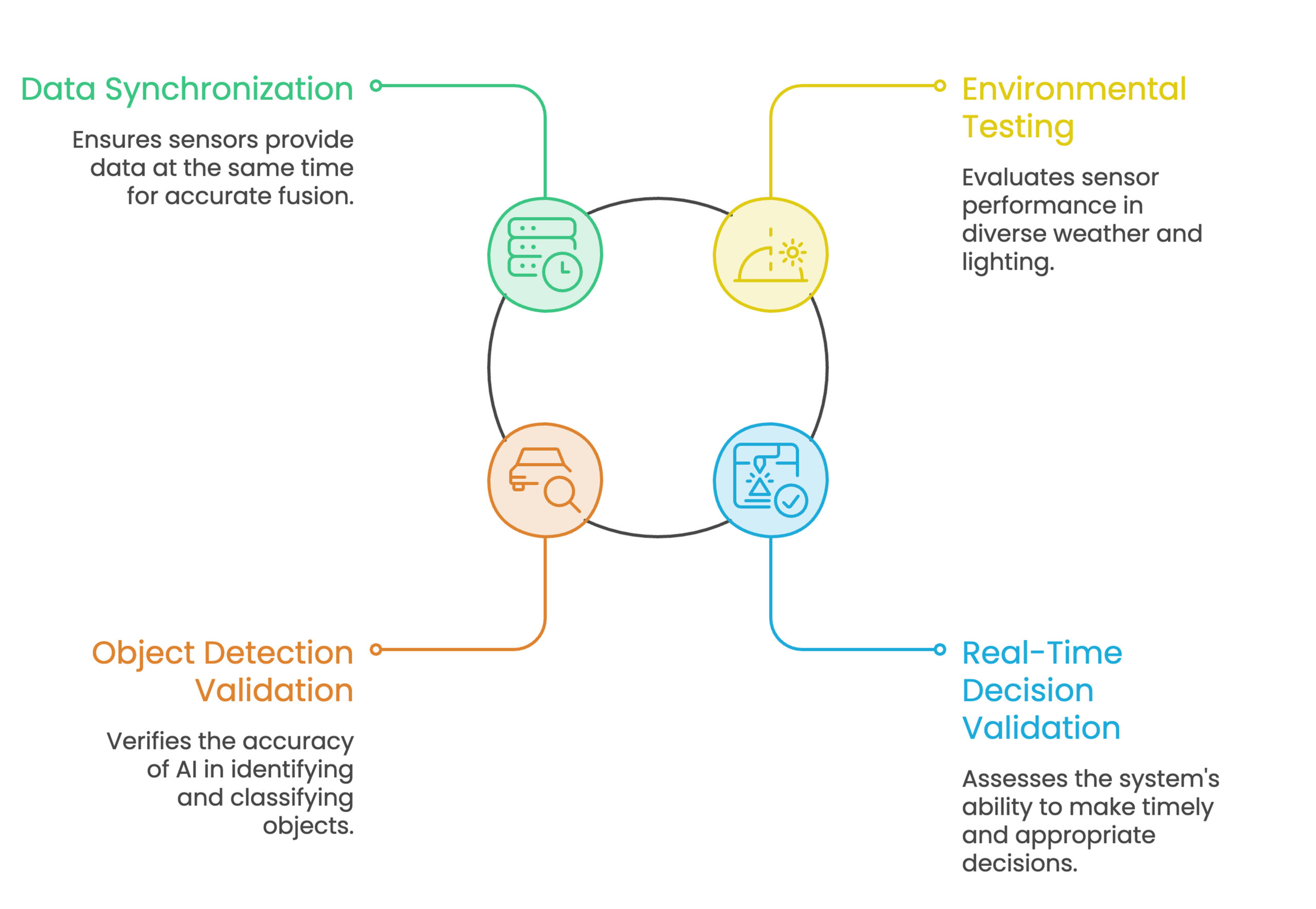
Testing sensor fusion in ADAS requires a combination of real-world validation and controlled testing environments. The goal is to ensure that the system can interpret and respond to complex driving situations accurately. This includes validating AI-driven perception models alongside the underlying sensor infrastructure. Let’s explore the key aspects of this validation process.
1. Multi-Sensor Data Synchronization
Ensuring that data from different sensors is aligned in time and context is critical for accurate decision-making.
- Synchronization of camera, radar, and LiDAR inputs
- Time alignment of sensor data streams
- Accurate correlation of objects across sensors
- Reduction of data inconsistencies
2. Environmental Condition Testing
ADAS systems must perform reliably under a wide range of environmental conditions.
- Testing in rain, fog, and low-visibility scenarios
- Handling glare, shadows, and changing light conditions
- Performance validation in urban and highway environments
- Adaptability to different road surfaces
3. AI-Based Object Detection and Classification Validation
AI and ML algorithms are responsible for recognizing and classifying objects from fused sensor data. Validation ensures these models maintain accuracy across diverse scenarios.
- Detection of vehicles, pedestrians, cyclists, and obstacles
- Validation of AI-based object classification accuracy
- Testing against edge cases and unusual traffic situations
- Reduction of false positives and missed detections
- Performance evaluation across diverse datasets and environments
4. Real-Time Decision Validation
ADAS systems must process data and make decisions instantly.
- Evaluation of system response time
- Validation of braking and steering decisions
- Testing under high-speed scenarios
- Ensuring consistent system behavior
Challenges in Validating Sensor Fusion for ADAS
Validating sensor fusion in real-world scenarios presents several challenges. One of the primary difficulties is managing the variability of environmental conditions. Unlike controlled testing environments, real-world scenarios introduce unpredictable factors that can affect sensor performance, AI/ML model accuracy, and overall system reliability.
Another challenge is the complexity of integrating multiple sensors and ensuring that they work seamlessly together. Differences in sensor characteristics, data formats, processing speeds, and AI/ML processing requirements can create inconsistencies that must be addressed during validation. This requires a robust approach to embedded system design, where system architecture is optimized for efficient data processing, synchronization, and intelligent decision-making.
Additionally, testing all possible driving scenarios is nearly impossible. Engineers must therefore rely on a combination of real-world testing, simulation, and AI/ML model validation to achieve comprehensive validation coverage. This makes it essential to adopt an advanced design solution approach that integrates testing, validation, and system optimization into a unified framework.
Ensuring Reliable ADAS Performance Through Structured Validation
Achieving reliable ADAS performance requires a structured and systematic validation approach. This involves combining real-world testing with simulation-based validation to cover a wide range of scenarios. By integrating validation early in the development process, teams can identify potential issues, evaluate AI/ML model behavior, and optimize system performance more effectively.
Another important aspect is continuous validation. As ADAS systems evolve with software updates, AI/ML model enhancements, and new features, validation must be an ongoing process. This ensures that system performance remains consistent and reliable over time. A well-planned strategy for designing embedded system architectures helps support this continuous validation process by enabling scalability, adaptability, and efficient deployment of AI/ML-enabled ADAS functions.
Driver Trust in ADAS: Building Confidence in Automated Systems
Advancing ADAS Validation with Tessolve
Tessolve brings deep expertise in validating complex automotive systems, including advanced ADAS platforms that rely on sensor fusion and AI/ML-driven perception systems. With strong capabilities in embedded system design, Tessolve supports the development of reliable, intelligent, and high-performance systems that can operate effectively in real-world conditions.
As a trusted embedded system company, Tessolve provides end-to-end validation support, including sensor integration testing, AI/ML model validation, real-world scenario testing, and system-level performance evaluation. By leveraging an advanced design solution approach, Tessolve helps ensure that both sensor fusion algorithms and AI/ML-powered decision-making systems are tested thoroughly and optimized for safe, reliable, and real-world deployment.
Frequently Asked Questions (FAQs)
1. What is sensor fusion in ADAS?
Sensor fusion in ADAS refers to combining data from multiple sensors, such as cameras, radar, and LiDAR, to create a unified and accurate understanding of the vehicle’s surroundings, improving decision-making and system reliability.
2. Why is real-world testing important for ADAS validation?
Real-world testing ensures that ADAS systems perform reliably under actual driving conditions, including varying weather, lighting, and traffic scenarios, which cannot be fully replicated in controlled environments.
3. What challenges are involved in validating sensor fusion?
Challenges include managing environmental variability, synchronizing multiple sensor inputs, ensuring accurate object detection, and testing system performance across diverse real-world scenarios.
4. How does embedded system design impact ADAS validation?
Embedded system design ensures efficient data processing, synchronization, and integration of sensors, which are critical for accurate sensor fusion and reliable ADAS performance.
5. How can an embedded system company support ADAS validation?
An embedded system company provides expertise in system architecture, sensor integration, and validation processes, helping ensure that ADAS systems perform accurately and reliably in real-world conditions.
6. How are AI and Machine Learning used in ADAS sensor fusion?
AI and ML algorithms analyze fused sensor data to identify objects, predict movement patterns, classify road users, and support real-time driving decisions. Validating these models is essential to ensure consistent performance across diverse driving environments and edge cases.


