


Modern embedded products are becoming increasingly complex as industries such as automotive, Internet of Things, consumer electronics, and industrial automation continue to adopt intelligent and connected technologies. Devices today must process large volumes of data, support advanced communication protocols, and operate reliably in real-time environments. As functionality expands, the design process for embedded systems must evolve to keep pace with growing performance and integration requirements.
Traditionally, product development followed a sequential model. Engineers would complete hardware design first, and only after that phase was finalized would firmware development begin. While this approach worked in simpler systems, it often creates integration challenges in modern products. Hardware limitations may emerge during firmware implementation, leading to redesign cycles, additional testing phases, and delayed product launches.
Hardware-firmware co-design addresses these challenges by enabling hardware and firmware to be developed simultaneously. This collaborative methodology allows engineering teams to optimize system architecture early in the development process. By aligning the design of embedded hardware with firmware development from the start, organizations can create more efficient architectures, accelerate development timelines, and deliver a robust embedded system solution. Successful co-design requires careful architecture planning, tight integration between hardware and firmware, and engineering expertise capable of delivering reliable embedded solution frameworks for complex embedded platforms.
Understanding Hardware-Firmware Co-Design in Embedded Systems
Hardware-firmware co-design is a development methodology in which hardware architecture and embedded firmware are designed in parallel rather than sequentially. Instead of waiting for hardware to be finalized before writing firmware, engineering teams collaborate early in the design cycle to define system functionality, processing requirements, and interface architecture. This approach allows both hardware and firmware to evolve together as part of a unified embedded system solution.
In traditional development workflows, hardware and software are often treated as separate components. Hardware engineers complete board design, processor selection, and peripheral integration before firmware teams begin implementing drivers and application logic. This separation can lead to compatibility issues, inefficient use of resources, and costly redesigns.
Hardware-firmware co-design encourages close collaboration between hardware engineers and firmware developers from the earliest design stages. By working together, teams can determine how functions should be partitioned between hardware and firmware, ensuring optimal performance and resource utilization. This approach helps improve power efficiency, processing speed, and system reliability while delivering a scalable embedded solution for modern platforms such as system-on-chips, edge devices, and smart electronic systems.
Why Hardware-Firmware Co-Design Matters in Modern Product Development
Embedded systems today must meet demanding performance targets while reaching the market faster than ever before. Hardware-firmware co-design provides a development model that supports both innovation and efficiency.
1. Faster Time-to-Market
Parallel development significantly reduces the time required to bring embedded products to market. When designing embedded hardware and firmware simultaneously, teams can detect compatibility issues early and resolve them before they impact later stages of development.
Key benefits include:
- Parallel hardware and firmware development
- Early system validation
- Reduced integration delays
- Faster product release cycles
This streamlined workflow allows organizations to deliver advanced products while maintaining competitive development timelines.
2. Improved System Performance
Co-design enables engineers to determine the most efficient way to distribute workloads between hardware and firmware components. Performance-critical tasks can be implemented in hardware, while firmware manages control logic and communication.
Key advantages include:
- Hardware acceleration for compute-intensive tasks
- Optimized firmware algorithms
- Efficient processor utilization
- Reduced latency
The result is a high-performance embedded system solution that delivers faster processing and improved responsiveness.
3. Better Resource Optimization
Efficient resource allocation is essential for modern embedded systems, particularly those operating within strict power and memory constraints. Hardware-firmware co-design enables engineers to optimize resource usage across the entire system architecture.
Key optimization capabilities include:
- Memory optimization
- Efficient power management
- Balanced workload between hardware and firmware
- Reduced system overhead
This integrated design approach helps create scalable embedded solution platforms capable of supporting complex applications.
4. Enhanced System Reliability
Reliability is critical in embedded products used in automotive, industrial, and consumer applications. Early collaboration between hardware and firmware teams allows engineers to identify potential issues before they become major problems.
Key reliability improvements include:
- Early issue detection
- Better hardware-firmware synchronization
- Improved debugging visibility
- Reduced integration risks
This process ensures that the final embedded system solution operates consistently and reliably under real-world conditions.
Key Architectural Elements of Hardware-Firmware Co-Design
Successful hardware-firmware co-design relies on clearly defined system architecture and communication interfaces. By establishing a structured architecture, engineers can ensure smooth interaction between hardware and firmware components.
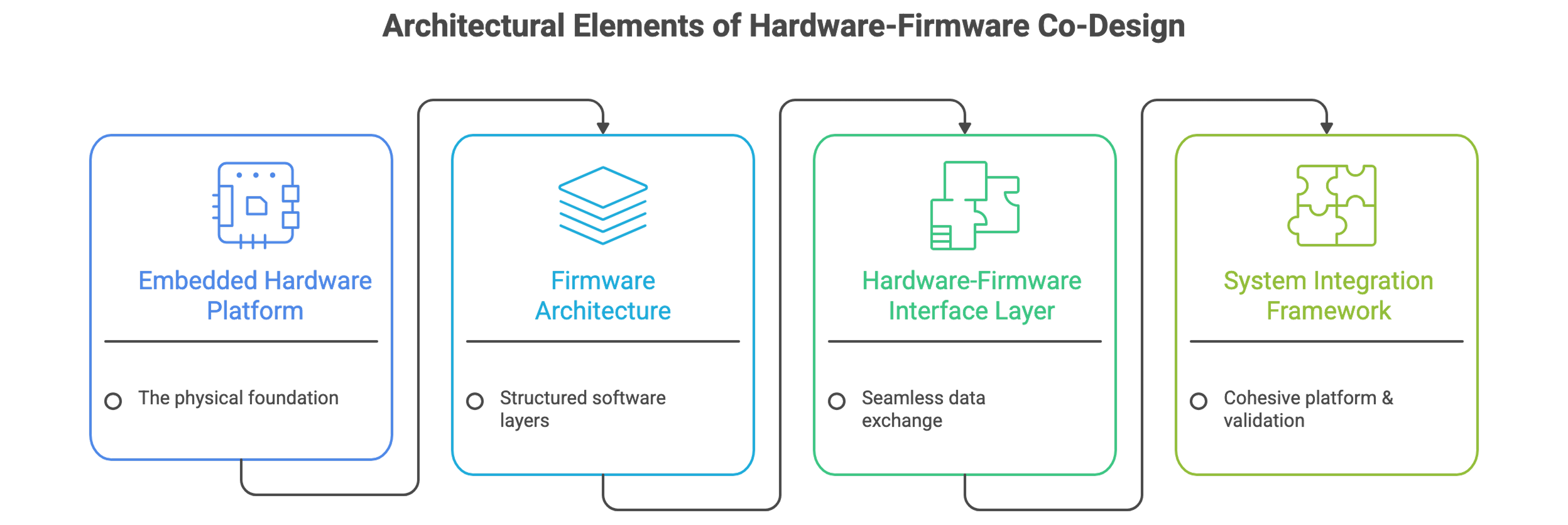
1. Embedded Hardware Platform
The hardware platform forms the physical foundation of the embedded system. It includes processors, memory modules, communication interfaces, and peripheral components that enable system functionality.
When designing embedded hardware, engineers must carefully evaluate processing requirements, power consumption, and connectivity needs.
Important architectural considerations include:
- Processing capability selection
- Hardware resource allocation
- Peripheral integration
- Power management design
Selecting the right hardware platform ensures that the embedded system can support both current and future firmware capabilities.
2. Firmware Architecture
Firmware architecture defines how software components interact with hardware resources. A structured firmware design ensures maintainability, scalability, and efficient system operation.
Typical firmware layers include low-level drivers, hardware abstraction layers, middleware components, and application-level logic.
Important firmware architecture principles include:
- Modular firmware design
- Real-time operating system integration
- Device driver development
- Interrupt and task management
This layered approach helps create a flexible embedded solution that can adapt to changing system requirements.
3. Hardware-Firmware Interface Layer
The interface layer enables communication between hardware components and firmware modules. Proper interface design is essential to ensure accurate data exchange and system control.
Key interface mechanisms include register mapping, communication protocols, and interrupt management.
Important elements include:
- SPI / I2C / UART interfaces
- Memory-mapped peripherals
- Interrupt handling
- Data transfer mechanisms
A well-designed interface layer improves efficiency and supports a reliable embedded system solution.
4. System Integration Framework
System integration ensures that hardware components and firmware modules operate together as a cohesive platform. Integration frameworks include testing environments and validation tools that verify system functionality.
Critical integration capabilities include:
- System validation
- Debugging tools
- Testing frameworks
- Performance monitoring
These capabilities enable teams to identify integration issues early and ensure stable system performance.
The infographic below perfectly summarizes how these four elements must interlock to pull off a successful co-design workflow:
Design Workflow for Hardware-Firmware Co-Development
Effective co-design requires a structured development workflow that supports collaboration between hardware and firmware teams
Stage 1: System Requirement Definition
The development process begins with defining system requirements. Engineers analyze product functionality, performance targets, and environmental conditions.
Important considerations include:
- Functional requirements
- Performance constraints
- Power and thermal considerations
- Hardware capability planning
Clear requirement definition ensures that both hardware and firmware teams work toward a unified design goal.
Stage 2: Architecture Modeling
Once requirements are defined, engineers develop a system architecture that outlines how components interact.
Key architecture activities include:
- System block diagrams
- Hardware-software partitioning
- Interface definition
- Resource allocation
This stage provides the blueprint for designing embedded hardware and developing firmware simultaneously.
From Concept to Prototype: The Complete Embedded System Design Process
Stage 3: Parallel Hardware and Firmware Development
During this phase, hardware and firmware teams work in parallel to implement system functionality.
Important development activities include:
- PCB design and component integration
- Firmware development and driver implementation
- Simulation and emulation tools
- Early prototype testing
Parallel development significantly accelerates the delivery of a fully functional embedded solution.
Stage 4: Integration and Validation
The final stage focuses on integrating hardware and firmware components and verifying system performance.
Key validation tasks include:
- Hardware-firmware integration testing
- Debugging and issue resolution
- Performance tuning
- System reliability verification
Comprehensive testing ensures that the final embedded system solution meets all functional and reliability requirements.
Challenges in Hardware-Firmware Co-Design
While hardware-firmware co-design provides significant advantages, it also introduces new engineering challenges. Coordinating development activities between hardware engineers and firmware developers requires careful planning and communication. Changes in hardware specifications during development can impact firmware implementation, requiring adjustments to maintain compatibility.
Another challenge is debugging issues that occur across hardware and firmware boundaries. Diagnosing whether a problem originates from hardware circuitry, firmware logic, or communication interfaces can be complex. Engineers must use specialized debugging tools and diagnostic methods to identify root causes.
In addition, embedded systems must balance performance, power efficiency, and cost constraints. Achieving this balance while maintaining system reliability requires deep technical expertise. Structured development workflows and collaborative engineering processes are essential for overcoming these challenges and delivering a robust embedded service for modern product development.
Engineering Strategies for Effective Hardware-Firmware Co-Design
Successful hardware-firmware co-design depends on practical engineering strategies that support efficient development and integration.
Strategy 1: Early Hardware-Software Partitioning
Determining how tasks are distributed between hardware and firmware is a critical design decision.
Key considerations include:
- Deciding which tasks belong to hardware or firmware
- Hardware acceleration opportunities
- System performance optimization
Early partitioning helps optimize the architecture of the final embedded solution.
Strategy 2: Use of Virtual Platforms and Simulation
Simulation tools enable firmware development before hardware prototypes are available.
Important advantages include:
- Hardware simulation environments
- Firmware development before hardware availability
- Faster debugging cycles
These tools accelerate development and reduce risks during system integration.
Strategy 3: Modular Firmware Development
Modular firmware architecture simplifies maintenance and scalability.
Important design practices include:
- Reusable drivers
- Hardware abstraction layers
- Scalable firmware architecture
This approach supports long-term maintainability of the embedded system solution.
Strategy 4: Iterative Prototyping and Testing
Prototyping allows engineers to validate design assumptions early in development.
Important techniques include:
- Rapid prototyping boards
- Continuous integration testing
- Performance validation
Iterative testing helps refine both hardware and firmware components.
Strategy 5: Cross-Team Collaboration
Hardware-firmware co-design relies heavily on collaboration between engineering teams.
Important collaboration practices include:
- Coordination between hardware and firmware teams
- Shared design tools and documentation
- Synchronized development cycles
This collaborative approach ensures efficient embedded service delivery for complex embedded platforms.
Strategy 4: Iterative Prototyping and Testing
Prototyping allows engineers to validate design assumptions early in development.
Important techniques include:
- Rapid prototyping boards
- Continuous integration testing
- Performance validation
Iterative testing helps refine both hardware and firmware components.
Enabling Hardware-Firmware Co-Design with Embedded Engineering Expertise
Developing complex embedded products requires deep expertise in hardware design, firmware development, and system integration. Organizations must adopt engineering practices that enable efficient collaboration between hardware and firmware teams while ensuring reliable product performance.
Tessolve provides comprehensive engineering capabilities that support hardware-firmware co-design across a wide range of embedded applications. With strong experience in designing embedded hardware, firmware development, and system architecture design, Tessolve helps organizations build optimized embedded platforms tailored to their product requirements.
Through integrated engineering methodologies, Tessolve delivers reliable embedded service offerings that include hardware-firmware integration, system validation, and performance optimization. These capabilities enable organizations to develop advanced embedded system solution frameworks that support innovation across automotive electronics, connected devices, and intelligent systems.
Accelerating Embedded Product Development with Integrated Engineering
Modern embedded products must be developed quickly while maintaining high levels of performance and reliability. Integrated engineering approaches that combine hardware design and firmware development are essential for meeting these demands. By aligning designing embedded hardware with firmware implementation, organizations can reduce development risks and create more efficient product architectures.
Scalable system architectures also play an important role in supporting future product expansion. As embedded systems become more intelligent and connected, development teams must design flexible platforms that support new features and evolving technologies. Hardware-firmware co-design provides the framework for achieving these goals while delivering high-quality embedded service capabilities.
FAQs
1. What is hardware-firmware co-design in embedded systems?
Hardware-firmware co-design is a development approach where hardware architecture and embedded firmware are designed simultaneously. Instead of following a sequential workflow, engineers collaborate early to optimize system functionality, performance, and resource utilization. This approach improves development efficiency and helps deliver a reliable embedded system solution with fewer integration challenges.
2. How does hardware-firmware co-design accelerate product development?
Hardware-firmware co-design allows hardware engineers and firmware developers to work in parallel during product development. Early collaboration helps detect design issues sooner, reduces integration delays, and minimizes redesign cycles. As a result, organizations can shorten development timelines and launch products faster while maintaining high system performance and reliability.
3. Why is collaboration between hardware and firmware teams important?
Close collaboration ensures that both hardware architecture and firmware functionality align with system requirements. When engineers communicate early in the design phase, they can make informed decisions about resource allocation, interface design, and performance optimization. This cooperation helps create a balanced and efficient embedded solution.
4. What role does firmware architecture play in hardware-firmware co-design?
Firmware architecture defines how software interacts with hardware components. It includes device drivers, hardware abstraction layers, middleware, and application logic. A well-structured firmware architecture enables efficient communication with hardware, supports scalability, and ensures that the embedded system solution operates reliably under different operating conditions.
5. What challenges can arise during hardware-firmware co-design?
Challenges may include coordinating hardware and firmware teams, managing evolving hardware specifications, and debugging issues that span both hardware and firmware layers. Engineers must also balance performance, power efficiency, and cost constraints. Addressing these challenges requires structured development workflows and experienced embedded service capabilities.


