


As vehicles evolve into highly connected, software-driven platforms, the complexity of automotive electronics continues to grow. Traditional Electronic Control Unit (ECU)-based architectures are increasingly unable to support the rising demand for faster data processing, seamless connectivity, and scalable system integration. This has led to the emergence of zonal architecture, a modern design approach that simplifies how electronic systems are structured and connected within vehicles.
Zonal architecture reorganizes vehicle electronics based on physical zones rather than functional domains, reducing wiring complexity and improving communication efficiency through centralized computing. Achieving this transformation requires robust embedded system design, scalable frameworks, and well-integrated development processes.
With the right embedded service capabilities and a flexible embedded system solution, automotive manufacturers can build smarter, more efficient, and future-ready vehicles.
Evolution from Domain-Based to Zonal Architecture
The transition to zonal architecture is driven by the limitations of traditional domain-based systems. In conventional architectures, each function is managed by a dedicated ECU, leading to an increase in hardware components and wiring complexity.
As vehicles incorporate features such as ADAS, electrification, and connectivity, ECU counts increase significantly, adding cost, weight, and integration complexity.
Zonal architecture addresses these challenges by reducing the number of ECUs and centralizing processing capabilities. Instead of multiple domain controllers, a few high-performance computing units manage vehicle operations, while zonal controllers handle localized tasks.
This evolution requires a strong focus on embedded system design to ensure that hardware and software components work together efficiently. By adopting an advanced embedded system approach, automotive manufacturers can create scalable architectures that support future innovations.
Key Components of Zonal Architecture
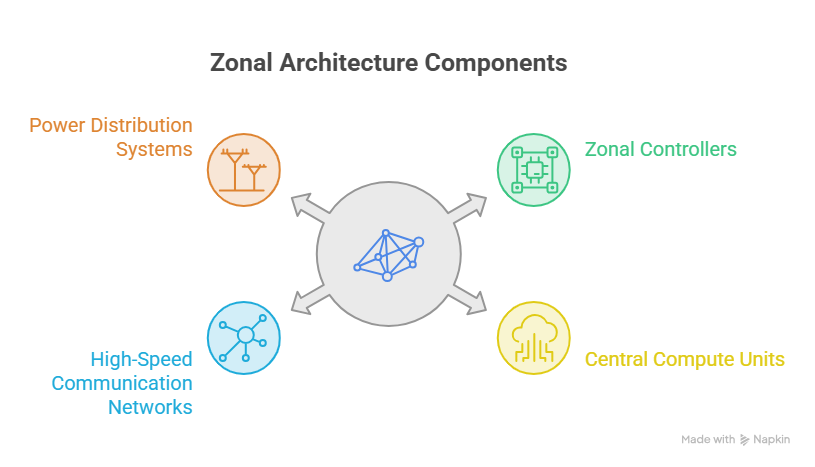
Zonal architecture consists of several interconnected components that enable efficient system operation and simplified connectivity.
1. Zonal Controllers
Zonal controllers are responsible for managing devices within a specific physical area of the vehicle. They collect data from sensors, control actuators, and communicate with central systems.
- Localized data processing
- Interface with sensors and actuators
- Reduced wiring requirements
- Efficient communication with central units
2. Central Compute Units
Central compute units serve as the brain of the vehicle, processing data from all zones and making system-level decisions.
- High-performance processing capabilities
- Centralized control of vehicle functions
- Support for software-defined features
- Integration of multiple subsystems
3. High-Speed Communication Networks
Efficient communication is essential for zonal architecture. High-speed networks enable seamless data transfer between zonal controllers and central units.
- Ethernet-based communication protocols
- Low-latency data transfer
- Scalable network design
- Real-time communication support
4. Power Distribution Systems
Power distribution is optimized in zonal architecture to reduce complexity and improve efficiency.
- Localized power management
- Reduced wiring harness length
- Improved energy efficiency
- Enhanced system reliability
How Zonal Architecture Simplifies Connectivity
Zonal architecture simplifies connectivity by reducing the number of direct connections between components. Instead of complex point-to-point wiring, systems are connected through structured communication networks.
This approach reduces the overall wiring length, which decreases vehicle weight and improves fuel or energy efficiency. It also simplifies manufacturing processes, as fewer connections need to be managed during assembly.
From a system perspective, zonal architecture enables better data management. Data is processed locally within zones before being transmitted to central systems, reducing network congestion and improving response times.
Implementing such systems requires a comprehensive embedded system solution that integrates hardware, firmware, and communication protocols. By leveraging embedded service expertise, engineers can ensure that connectivity remains efficient and reliable across all operating conditions.
Role of Embedded System Design in Zonal Architecture
Embedded system design plays a critical role in enabling zonal architecture. It ensures that all components, from sensors to central processors, work together seamlessly.
Engineers must design hardware platforms that support high-speed communication and real-time processing. Firmware must be optimized to handle data efficiently while maintaining system stability. Communication protocols must be carefully selected to ensure compatibility across different components.
Designing embedded system frameworks for zonal architecture also involves ensuring scalability. As new features are added, the system should be able to accommodate them without requiring major redesigns.
By adopting an advanced embedded system approach, automotive platforms can achieve higher levels of performance, flexibility, and reliability.
Zonal Architectures: Re-Engineering the Centralized Brain of the Car
Data Flow and Processing in Zonal Systems
In zonal architecture, data flow is structured to maximize efficiency and minimize latency. Sensors within each zone collect data, which is processed locally by zonal controllers. This processed data is then transmitted to central compute units for further analysis and decision-making.
This hierarchical data flow reduces the burden on central systems, improves response times, and enhances reliability through localized processing. Efficient communication protocols and optimized hardware-software integration are essential for real-time performance.
Security Considerations in Zonal Architecture
As vehicles become more connected, security becomes a critical concern. Zonal architecture introduces new security challenges due to centralized processing and increased data exchange.
Engineers must implement robust security measures to protect against potential threats. This includes secure communication protocols, encryption mechanisms, and intrusion detection systems.
Security must be integrated into the system from the early stages of development. A well-planned embedded design service approach ensures that security considerations are embedded within the architecture rather than added as an afterthought.
Scalability and Future Readiness
One of the key advantages of zonal architecture is its scalability. As automotive technologies evolve, vehicles must support new features and functionalities without requiring complete system redesigns.
Zonal architecture enables this by providing a flexible framework that can accommodate changes. New sensors, actuators, or software features can be integrated into existing zones without disrupting the overall system.
This scalability is essential for supporting software-defined vehicles and over-the-air updates. By leveraging a robust embedded system solution, manufacturers can ensure that their platforms remain adaptable to future requirements.
Engineering Challenges in Zonal Architecture
Despite its advantages, implementing zonal architecture presents several engineering challenges. Integrating multiple components into a unified system requires precise coordination and robust design methodologies.
Communication latency, data synchronization, and fault tolerance must be carefully managed to ensure system performance. Engineers must also address thermal and power management challenges associated with centralized processing.
These challenges highlight the importance of working with an experienced embedded system company that can provide the expertise needed to develop and implement complex automotive architectures.
Testing and Validation in Zonal Systems
Testing and validation are critical to ensuring the reliability of zonal architecture. Engineers must validate system performance under various conditions to ensure consistent operation.
This includes testing communication networks, verifying data flow, and evaluating system responses to different scenarios. Validation processes must also address security, reliability, and scalability requirements.
A structured embedded service approach ensures that testing is integrated into the development process, enabling early detection of issues and reducing development risks.
Software-Defined Vehicles and the Role of Zonal Architecture
The automotive industry is rapidly moving toward software-defined vehicles, where software capabilities define functionality, performance, and user experience. Zonal architecture plays a critical role in enabling this transformation by supporting centralized computing and scalable software deployment.
In traditional systems, updating or adding features often requires hardware changes or complex reconfiguration. With zonal architecture, software updates can be deployed more efficiently across centralized systems, enabling continuous feature enhancements and over-the-air updates. This shift allows manufacturers to extend vehicle lifecycles and introduce new capabilities without physical modifications.
From an engineering perspective, this requires a strong embedded system solution that integrates hardware flexibility with software scalability. A well-structured embedded system design ensures that zonal architectures can support evolving software requirements while maintaining system stability and performance.
Interoperability and Standardization in Zonal Automotive Systems
As zonal architecture becomes more widely adopted, interoperability and standardization are becoming increasingly important. Automotive systems must ensure seamless communication between components from different vendors while maintaining consistent performance and reliability.
Standardized communication protocols, such as automotive Ethernet, play a key role in enabling interoperability across zonal systems. These standards ensure that different components can communicate effectively, reducing integration complexity and improving system efficiency.
At the same time, adopting standardized frameworks simplifies development and validation processes. Engineering teams can focus on optimizing system performance rather than managing compatibility issues. This is where a structured embedded design service approach becomes essential, ensuring that all components align with industry standards.
By leveraging an advanced embedded system framework, manufacturers can build interoperable and future-ready automotive platforms that support seamless integration across diverse ecosystems.
How Tessolve Simplifies Zonal Architecture with Advanced Embedded Engineering
As automotive systems become more complex, the need for integrated and scalable embedded solutions continues to grow. Tessolve provides comprehensive engineering expertise to support the development of advanced automotive architectures, including zonal systems.
With strong capabilities in embedded system design, Tessolve enables the creation of high-performance platforms that simplify connectivity and enhance system efficiency. Our teams deliver end-to-end embedded service capabilities, covering system architecture, hardware design, firmware development, and validation.
As a trusted embedded system company, Tessolve offers scalable embedded system solution frameworks tailored to modern automotive requirements. Through advanced embedded design service approaches and expertise in advanced embedded system development, Tessolve helps organizations build reliable, future-ready automotive platforms.
FAQs
1. What is zonal architecture in automotive systems?
Zonal architecture is an approach where vehicle electronics are organized based on physical zones rather than functional domains. It reduces wiring complexity, improves communication efficiency, and supports centralized computing, enabling better scalability, faster data processing, and simplified system integration for modern software-defined vehicles and advanced automotive platforms.
2. How does zonal architecture simplify vehicle connectivity?
Zonal architecture simplifies connectivity by reducing point-to-point wiring and replacing it with structured communication networks. Local zonal controllers manage nearby components and communicate with central systems, minimizing wiring length, improving data flow efficiency, reducing system complexity, and enabling faster and more reliable communication across vehicle subsystems.
3. Why is embedded system design critical in zonal architecture?
Embedded system design ensures seamless integration between hardware, firmware, and communication protocols in zonal architectures. It enables real-time data processing, efficient system control, and reliable performance. Proper design helps manage complexity, ensures scalability, and supports the development of high-performance automotive systems with centralized and distributed processing capabilities.
4. What challenges are involved in implementing zonal architecture?
Implementing zonal architecture involves challenges such as system integration complexity, managing high-speed communication networks, ensuring data synchronization, and addressing security risks. Engineers must also handle power distribution, thermal management, and scalability requirements, making structured development processes and strong engineering expertise essential for successful implementation in modern automotive systems.
5. How does Tessolve support zonal architecture development?
Tessolve supports zonal architecture development through comprehensive embedded engineering capabilities, including system architecture design, hardware development, firmware integration, and validation. With expertise in embedded system design and scalable solutions, Tessolve helps automotive manufacturers simplify connectivity, improve performance, and build future-ready vehicle platforms aligned with evolving industry requirements.


