

Vehicles today are evolving into highly connected, automated, and intelligent machines. This shift depends on how efficiently on-board components exchange data in safety-critical moments, from Adaptive Cruise Control (ACC) to Vehicle-to-Everything (V2X) communication and powertrain coordination. At the core of this evolution is embedded system design, which goes far beyond firmware to manage tight hardware-software interaction under strict timing rules.
Automotive environments demand hard real-time behavior where even microsecond delays can affect safety and performance. That’s why designing embedded system architectures for deterministic communication across ECUs is no longer optional but essential. Engineers increasingly rely on an advanced design solution mindset delivered by every capable embedded system company to ensure predictable data flow, reliability, and responsiveness in modern vehicle networks.
The Real-Time Imperative in Automotive Networks
Cars today contain dozens of ECUs managing everything from engine control to infotainment. These ECUs communicate over networks such as CAN (Controller Area Network), FlexRay, and increasingly Ethernet, depending on bandwidth and latency needs. Classic bus systems like CAN provide robustness at low cost, but newer domains like autonomous driving require high throughput and even stricter latency guarantees, pushing automotive designers to adopt Time-Sensitive Networking (TSN) over Ethernet. TSN extends Ethernet with scheduling and traffic prioritization mechanisms, delivering real-time performance expected in critical systems.
To leverage these capabilities, automotive embedded systems integrate sophisticated scheduling algorithms, queue-management techniques, and hardware acceleration, ensuring data flows exactly when needed. This level of determinism doesn’t happen by accident; it requires careful architectural planning and simulation during the earliest stages of development.
Key Principles in Automotive Embedded Network Design
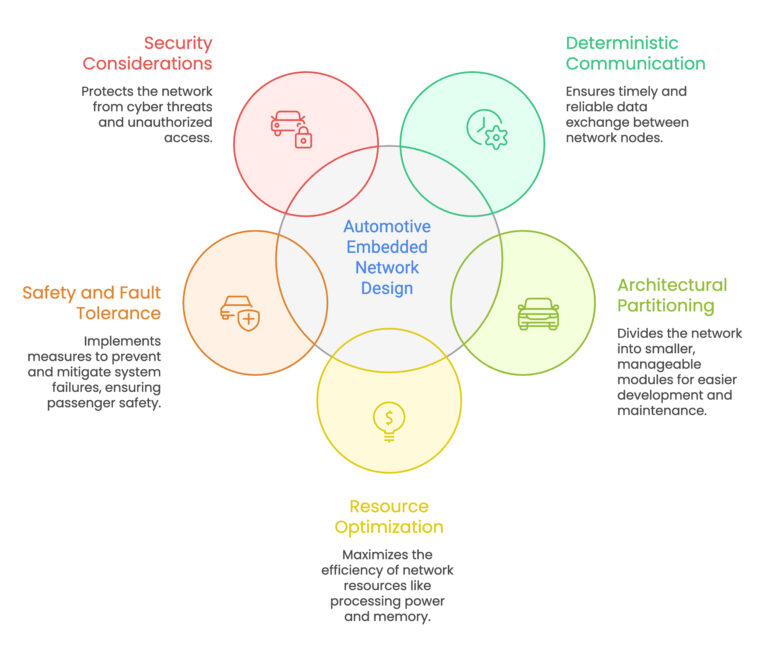
When we talk about designing for time-sensitive automotive networking, several guiding principles come into play:
1. Deterministic Communication
As vehicles introduce features like collision avoidance or lane-keeping assist, predictable timing becomes non-negotiable. Deterministic protocols like TSN and FlexRay guarantee time-bound message delivery, vital where microsecond-level delays can have real consequences. Prioritizing safety-critical traffic over less urgent data (like infotainment) ensures a timely response.
2. Architectural Partitioning
Modern automotive systems often adopt Domain-Oriented or Zonal architectures. Instead of distributing functions randomly across ECUs, related tasks are grouped logically (engine control, body electronics, safety systems), reducing communication overhead and simplifying latency control. This partitioning also allows greater reuse of software and hardware modules, accelerating time-to-market.
3. Resource Optimization
Real-time systems must make the most of available CPU, memory, and network bandwidth. This often involves lightweight operating systems, hardware offloads for network acceleration, and optimized task scheduling to ensure critical operations never wait behind less important work.
4. Safety and Fault Tolerance
Embedded automotive networks must gracefully handle unexpected failures. Standards like ISO 26262 guide functional safety, enabling redundancy, error detection, and recovery strategies. For example, if a sensor node fails, fallback mechanisms can ensure the vehicle continues to operate safely until repair.
5. Security Considerations
Time-sensitive networks aren’t just about speed; they must also be secure. With vehicles increasingly connected to the internet and external devices, protecting communication lanes from tampering is as important as ensuring timely message delivery. Security measures must be integrated into the network stack without introducing unacceptable latency.
Design Flow: From Concept to Deployment
A robust embedded automotive networking solution doesn’t begin with code. It starts with requirements, both functional and temporal. Here’s a simplified flow of how engineers approach such designs:
1. Requirement Analysis: Understand what functions the system must perform, what timing constraints exist, and what safety/security standards must be met.
2. System Architecture Definition: Choose communication protocols, define node responsibilities, and partition tasks. At this stage, hardware choices (microcontrollers, switches, transceivers) are selected based on throughput and timing capabilities.
3. Modeling & Simulation: Before writing production code, simulation tools model network traffic and compute latencies across scenarios. This step is crucial for identifying bottlenecks early.
4. Implementation & Integration: Developers write code for individual ECUs, configure network slices or time slots (in TSN), and integrate device drivers and middleware for protocol support.
5. Verification & Validation: Rigorous testing, both in simulation and on hardware, ensures the system meets timing, safety, and security requirements. Hardware-in-the-loop (HIL) and software-in-the-loop (SIL) testing platforms are commonly used here.
6. Deployment & Monitoring: Once in the vehicle, systems continue to be monitored, with over-the-air (OTA) updates addressing performance tweaks or security patches.
Throughout this flow, teams lean on best practices and advanced tools, a blend that turns design concepts into reliable, high-performance automotive systems.
Challenges and Emerging Trends
As vehicles evolve toward fully autonomous operation, the complexity of car networks intensifies. Future designs must accommodate massive data streams from LiDAR, radar, cameras, and numerous sensors, all while preserving safety and responsiveness. Architectures are shifting toward centralized computing domains with high-performance compute nodes managing diverse workloads, a departure from today’s distributed ECUs.
Software-defined vehicles (SDVs) and zonal architectures reduce wiring complexity by centralizing compute and relegating I/O to “smart zones”. These trends demand even more advanced network design thinking, blending real-time guarantees with flexibility and scalability.
Moreover, with electrification on the rise, integrated power-electronics control and battery management systems bring new real-time communication challenges, often at the intersection of safety, latency, and efficiency.
At every stage, automotive engineers still circle back to fundamental questions: Have we architected the system to handle time-critical events? Are our protocols configured for worst-case scenarios? What happens when a node fails, or a packet doesn’t arrive on time?
Answering these depends on expertise and proven approaches to embedded automotive networking.
Leveraging TERA for Time-Sensitive Networking (TSN) in Industrial Automation
Tessolve: Empowering Next-Gen Automotive Embedded Solutions
With over two decades of engineering excellence, Tessolve supports automotive innovators through robust embedded system design and end-to-end product engineering. Our teams specialize in designing embedded system architectures that combine hardware expertise, real-time firmware, connectivity stacks, and thorough validation aligned with ISO 26262 and TSN standards. As a trusted embedded system company, we work closely with global OEMs and Tier-1 suppliers to build deterministic vehicle networks, high-performance gateways, and OTA-ready platforms. Backed by advanced labs and certified processes, Tessolve delivers each advanced design solution with reliability, scalability, and speed. From ADAS communication to centralized compute platforms, we help transform complex automotive challenges into production-ready embedded innovations.
Frequently Asked Questions (FAQs)
1. Why is real-time communication critical in automotive networks?
Even microsecond delays between sensors and controllers can affect safety features like braking, steering, and collision avoidance.
2. Which protocols are used in time-sensitive automotive systems?
CAN, FlexRay, Automotive Ethernet, and TSN are widely used to ensure deterministic, prioritized, and reliable in-vehicle communication.
3. How is deterministic behavior maintained across ECUs?
Through careful architecture planning, task scheduling, protocol configuration, simulation, and rigorous hardware-in-the-loop validation testing.
4. What challenges come with zonal and centralized architectures?
Higher data loads, complex timing coordination, and the need for scalable, high-bandwidth, low-latency communication frameworks.
5. How does functional safety influence embedded network design?
Standards like ISO 26262 require redundancy, fault detection, and fail-safe communication paths to maintain operational safety.


