


In today’s world of safety-critical applications, especially in automotive, industrial, and medical devices, ensuring that embedded systems behave predictably under all conditions isn’t just good practice; it’s a requirement. Whether it’s a vehicle’s braking system or a hospital’s life-support controller, functional safety must be built into every layer of the design. That’s where standards like ISO 26262 and the concept of Automotive Safety Integrity Levels (ASILs) come in.
In this blog, we’ll walk through embedded system design for safety-critical environments, unpack how ASIL requirements shape system architecture, and explore practical strategies for building systems that not only work but also work safely.
What Is ASIL?
ASIL stands for Automotive Safety Integrity Level, a key part of the ISO 26262 standard for functional safety in road vehicles. ASIL classifies the risk associated with potential hazards and dictates how rigorous your design and validation activities must be to reduce those risks to an acceptable level.
There are four levels, ASIL A through ASIL D, with ASIL D representing the most stringent requirements. Achieving compliance involves systematic hazard analysis, risk assessment, and controlled development processes that span hardware, software, and system interactions.
Why ASIL Matters in Embedded Systems
When you are designing embedded system architectures for safety-critical applications, you’re not just writing code or assembling hardware; you’re crafting systems that might, literally, mean the difference between life and death. A typical embedded controller for automotive braking, for example, must handle sensor data, compute control actions, and interact with actuators without failure. The cost of malfunction is too high to ignore.
ASIL compliance ensures your system:
- Identifies hazards early and categorizes them properly,
- Applies rigorous design and verification practices,
- Demonstrates traceability from requirements to implementation,
- Automatically handles faults and failsafe when unexpected conditions arise.
Principles of Functional Safety in Embedded Design
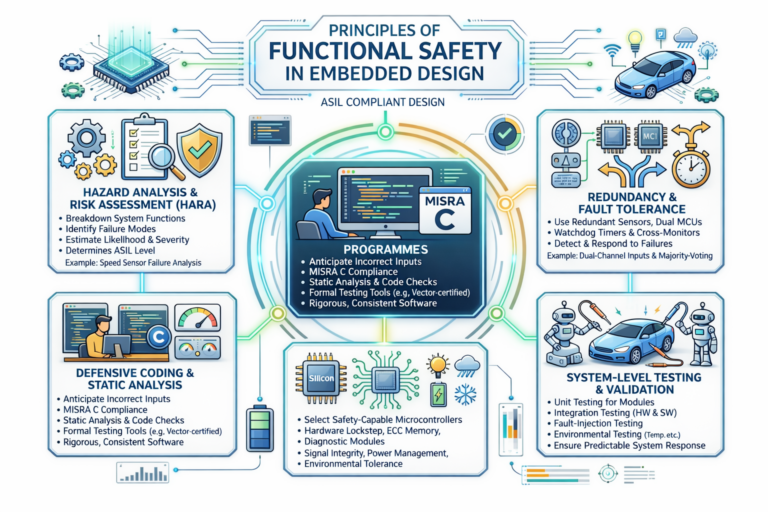
1. Hazard Analysis and Risk Assessment
Any ASIL-compliant design begins with thorough hazard and risk analysis. Teams break down system functions, identify how each function could fail, and estimate the likelihood and severity of those failures. This process helps determine which ASIL level applies and drives downstream design decisions.
For example, a sensor that measures speed for a safety feature might be classified at a higher ASIL level because its failure could lead to catastrophic outcomes. That, in turn, means more robust design and testing strategies.
2. Redundancy and Fault Tolerance
When designing for higher ASILs, redundancy is your friend. Redundant sensors, dual-microcontroller setups, and error-checking mechanisms such as watchdog timers or cross-monitors help the system detect failures and respond appropriately without bringing down the entire system.
For instance, dual-channel sensor inputs with majority-voting logic can help identify and isolate a faulty reading before it causes a hazardous decision, easing the path to ASIL D compliance.
3. Defensive Coding and Static Analysis
Software in safety-critical embedded systems should be defensive in nature. That means anticipating incorrect inputs, handling all possible states explicitly, and ensuring that code branches are tested and covered. Practices such as MISRA C compliance, static analysis, and automated code checks help catch issues early, which is key to achieving ASIL compliance.
Tools such as Vector-certified toolchains are often used to provide formalized software testing and verification capabilities aligned with automotive safety processes. The result? A more rigorous, consistent, and verifiable software base.
4. Robust Hardware Selection
Hardware plays a foundational role in meeting ASIL requirements. Selecting microcontrollers and processors that support safety features, such as hardware locksteps, ECC memory, and integrated diagnostic modules, gives your design the inherent stability needed for high-integrity applications.
Beyond chip selection, careful attention must be paid to signal integrity, power management, and environmental tolerance, all of which feed into safety assessments and fault management strategies.
5. System-Level Testing & Validation
Designing embedded systems compliant with ASIL standards isn’t complete without rigorous testing and validation. This means:
- Unit testing each software module,
- Integration testing combined hardware and software layers,
- Fault-injection testing to trigger and observe the system’s response,
- Environmental testing that simulates conditions like temperature extremes or vibration.
Comprehensive validation ensures that your system responds predictably even under adverse or unexpected conditions, a cornerstone of functional safety.
Tools and Methodologies to Support ASIL Compliance
Achieving ASIL compliance typically involves a mix of standards-driven processes and tool-supported verification practices. Some of the effective strategies teams use include:
- Model-based design: Allows early and continuous verification of system behavior,
- Automated Test Frameworks: Provide repeatable, verifiable test coverage,
- Hardware-in-the-Loop (HIL) testing: Validates real-time behavior under simulated conditions,
- Formal Methods: Mathematically verify certain safety properties.
Together, these help provide the evidence needed to support functional safety claims during certification audits.
From Concept to Prototype: The Complete Embedded System Design Process
Real-World Example: Automotive System Safety
Imagine you’re developing a control unit for a lane-keeping assistance feature. Your target ASIL level might be ASIL B or ASIL D, depending on the risk analysis. This drives decisions around redundant sensors, real-time operating systems with safety certification, and multiple verification passes across both software and hardware.
By integrating hardware diagnostics, robust error handling, and detailed traceability from requirements to test results, the system is positioned not just to work, but to be proven safe under the guidance of ISO 26262.
Tessolve: Your Embedded Safety Engineering Partner
At Tessolve, we live and breathe embedded engineering. With over two decades in the semiconductor and systems domain, we offer advanced design solution expertise that spans from concept to production, helping businesses turn complex safety-critical requirements into real-world products.
Our teams specialize in safety-oriented system design, including hardware and firmware for automotive-grade applications, supported by internationally recognized certifications, such as TÜV SÜD ISO 26262 functional safety process compliance.
We integrate stringent safety processes, robust validation labs, and global best practices to help clients meet ASIL requirements with confidence. Whether you need support for functional safety analysis, embedded firmware development, or automotive system-level testing, we’ve got you covered with proven expertise and end-to-end execution. Partner with Tessolve, a trusted embedded system company that delivers solutions engineered to meet today’s most demanding safety and performance standards.
Frequently Asked Questions (FAQs)
1. What does ASIL stand for in embedded systems?
ASIL defines risk levels under ISO 26262 to ensure functional safety in automotive embedded electronic systems.
2. Why is ASIL compliance critical in embedded system development?
It reduces safety risks by enforcing rigorous design, verification, and validation processes for safety-critical applications.
3. Which industries commonly require ASIL-compliant embedded systems?
Automotive, autonomous mobility, EVs, and advanced driver assistance systems heavily depend on ASIL-compliant embedded solutions.
4. How does redundancy help meet ASIL safety requirements?
Redundancy enables fault detection and safe system behavior by preventing single-point failures during operation.
5. Can ASIL requirements be addressed during early design stages?
Yes, early hazard analysis and architecture planning significantly simplify compliance and reduce costly redesigns later.


