

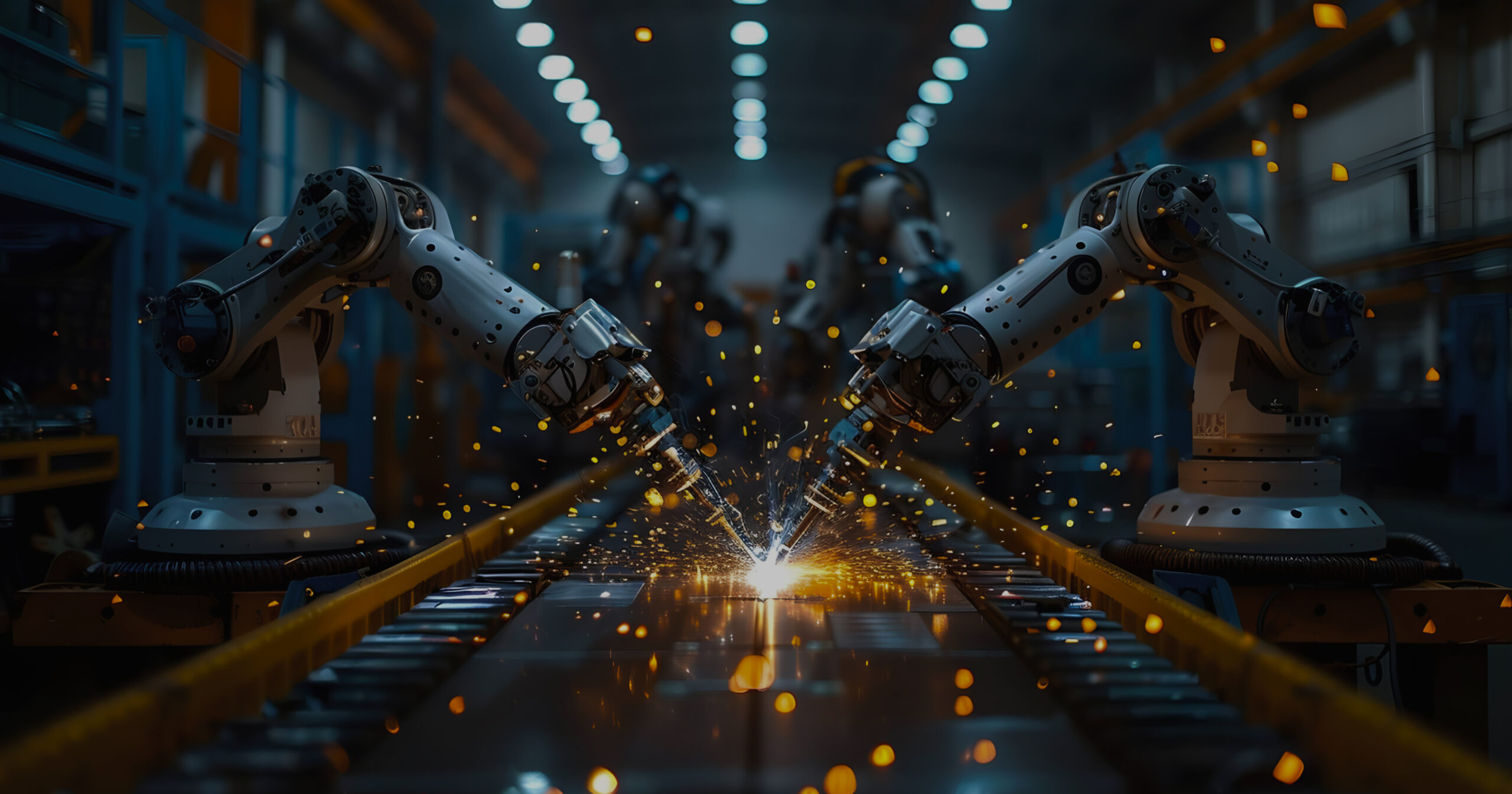
Industrial robots were once predictable, heavy, and programmed to repeat the same motion endlessly. But today’s landscape looks very different. Robots are now collaborative, intelligent, perception-driven, and capable of making real-time decisions. They adapt to dynamic environments, learn from data, and safely work alongside humans. At the core of this evolution lies embedded systems, the invisible intelligence that turns mechanical hardware into autonomous industrial performers.
From real-time control loops to vision processing, safety firmware, and edge inference, embedded systems are what make modern robotics capable, safe, and future-ready.
Why Embedded Systems Matter in Advanced Robotics
Embedded systems are no longer just controllers; they act as the robot’s brain and nervous system, enabling:
- Precise motion control
- Real-time decision-making
- Machine learning at the edge
- Safe human-robot collaboration
- Predictable system behavior in demanding industries
Whether it’s a robot welding a car panel or a mobile robot navigating a warehouse, the reliability and intelligence of embedded architectures define performance.
This is where thoughtful embedded system design becomes essential. Everything from processor selection, real-time operating system, sensing architecture, and communication stack must work together seamlessly. And as teams scale prototypes to production, they must also consider certification, ruggedization, and testing.
At the same time, resilience and safety must be planned early. Redundancies, watchdogs, and fail-safe logic are not optional; they’re mandatory, especially in environments where robots interact with people. A production-ready approach to embedded system design ensures safety, determinism, and scalability from day one.
Embedded System Architecture in Industrial Robotics
To better understand how embedded systems function inside next-generation industrial robots, it helps to look beyond the mechanical components and see the electronics and computing backbone that drives them. The graphic below illustrates a real-world embedded control architecture, showing how processors, sensor interfaces, power circuits, and actuators work together to enable precise robotic motion and autonomous decision-making.
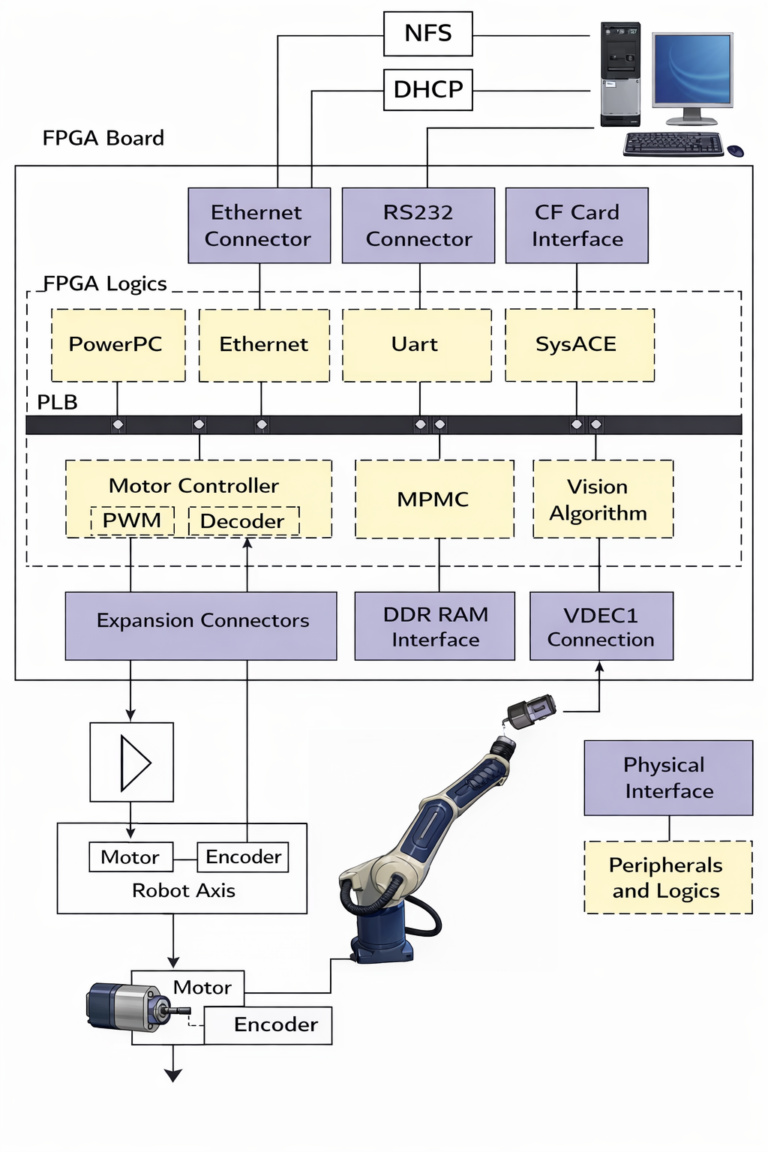
The Embedded Robot Control Architecture
Key Design Priorities in Next-Gen Industrial Robotics
Robots operating in smart factories must meet strict performance demands. Below are core principles shaping embedded robotics systems today:
1. Real-Time Performance and Deterministic Control
Motion planning, trajectory execution, and sensor feedback loops must operate within microsecond tolerances. Teams working on designing embedded system solutions must prioritize:
- Low-latency architecture
- Real-time OS scheduling
- Efficient fieldbus communication
- Hardware-software co-optimization
2. Edge AI and Intelligence
Robots now perform inference locally, including detecting objects, predicting failures, and adjusting behavior in real time. This requires careful designing embedded system strategies around:
- DSPs, GPUs, and NPUs
- Firmware optimization
- Power and thermal budgets
3. Sensor Fusion and Environment Awareness
Industrial robots rarely rely on a single sensor. They process IMU, camera, LiDAR, force, and proximity inputs simultaneously. Sensor fusion modules make perception faster and more reliable.
4. Safety and Cybersecurity by Default
Secure boot, signed firmware, OTA update security, and runtime attestation are now standard, especially with cloud-connected robotics.
Embedded System Patterns Common in Robotics
To meet industrial demands, most robotics platforms adopt architecture strategies such as:
- Modular control stacks for motion, safety, sensing, and vision
- FPGA-accelerated loops for deterministic response
- RTOS-enabled motor and actuator boards
- TSN (Time-Sensitive Networking) for predictable data transport
These approaches reflect the qualities of an advanced design solution, built with foresight, robustness, and scalability.
The same mindset applies when implementing robotic perception, AGV localization, or ML-based inspection. A strong advanced design solution must balance compute capability with power constraints, thermal efficiency, and longevity.
Real-World Robotics Applications Using Embedded Systems
Where are these advancements showing impact? Nearly everywhere:
- Collaborative cobots: Safe, force-feedback robots working alongside humans.
- Smart manufacturing: Automated welding, assembly, and handling systems.
- Autonomous material movement: AMRs and AGVs navigating complex paths.
- Vision-based quality inspection: On-device AI detecting micro-defects instantly.
- Adaptive assembly cells: Robots responding to variable components and workflow changes.
Behind every one of these breakthroughs is expertise, often provided by a specialized embedded system company capable of delivering integration, firmware development, validation, and scaling.
Manufacturers increasingly rely on an experienced embedded system company to bridge innovation with reliability, compliance, and manufacturability.
Checklist for Teams Building Robotics Systems
Before scaling development, robotics teams should evaluate:
- Defined latency and control budgets
- Built-in telemetry and debug modes
- OTA firmware update strategy
- EMI/thermal/vibration test plans
- Hardware-software co-design alignment
Following these principles helps accelerate development while reducing integration bottlenecks later.
Tessolve: Accelerating Embedded Innovation in Robotics
At Tessolve, we help robotics teams build reliable, intelligent systems that scale. With deep expertise in silicon engineering, embedded software development, PCB and system design, and post-silicon validation, we support customers from concept to full product deployment.
Our engineering labs span RF, mixed-signal testing, advanced ATE environments, and compliance workflows, ensuring every solution meets industrial and safety requirements. Whether teams need firmware optimization, processor selection guidance, reliable testing, or end-to-end development support, our multidisciplinary engineering model ensures speed, collaboration, and production-grade quality.
We don’t just engineer embedded robotics systems; we help transform them into market-ready innovations with resilience, intelligence, and performance built in.
Frequently Asked Questions (FAQs)
1. What is the role of embedded systems in industrial robots?
Embedded systems control sensors, motors, processing, and communication, enabling robots to execute tasks with precision, speed, and automation.
2. Which processors are commonly used in industrial robotic embedded systems?
Most industrial robots use microcontrollers, ARM processors, DSPs, or real-time processors, depending on performance and control requirements.
3. Why is real-time processing important in robotics?
Real-time processing ensures accurate motion, safe operation, faster response time, and seamless coordination between sensors and actuators.
4. How do embedded systems support AI-driven robotics?
Embedded systems enable edge processing, sensor fusion, machine learning inference, and autonomous decision-making without depending solely on cloud systems.
5. Are embedded systems in robotics customizable?
Yes, embedded systems can be tailored based on application needs, safety requirements, control logic, and hardware constraints.


