

The automotive industry is undergoing a fundamental transformation. Vehicles are no longer just mechanical machines; they are becoming intelligent, software-driven systems. From driver assistance and infotainment to powertrain control and vehicle connectivity, embedded electronics now define the overall driving experience.
However, as vehicle functionality expands, traditional embedded architectures built around multiple independent ECUs are reaching their limits. Increasing complexity, rising costs, and integration challenges are pushing automakers to rethink how vehicle electronics are designed. Domain controllers are emerging as a powerful architectural shift that addresses these challenges while enabling future-ready automotive platforms.
At Tessolve, we support this evolution through an advanced design solution approach that helps automotive innovators build scalable, reliable, and software-defined embedded systems.
The Evolution of Automotive Embedded Architectures
For decades, automotive embedded systems followed a distributed design model. Each function inside a vehicle was managed by a separate electronic control unit, often developed in isolation. While this worked well for earlier generations of vehicles, modern requirements have exposed several inefficiencies.
As the number of ECUs increased, so did wiring complexity, system weight, and integration effort. Software updates became harder to manage, and validating interactions between systems turned into a major engineering challenge. This architecture also limited scalability, making it difficult to introduce new features without adding more hardware.
Domain controllers represent a shift away from fragmented designs toward centralized, coordinated control. By consolidating related functions into dedicated domains, automotive embedded architectures become cleaner, smarter, and more adaptable to future demands.
How Domain Controllers Are Reshaping Automotive Embedded Architectures
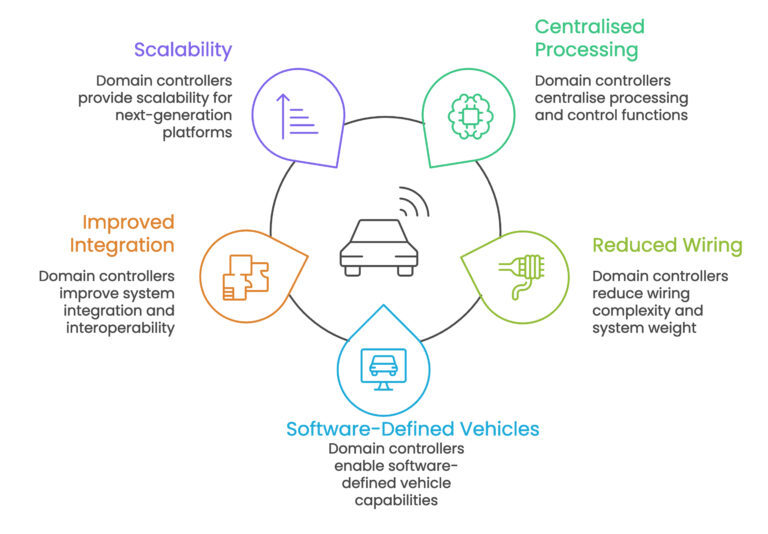
Domain controllers are not just replacing ECUs; they are redefining how automotive embedded systems are designed, developed, and validated. This transformation touches every layer of the architecture, from hardware design to software deployment.
Below are the key ways domain controllers are reshaping modern automotive embedded platforms.
1. Centralised Processing and Control
Domain controllers consolidate computing resources by managing multiple related functions within a single embedded platform. Instead of spreading processing power across numerous ECUs, control is centralized at the domain level.
Key impacts include:
- Reduced redundancy in hardware components
- Improved coordination between related vehicle functions
- Faster data processing and response times
- Simplified system architecture and maintenance
2. Reduced Wiring Complexity and System Weight
One of the most visible changes enabled by domain controllers is a reduction in wiring harness complexity. Fewer ECUs mean fewer physical connections across the vehicle.
Benefits include:
- Lower vehicle weight
- Reduced manufacturing and assembly effort
- Improved reliability due to fewer failure points
- Easier diagnostics and servicing
3. Software-Defined Vehicle Capabilities
Domain controllers enable a software-first approach to vehicle development. Features that once required hardware changes can now be delivered through software updates.
This allows automakers to:
- Deploy over-the-air software updates
- Add new features post-production
- Improve cybersecurity and system monitoring
- Extend vehicle lifespan through continuous enhancements
As an embedded system company, Tessolve helps integrate embedded software frameworks that support these software-defined capabilities.
4. Improved System Integration and Interoperability
With centralized domain control, subsystems no longer operate in isolation. Domain controllers enable seamless communication across sensors, actuators, and software layers.
Key advantages include:
- Better data sharing across domains
- Enhanced sensor fusion and decision-making
- Optimized power and energy management
- Improved real-time system coordination
5. Scalability for Next-Generation Automotive Platforms
Domain controllers provide a scalable foundation for future automotive innovation. New functionalities can be introduced by updating software or expanding domain capabilities rather than redesigning entire architectures.
This scalability supports:
- Advanced driver assistance systems
- Connected and autonomous vehicle functions
- Electrification and energy optimization
- Evolving regulatory and safety requirements
Embedded Software and Safety in Domain Controller Architectures
Centralizing control in vehicles makes embedded software reliability and functional safety more critical than ever. Domain controllers manage multiple vehicle functions simultaneously while complying with strict automotive safety and performance standards.
The embedded software within these platforms handles real-time task scheduling, communication between software components, fault detection, and secure data exchange. Because a single issue can affect multiple systems simultaneously, thorough validation and testing are essential.
Through its embedded solution capabilities, Tessolve supports automotive engineering teams with embedded software integration, system-level validation, and safety-driven engineering practices. This ensures domain controller platforms operate reliably, respond predictably under real-world conditions, and meet the safety expectations of modern, software-defined vehicles.
How Automotive Embedded Systems Are Transforming In-Vehicle Infotainment
Why Tessolve Is Enabling the Future of Automotive Domain Controllers
Tessolve plays a critical role in helping automotive companies transition to domain controller-based architectures. Our engineering teams bring deep expertise across embedded hardware, software, and system validation, ensuring seamless integration across complex automotive platforms. We innovate and develop critical automotive electronics solutions, including ECUs, ADAS, Body Electronics, and Infotainment.
With our advanced design solution approach, we support the entire development lifecycle, from architectural planning and embedded software enablement to system-level testing and performance optimization. This end-to-end capability helps reduce risk, improve quality, and accelerate time to market.
As a trusted embedded system company, Tessolve works closely with automotive OEMs and technology providers to build scalable, safe, and future-ready domain controller platforms that meet evolving industry demands.
Frequently Asked Questions (FAQs)
1. What is a domain controller in automotive embedded systems?
A domain controller is a centralized embedded computing unit that manages multiple related vehicle functions within a specific domain, reducing reliance on multiple independent ECUs.
2. How do domain controllers improve automotive system scalability?
They allow new features to be added through software updates or modular expansion without requiring a redesign of the entire embedded architecture.
3. Are domain controllers essential for software-defined vehicles?
Yes. Domain controllers provide the centralized computing and software infrastructure required for software-defined vehicle platforms.
4. Do domain controllers increase safety risks due to centralization?
While centralization increases responsibility, proper safety mechanisms, redundancy, and validation significantly reduce overall system risk.
5. How does Tessolve support automotive domain controller development?
Tessolve provides architecture design support, embedded software integration, validation, and performance optimization through its embedded and advanced design solutions.


