


Autonomous vehicles (AVs) are no longer a distant vision; they are steadily transforming the way we move, commute, and think about mobility. From driverless taxis to advanced driver-assistance systems (ADAS), the technology powering these innovations relies on sophisticated computing rather than traditional mechanical control. At the heart of this evolution lies the embedded system solution, which integrates sensors, processors, and algorithms to interpret complex road scenarios and make real-time driving decisions.
Designing such systems is highly challenging, as they must process massive streams of data, interact seamlessly with AI models, and meet rigorous safety standards to protect both passengers and pedestrians. In this blog, we will explore the architecture, safety frameworks, and validation processes that make embedded systems the true enablers of autonomy. Ensuring that the future of transportation is not only intelligent but also safe and dependable.
Role of Embedded Systems in Autonomous Vehicles
Embedded systems act as the brain of autonomous vehicles, managing perception, decision-making, and control. Their role can be understood across several key functions:
1. Core Definition & Importance
- An embedded system is a specialized computing unit designed for dedicated tasks with high reliability and efficiency.
- In AVs, embedded system design ensures real-time operations where every component works seamlessly together.
2. Sensor Data Processing
AVs rely on a network of sensors:
- LiDAR for depth perception.
- Radar for distance measurement.
- Cameras for object recognition.
Embedded systems process this data using AI algorithms to:
- Detect objects.
- Predict movement.
- Plan safe driving strategies.
Without this, critical functions like lane-keeping, adaptive cruise control, and emergency braking wouldn’t be possible.
3. Communication & Control
- A major role of designing embedded system frameworks is ensuring smooth communication between Electronic Control Units (ECUs).
- ECUs handle tasks like steering, acceleration, and braking.
- A reliable embedded system solution minimizes latency and ensures precision in execution.
4. Enabling Autonomy
- Beyond basic control, embedded systems synchronize perception, planning, and control into one framework.
- This transforms vehicles from passive machines into intelligent, decision-making agents on the road.
Ultimately, the role of embedded systems extends beyond basic control to enabling autonomy at higher levels. By combining perception, planning, and power into a synchronized framework, embedded systems transform vehicles from passive machines into intelligent, decision-making agents on the road.
Also Read: Enhancing Automotive IoT with TERA: The Future of Connected Vehicle Solutions
Architecture of Embedded Systems in Autonomous Vehicles
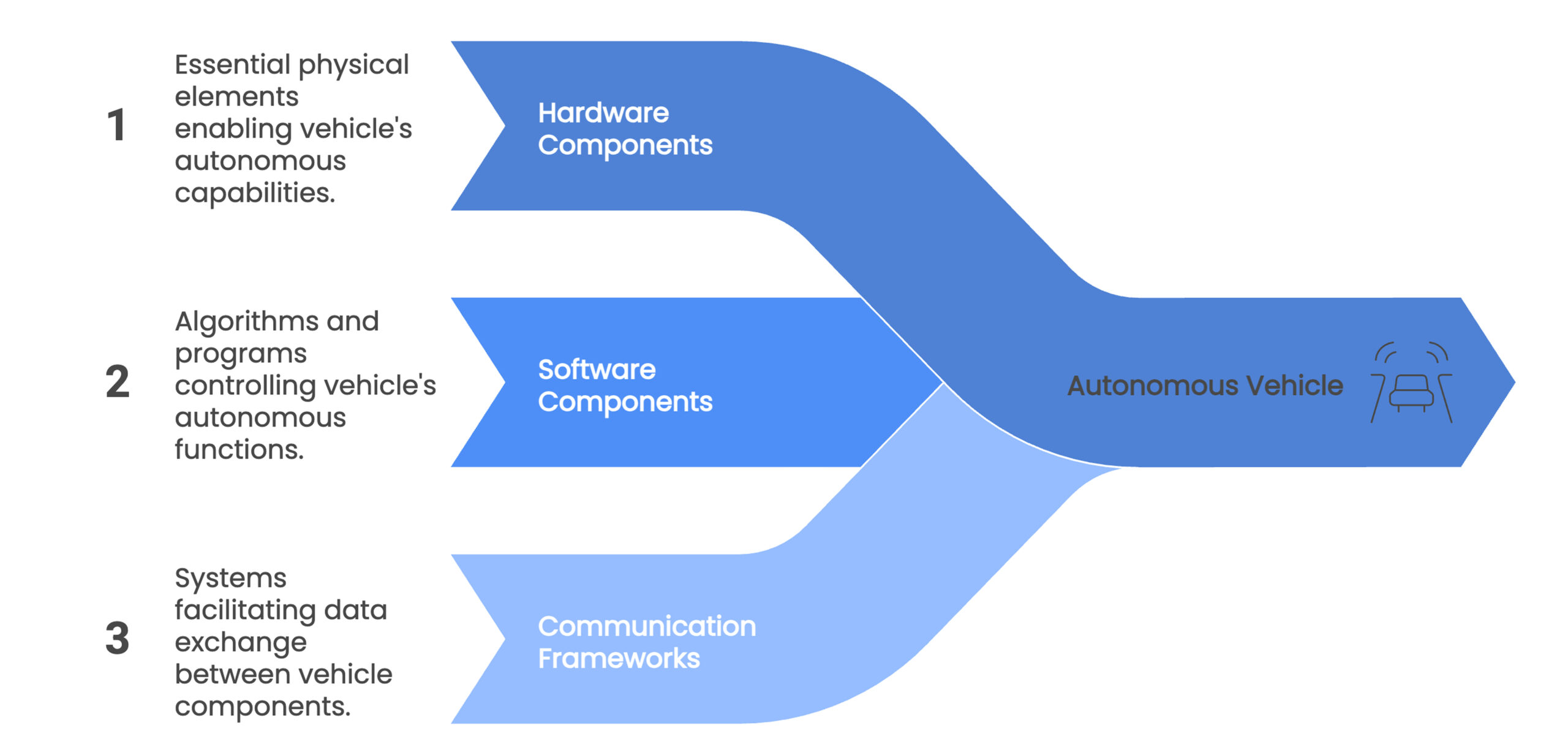
The architecture of embedded systems in autonomous vehicles is a sophisticated integration of hardware, software, and communication layers. Each component contributes to making AVs capable of perceiving their environment, interpreting information, and acting safely in real time. A well-thought-out embedded system design is therefore the backbone of autonomy.
1. Hardware Components
The hardware layer includes sensors, processing units, and actuators. Sensors such as LiDAR, radar, ultrasonic, and cameras provide continuous streams of data about road conditions, obstacles, and traffic. Processing units, ranging from traditional ECUs to high-performance GPUs and System-on-Chips (SoCs), analyze this data in milliseconds. Actuators then execute commands by controlling steering, braking, or acceleration. Designing embedded system hardware requires balancing high computational power with efficiency, since AVs demand rapid responses without draining excessive energy.
2. Software Components
The software layer is equally critical. Real-time operating systems (RTOS) manage the execution of safety-critical tasks with low latency. Middleware platforms such as ROS and AUTOSAR Adaptive provide standardization, making it easier to scale and integrate systems from multiple vendors. On top of these layers, AI and machine learning algorithms power functions like object detection, path planning, and predictive analytics. Every embedded system solution must ensure that these algorithms run reliably, even under complex road conditions.
3. Communication Frameworks
Effective communication is what ties the architecture together. Protocols like CAN bus, automotive Ethernet, and V2X (vehicle-to-everything) ensure seamless information flow between ECUs, sensors, and external infrastructure. Low latency is crucial; delays of even a few milliseconds can compromise safety. An optimized embedded system design reduces this risk by ensuring redundant pathways and error-handling mechanisms.
Safety in Embedded Systems for AVs
Safety is the foundation of autonomous vehicle (AV) development, and embedded systems are at the heart of ensuring it. Their safety role can be broken down into key aspects:
1. Functional Safety & Standards
- AVs must comply with ISO 26262, the global standard for automotive electronics.
- This ensures all components are designed, tested, and validated for reliability.
- Engineers face the challenge of designing embedded system frameworks that balance high performance with resilience against unexpected failures.
2. Cybersecurity Risks & Protection
- With V2X communication and cloud updates, AVs are increasingly vulnerable to hacking.
- An advanced embedded system must integrate:
- Strong encryption.
- Intrusion detection systems.
- Real-time monitoring.
These measures safeguard both passengers and external systems from cyber threats.
3. Redundancy & Fault Tolerance
- Redundant pathways, such as dual braking systems, prevent catastrophic failures.
- Fault-tolerant mechanisms ensure vehicles can continue safe operation even if some components fail.
- A reliable embedded system solution combines cost-efficiency with resilience.
4. Fail-Safe vs. Fail-Operational Approaches
- Fail-safe design: The system halts or switches to safe mode when faults are detected.
- Fail-operational design: The system continues functioning, which is crucial for AVs at highway speeds.
- Real-World Safety Practices
- Tesla employs multiple sensor redundancies.
- Waymo uses layered safety with real-time decision-making.
- GM Cruise focuses on rigorous testing aligned with global safety standards.
These examples prove that designing embedded system architectures with strong safety and security measures is non-negotiable. Without a secure and advanced embedded system, autonomous driving cannot gain regulatory approval or public trust.
Validation and Testing of Embedded Systems
Validation is one of the most critical phases in autonomous vehicle development. No matter how sophisticated the architecture, without rigorous testing, even the best embedded system solution cannot guarantee safety and reliability on the road. Validation ensures that the system performs consistently under real-world and simulated conditions, addressing both functional and safety requirements.
Several methods are used in testing:
- Hardware-in-the-loop (HIL): Simulates real driving scenarios by connecting actual hardware to virtual environments. This helps engineers verify that hardware behaves correctly before deploying it in vehicles.
- Software-in-the-loop (SIL): Focuses on testing software algorithms without involving hardware, speeding up development cycles.
- Model-in-the-loop (MIL): Uses mathematical models to validate system design concepts early in the lifecycle.
- Simulation and Digital Twins: These replicate millions of virtual miles in diverse road conditions, reducing reliance on costly on-road trials.
On-road testing still plays a vital role, as real-world data exposes challenges not always captured in simulations, such as unpredictable pedestrian behavior or sudden weather changes. However, combining simulation with physical testing provides the most comprehensive validation process.
Regulatory compliance adds another dimension. Standards such as ISO 26262 and UNECE regulations mandate specific testing protocols to certify vehicle safety. Meeting these requirements demands careful designing embedded system validation frameworks that integrate traceability, documentation, and automated test reporting.
As AVs advance, the scope of validation grows. Engineers must now test not only control systems but also AI-driven perception algorithms, making validation more complex. This is where an advanced embedded system plays a vital role; its architecture must allow testing at multiple layers, from low-level hardware responses to high-level decision-making algorithms.
Ultimately, a robust validation strategy ensures that every embedded system solution deployed in AVs functions flawlessly under both expected and unforeseen conditions. This rigorous process builds confidence among regulators, manufacturers, and the public, paving the way for safer autonomous mobility.
Key Challenges in Embedded Systems for AVs
Despite rapid progress, several hurdles remain in the development of embedded systems for autonomous vehicles:
1. Scalability of Processing Power
- AVs require enormous computational resources to process high volumes of sensor data in real time.
- Balancing designing embedded system hardware for both efficiency and performance is still a major challenge.
2. Power Efficiency vs. Performance
- High-performance processors often consume excessive energy, impacting battery life and overall efficiency.
- Engineers must optimize designs to deliver maximum compute capacity without compromising sustainability.
3. Safety Assurance
- Regulators demand near-zero tolerance for system failures before approving large-scale deployment.
- Proving reliability across millions of miles and unpredictable scenarios is a complex task for every embedded system solution.
Future Trends Shaping AV Embedded Systems
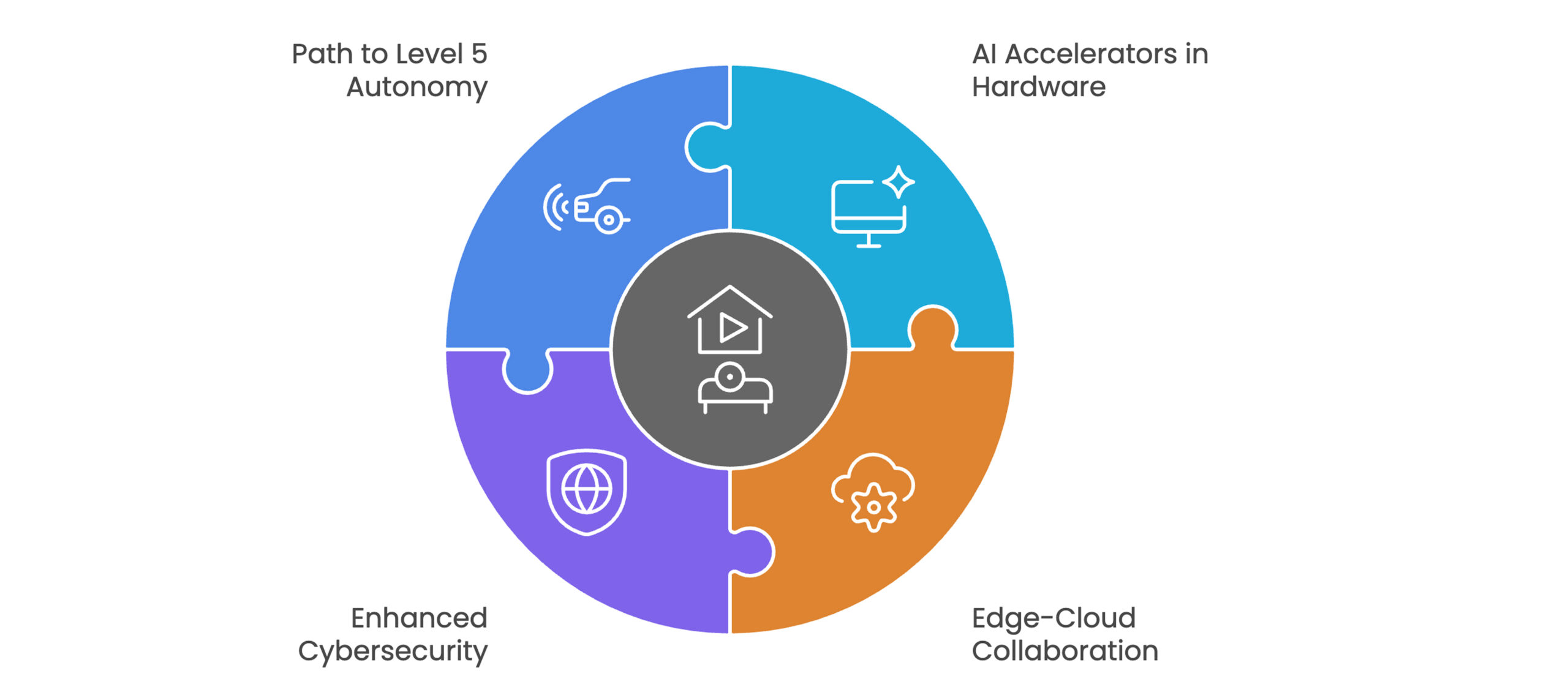
Looking ahead, innovations in technology are reshaping the direction of autonomous vehicle development:
AI Accelerators in Hardware
- Specialized chips for deep learning will enable faster perception and decision-making.
- These advances demand advanced embedded system architectures that can handle real-time AI computations.
Edge-Cloud Collaboration
- Vehicles will process critical data locally (edge) while sending non-urgent tasks to the cloud.
- This hybrid approach ensures low latency and greater efficiency.
Enhanced Cybersecurity
- With AVs constantly exchanging data, stronger encryption and intrusion detection will be built into future embedded system solution designs.
- Cybersecurity will no longer be an add-on but a core function of system architecture.
Path to Level 5 Autonomy
- Achieving full self-driving will require breakthroughs in AI algorithms, sensor fusion, and system validation.
- Trust in secure and advanced embedded system frameworks will be key to widespread adoption.
Learn: How Gateway Modules Unify Modern Car Systems
Why Choose Tessolve as Your Embedded Systems Partner
At Tessolve, every autonomous vehicle project deserves a partner who delivers not just components, but full lifecycle embedded system solutions, from concept through to manufacturing and validation. Our teams specialise in system architecture, embedded software, hardware design, FPGA/ASIC development, and automotive-specific testing.
Key highlights of what sets us apart:
- Automotive-Grade Compliance: Tessolve has achieved ISO 26262 Functional Safety Process Certification from TÜV SÜD, ensuring our embedded solutions meet rigorous safety standards.
- Comprehensive Capabilities: We offer turnkey services, from system design and prototyping to software/hardware integration, test labs, and production readiness.
- Focus on Validation & Reliability: With state-of-the-art automotive labs, System-Level Tests (SLT), and Environmental, Functional & Compliance testing, we ensure embedded systems deliver reliable performance in real-world scenarios.
If you are developing autonomous vehicle architectures, safety-critical features, or advanced driver-assistance systems, partnering with Tessolve means your embedded system is not just built; it’s engineered for safety, validation, and scalability every step of the way.


