


Modern vehicles are far more than mechanical machines; they are intelligent systems packed with dozens of Electronic Control Units (ECUs), sensors, and software-driven features. From Advanced Driver Assistance Systems (ADAS) and infotainment to powertrain and body electronics, these components must communicate quickly and reliably.
While the traditional Controller Area Network (CAN) protocol has served the automotive industry well for decades, growing data demands have led to the adoption of CAN FD (CAN with Flexible Data-Rate). Designed as an enhancement to classic CAN, CAN FD supports larger payloads and faster data transmission, making it ideal for today’s connected and software-defined vehicles.
Let’s explore how CAN FD works, its advantages, and where it’s making the biggest impact in automotive embedded networks.
What is CAN FD?
CAN FD (Controller Area Network with Flexible Data-Rate) is an improved version of the classic CAN communication protocol. It maintains compatibility with existing CAN networks while increasing both the data payload and communication speed.
Traditional CAN limits each frame to 8 bytes of data. CAN FD expands this capacity to 64 bytes per frame and allows higher data rates during the data transmission phase.
These improvements enable ECUs to exchange more information in less time, reducing network congestion and supporting increasingly sophisticated automotive functions.
For every modern embedded system company, CAN FD has become a key technology for developing high-performance automotive communication systems.
Why the Automotive Industry Needed CAN FD
As vehicles become more intelligent, the amount of data flowing across in-vehicle networks has grown dramatically.
Modern vehicles include:
- ADAS sensors
- Multiple cameras
- Radar systems
- Infotainment platforms
- Battery management systems
- Electric powertrain controllers
- Vehicle diagnostics
Classic CAN networks struggle to efficiently manage these growing communication requirements.
CAN FD addresses these limitations by increasing bandwidth without requiring an entirely new communication architecture.
Key Benefits of CAN FD
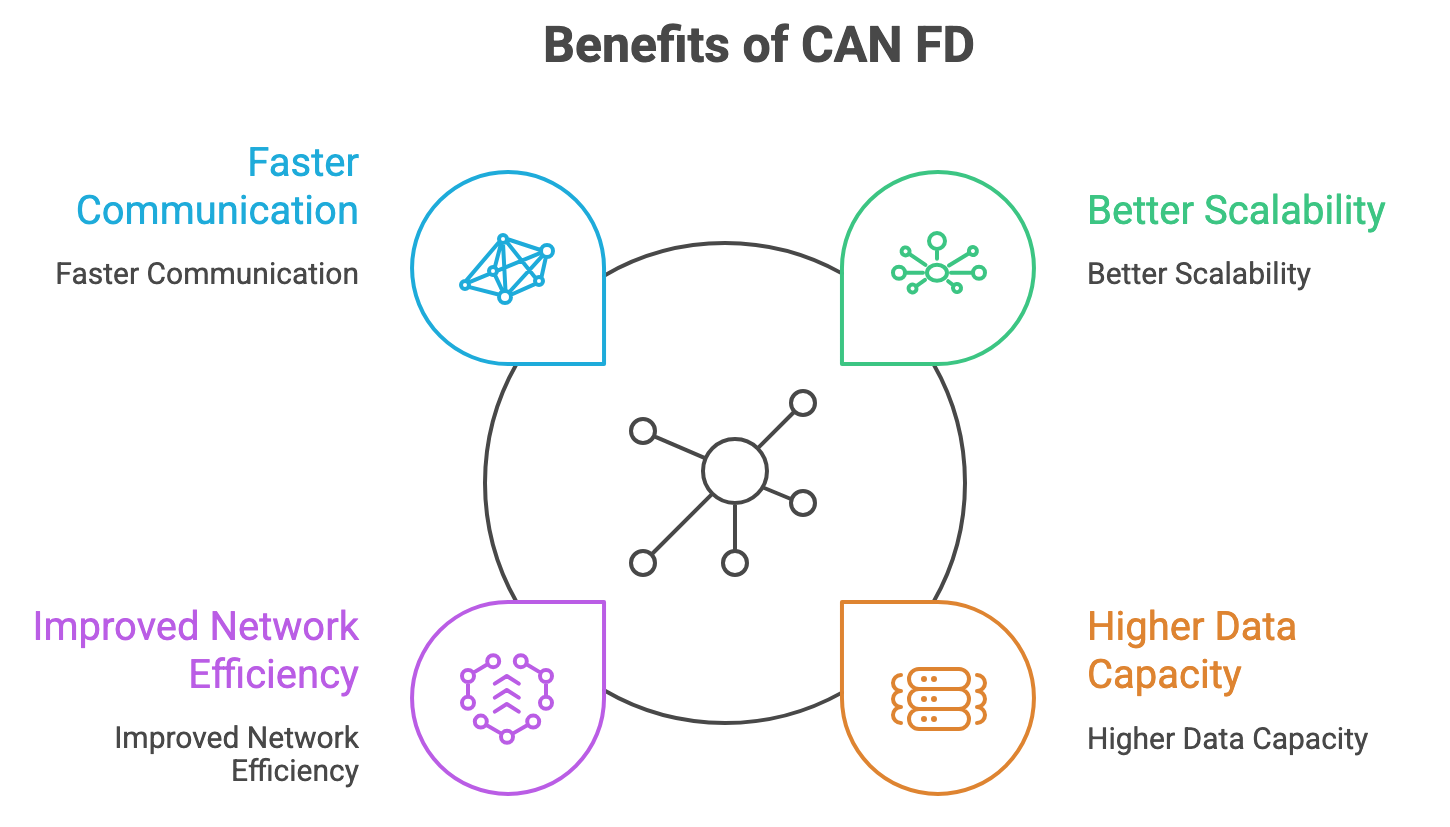
CAN FD addresses many of the limitations of the classic CAN protocol, making it better suited for today’s data-intensive automotive applications. Here are some of its key advantages:
1. Higher Data Capacity
One of the biggest improvements in CAN FD is its ability to transmit up to 64 bytes of data per frame, compared to the 8-byte limit of classic CAN. With more data carried in each message, fewer transmissions are needed, improving communication efficiency and reducing network traffic.
2. Faster Communication
CAN FD supports higher data transmission rates during the data phase while maintaining reliable message arbitration. This enables Electronic Control Units (ECUs) to exchange information much faster, helping critical automotive functions respond with minimal delay.
3. Improved Network Efficiency
Since each message can carry more information, the network spends less time transmitting multiple frames for the same amount of data. This reduces latency, optimizes bus utilization, and allows multiple vehicle systems to communicate more efficiently.
4. Better Scalability
As modern vehicles continue to incorporate more sensors, controllers, and intelligent features, CAN FD provides the flexibility to support these growing communication demands. Its backward compatibility with classic CAN also makes upgrading existing vehicle networks simpler and more cost-effective.
CAN FD in Automotive Embedded Systems
CAN FD plays an important role across numerous vehicle subsystems.
How Car Gateway Modules Are Driving the Future of Smart Cars
Advanced Driver Assistance Systems (ADAS)
ADAS features rely on continuous communication between cameras, radar, LiDAR, sensors, and processing units. CAN FD supports the fast data exchange needed for functions like lane-keeping, adaptive cruise control, parking assistance, and collision avoidance.
Electric Vehicles
Electric vehicles depend on seamless communication between battery management systems, motor controllers, charging modules, and thermal management units. CAN FD helps these components exchange critical data quickly for efficient vehicle operation.
Powertrain Control
Powertrain systems require accurate real-time communication for engine management, transmission control, and emissions monitoring. CAN FD enables faster data transfer, improving performance and system reliability.
Vehicle Diagnostics
CAN FD accelerates the transfer of fault codes, software updates, and diagnostic data, making vehicle maintenance and troubleshooting more efficient.
These applications highlight why robust embedded system design is essential for building reliable, high-performance automotive communication networks.
CAN FD and the Future of Connected Vehicles
As vehicles become increasingly software-defined, communication networks must support growing data requirements.
CAN FD complements technologies such as Automotive Ethernet, LIN, and FlexRay by providing a reliable solution for many real-time embedded applications.
Emerging automotive platforms also combine CAN FD with AI-enabled diagnostics, predictive maintenance, over-the-air (OTA) software updates, and intelligent vehicle health monitoring. These innovations improve performance while simplifying maintenance and reducing downtime.
For every forward-looking embedded system company, adopting CAN FD is becoming essential to support next-generation vehicle architectures.
Choosing the Right Embedded Development Partner
Successfully implementing CAN FD requires expertise across hardware, firmware, PCB design, validation, and automotive communication protocols.
A strong development partner helps optimize system performance while ensuring compliance with automotive quality standards and reducing development risks.
Whether developing ECUs, battery management systems, infotainment platforms, or ADAS controllers, comprehensive embedded system design and specialized embedded design services are key to delivering reliable, future-ready automotive solutions.
Why Tessolve is Your Trusted Partner for Automotive Embedded Engineering
At Tessolve, we combine deep semiconductor expertise with end-to-end embedded engineering to help customers develop high-performance automotive and embedded solutions.
Modern vehicles include:
- We provide embedded hardware and software development, BSP development, Linux and Android platform support, RTOS solutions, firmware development, device driver engineering, and system integration.
- Our capabilities include PCB design, high-speed hardware development, silicon validation, verification, and complete product engineering for complex embedded applications.
- We support automotive, aerospace, defence, industrial automation, consumer electronics, healthcare, communications, and IoT industries with scalable engineering solutions.
- Our integrated engineering approach helps customers accelerate development, improve product quality, and bring reliable embedded products to market faster.
FAQs
1. What is CAN FD in automotive networks?
CAN FD is an enhanced CAN protocol offering faster communication speeds and larger data payloads for modern automotive applications.
2. How is CAN FD different from classic CAN?
CAN FD supports up to 64-byte payloads and higher data rates, unlike classic CAN’s 8-byte message limit.
3. Where is CAN FD commonly used in vehicles?
CAN FD is widely used in ADAS, electric vehicles, powertrain systems, battery management, and vehicle diagnostics applications.
4. What are the main benefits of CAN FD?
CAN FD improves bandwidth, reduces network congestion, supports larger data transfers, and enhances communication efficiency between vehicle ECUs.
5. How does Tessolve support automotive embedded development?
Tessolve provides embedded engineering, hardware, software, validation, and system integration services for advanced automotive and embedded solutions.


