


The demand for real-time intelligence has never been greater. Whether it’s autonomous vehicles making split-second decisions, industrial robots responding to changing conditions, or medical devices monitoring patients continuously, waiting for data to travel to the cloud and back is no longer practical.
This is where edge intelligence is transforming embedded systems. By processing data directly on the device, organizations can significantly reduce latency, improve reliability, and enhance security. However, achieving this requires far more than deploying powerful processors; it demands thoughtful hardware and software optimization from the ground up.
Let’s explore how edge intelligence addresses embedded latency challenges and why it has become a cornerstone of modern embedded engineering.
Understanding Edge Intelligence
Edge intelligence refers to running data processing and AI workloads directly on embedded devices instead of relying entirely on cloud infrastructure.
Rather than transmitting every piece of sensor data to remote servers, edge-enabled systems analyze information locally and respond almost instantly. This approach is especially valuable in applications where even a few milliseconds of delay can affect safety, performance, or user experience.
From smart factories and autonomous systems to healthcare equipment and consumer electronics, edge computing enables devices to become faster, smarter, and more responsive.
Why Latency Matters in Embedded Systems
Latency is the delay between receiving input and producing an output. In embedded systems, this delay can determine whether a system performs effectively or fails to meet operational requirements.
Consider a few real-world examples:
- An autonomous vehicle detecting an obstacle
- Robotic arm adjusting its movement on a production line
- A medical monitoring device identifying abnormal vital signs
- An industrial controller responding to equipment failures
In each scenario, cloud-based processing may introduce unacceptable delays. Local processing ensures faster decision-making and greater operational reliability.
This is why every embedded system company developing next-generation products places strong emphasis on reducing latency throughout the design process.
What Causes Latency?
Several factors contribute to latency in embedded applications.
Network Dependency
Cloud communication introduces unavoidable transmission delays. Network congestion, bandwidth limitations, or temporary connectivity loss can further increase response times.
Cloud Connectivity Planning Considerations for IoT Edge Devices
Limited Hardware Resources
Embedded devices often operate within strict power, memory, and processing constraints. Without optimized hardware selection, computational workloads may overwhelm available resources.
Software Inefficiencies
Poor task scheduling, excessive background processes, or unoptimized code can significantly slow system performance.
Data Processing Bottlenecks
Processing large amounts of sensor data without intelligent filtering increases computational overhead and delays system responses. Identifying these bottlenecks early is a fundamental part of successful embedded system design.
Strategies for Solving Embedded Latency Challenges
Reducing latency requires optimization across the complete hardware-software ecosystem.
Process Data at the Edge
The most effective strategy is to move computation closer to the data source.
Instead of continuously transmitting sensor information to centralized servers, edge devices perform analytics locally and send only essential insights to the cloud. This dramatically reduces communication delays while improving system responsiveness.
Optimize Hardware ArchitectureOptimize Hardware Architecture
Selecting the right processor, memory architecture, and hardware accelerators plays a major role in minimizing latency.
Modern embedded platforms increasingly integrate AI accelerators, DSPs, GPUs, and dedicated neural processing units that execute machine learning workloads efficiently without consuming excessive power.
Build Efficient Software
Software optimization remains equally important.
Engineers improve latency by:
- Optimizing task scheduling
- Reducing unnecessary memory usage
- Streamlining communication protocols
- Minimizing interrupt handling delays
- Leveraging lightweight operating systems where appropriate
Well-optimized firmware enables hardware to perform at its full potential.
Use Real-Time Operating Systems
Many embedded applications rely on Real-Time Operating Systems (RTOS) that guarantee predictable task execution.
Unlike general-purpose operating systems, RTOS platforms prioritize critical processes, ensuring consistent response times even under heavy workloads.
The Role of AI at the Edge
Artificial iIntelligence is rapidly becoming a standard feature of embedded products.
Instead of running AI models exclusively in cloud environments, developers now deploy compact, optimized models directly on edge devices.
This enables applications such as:
- Predictive maintenance
- Machine vision
- Speech recognition
- Intelligent surveillance
- Autonomous navigation
- Industrial quality inspection
TinyML, model quantization, hardware-aware optimization, and neural network compression are making edge AI practical even on resource-constrained embedded devices.
For organizations delivering advanced embedded design services, combining AI with efficient edge processing has become a major competitive advantage.
Balancing Performance, Power, and Reliability
Reducing latency should never come at the expense of power efficiency or system reliability.
Embedded engineers constantly balance three critical objectives:
- Fast response times
- Low power consumption
- Reliable long-term operation
Achieving this balance requires close collaboration between hardware designers, firmware developers, PCB engineers, and validation teams throughout the product lifecycle.
A holistic engineering approach ensures that every system component contributes to overall performance rather than becoming a bottleneck.
Emerging Trends in Edge Embedded Systems
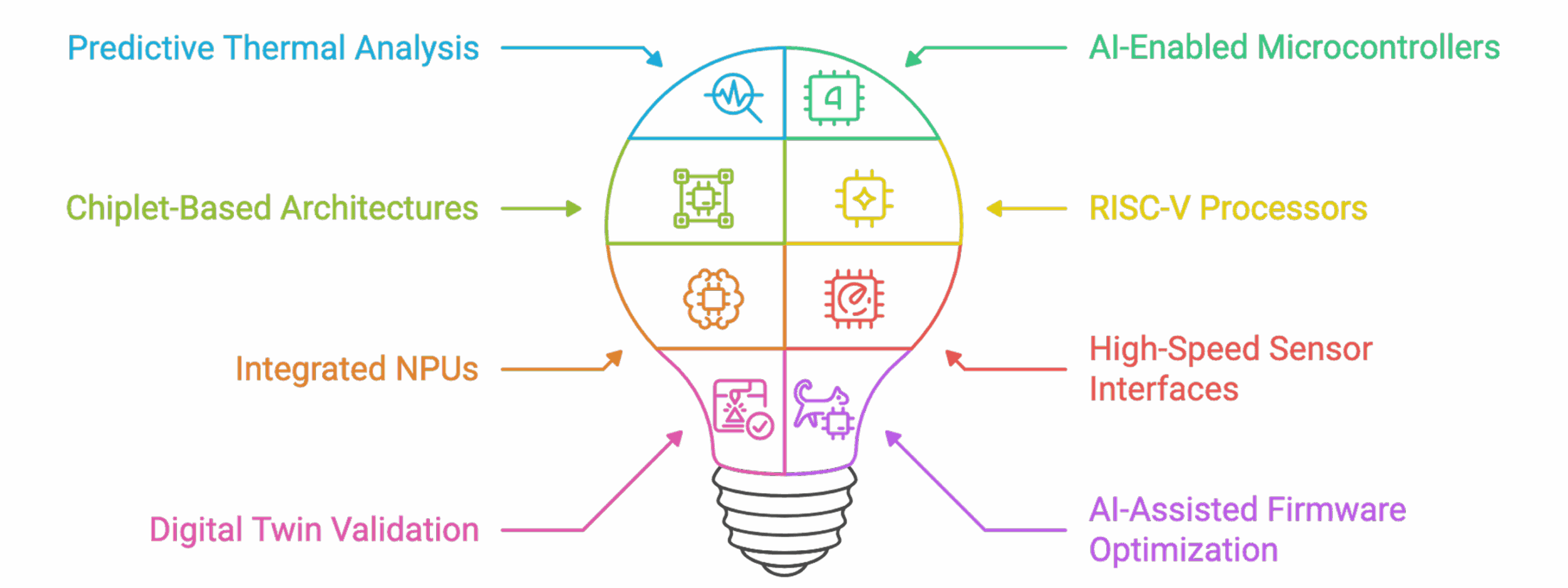
The evolution of edge intelligence continues to reshape embedded engineering.
Some important developments include:
- AI-enabled microcontrollers
- Chiplet-based embedded architectures
- RISC-V processors for flexible embedded computing
- Integrated NPUs for on-device inference
- High-speed sensor interfaces
- Digital twin-assisted system validation
- AI-assisted firmware optimization
- Predictive thermal and power analysis
These innovations enable embedded devices to process increasingly complex workloads while maintaining low latency and energy efficiency.
As demand grows for intelligent edge devices, every leading embedded system company must continually evolve its engineering capabilities to support these next-generation technologies.
Why Tessolve is Your Trusted Partner for Embedded Engineering
At Tessolve, we deliver end-to-end embedded engineering solutions backed by deep semiconductor expertise, helping customers build reliable, production-ready products.
- We provide embedded hardware and software development, BSP, Linux/Android platforms, RTOS, firmware, device drivers, and system integration.
- Our capabilities also include PCB design, high-speed hardware development, silicon validation, verification, and complete product engineering.
- We support automotive, industrial, consumer electronics, medical, communications, and IoT applications with scalable, high-performance embedded solutions.
- Our integrated engineering approach helps accelerate development, improve product quality, and speed up time-to-market.
FAQs
1. What is edge intelligence in embedded systems?
Edge intelligence processes data directly on embedded devices, enabling faster decisions, lower latency, and reduced dependence on cloud connectivity.
2. Why is low latency important for embedded applications?
Low latency ensures real-time responses, improving safety, reliability, and performance in automotive, industrial, healthcare, and IoT applications.
3. How does AI help reduce embedded system latency?
AI enables on-device processing, predictive analytics, and optimized decision-making, reducing response times without relying on remote cloud servers.
4. What technologies improve edge computing performance?
RTOS, AI accelerators, optimized firmware, efficient processors, and high-speed interfaces help improve edge computing performance and responsiveness.
5. How does Tessolve support embedded engineering projects?
Tessolve provides end-to-end embedded engineering, hardware, software, validation, and system integration services for high-performance embedded product development.


