


The Internet of Things (IoT) is transforming industries by connecting billions of devices that collect, process, and share data. However, powering these devices remains one of the biggest challenges. Batteries have a limited lifespan, require regular replacement, and contribute to maintenance costs and electronic waste, especially in large-scale deployments.
This is where Ambient IoT is changing the game. By combining ultra-low-power electronics with energy harvesting technologies, Ambient IoT devices can operate without traditional batteries. Instead, they capture energy from their surrounding environment, enabling sustainable, maintenance-free sensor networks.
Let’s explore how battery-free sensors work and why they represent the next evolution of embedded systems.
What is Ambient IoT?
Ambient IoT refers to connected devices that harvest energy from their surroundings to power sensing, computing, and wireless communication without traditional batteries.
These devices use sources like light, RF signals, heat, and vibration to operate efficiently with ultra-low-power components. As demand for sustainable IoT grows, Ambient IoT is becoming a key innovation area for every modern embedded system company.
Why Battery-Free Sensors Matter
Battery maintenance becomes increasingly difficult as IoT deployments grow from hundreds to thousands, or even millions, of connected devices.
Replacing batteries across smart factories, warehouses, hospitals, or agricultural fields can be expensive and time-consuming. Battery-free sensors offer several advantages:
- Lower maintenance costs
- Longer operational life
- Reduced electronic waste
- Improved sustainability
- Easier deployment in hard-to-reach locations
- Greater scalability
These benefits make Ambient IoT attractive across industrial, commercial, healthcare, and smart city applications.
How Energy Harvesting Works
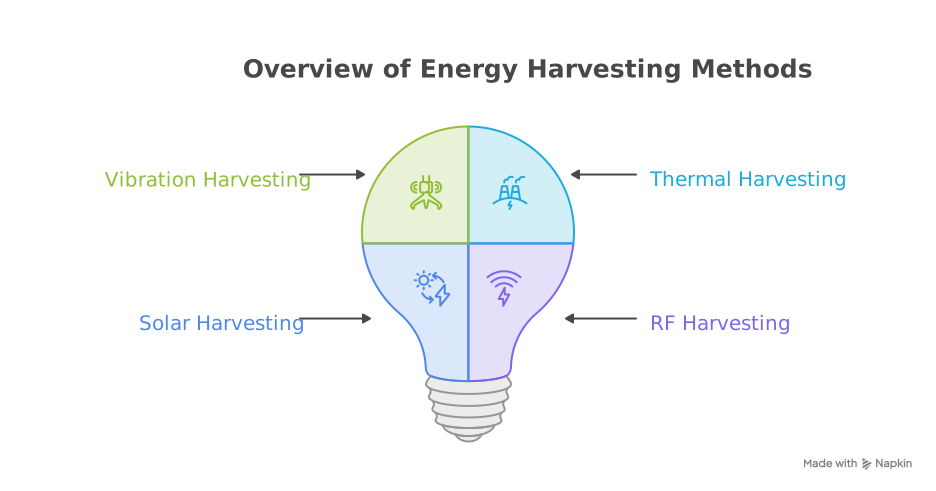
Energy harvesting captures small amounts of naturally available energy and converts it into electrical power for embedded devices.
Different applications use different harvesting methods depending on the available energy source.
Solar and Indoor Light Harvesting
Small photovoltaic cells convert natural or artificial light into electricity.
This is one of the most efficient approaches for indoor sensors such as occupancy monitors, asset trackers, and smart building devices.
RF Energy Harvesting
Wireless signals from Wi-Fi routers, cellular networks, RFID readers, and Bluetooth devices contain small amounts of usable energy.
Specialized circuits capture these signals to power ultra-low-power sensors.
Thermal Energy Harvesting
Temperature differences between two surfaces generate electrical energy using thermoelectric generators.
Industrial machinery and manufacturing equipment often provide ideal environments for thermal harvesting.
Vibration and Motion Harvesting
Piezoelectric materials convert mechanical movement into electricity.
This method works well for rotating machinery, transportation systems, bridges, and industrial equipment where continuous vibrations are available.
Designing Battery-Free Embedded Systems
Creating a battery-free device requires much more than simply adding an energy harvester.
Every hardware and software component must be optimized to consume extremely low power.
Ultra-Low-Power Hardware
Selecting energy-efficient microcontrollers, sensors, wireless modules, and memory devices is essential.
Modern embedded processors can remain in deep sleep modes while consuming only tiny amounts of energy before waking briefly to perform sensing and communication tasks.
Intelligent Power Management
Power management circuits determine how harvested energy is stored and distributed.
Small capacitors or rechargeable micro-storage devices temporarily accumulate harvested energy until sufficient power is available for operation.
Efficient Wireless Communication
Wireless transmission often consumes the most energy in embedded systems.
Protocols such as Bluetooth Low Energy (BLE), Zigbee, Thread, and other low-power communication technologies help minimize power consumption while maintaining reliable connectivity.
Optimizing these elements is a core objective of modern embedded system design, especially for energy-constrained IoT devices.
Low-Power SoC Chip Design: Strategies for Mobile and IoT Devices
Applications of Ambient IoT
Battery-free sensors are opening new possibilities across industries.
Some of the fastest-growing applications include:
- Smart factories monitoring equipment health
- Asset tracking in warehouses
- Environmental monitoring
- Smart agriculture
- Healthcare wearables
- Smart retail inventory systems
- Building automation
- Infrastructure monitoring
Because these sensors require minimal maintenance, organizations can deploy significantly larger networks while reducing long-term operational costs.
AI Makes Ambient IoT Smarter
Artificial intelligence is making battery-free IoT devices more efficient by enabling local data processing with minimal power consumption.
Using TinyML, embedded devices analyze data on-device instead of continuously sending it to the cloud. This supports applications like predictive maintenance, anomaly detection, and smart energy management while reducing network traffic and improving responsiveness.
Today, providers of advanced embedded design services are integrating TinyML, edge AI, and intelligent power optimization to build smarter Ambient IoT solutions.
Challenges in Battery-Free Sensor Design
Although Ambient IoT offers enormous potential, engineers still face several challenges.
Limited Energy Availability
Harvested energy varies depending on environmental conditions. Systems must continue operating efficiently even when energy sources fluctuate.
Energy Storage Optimization
Efficient storage components are essential for ensuring reliable operation during periods of limited harvested energy.
Miniaturization
Modern sensors must remain compact while integrating processors, communication modules, harvesting circuits, and storage elements into a small footprint.
Reliable Connectivity
Maintaining stable wireless communication using extremely limited energy requires careful protocol selection and optimized firmware.
Addressing these challenges demands expertise in both hardware and software, making embedded system company teams with multidisciplinary capabilities valuable partners for Ambient IoT development.
The Future of Ambient IoT
As semiconductor technologies continue advancing, Ambient IoT devices will become smaller, more intelligent, and even more energy-efficient.
Future innovations are expected to include AI-enabled sensor nodes, advanced ultra-low-power chipsets, multi-source energy harvesting, improved power management ICs, and highly efficient wireless connectivity. These developments will support widespread adoption across smart cities, industrial automation, healthcare, logistics, and consumer electronics.
As businesses embrace sustainable technologies, robust embedded system design and innovative embedded design services will play a critical role in enabling reliable, battery-free IoT ecosystems.
Why Tessolve is Your Trusted Partner for Embedded Engineering
At Tessolve, we help customers develop intelligent embedded products by combining semiconductor expertise with end-to-end product engineering capabilities.
- We provide embedded hardware and software development, BSP development, Linux and Android platform support, RTOS solutions, firmware development, device driver engineering, and system integration.
- Our capabilities extend to PCB design, high-speed hardware development, silicon validation, verification, and complete product engineering for seamless embedded solutions.
- We support automotive, aerospace, defence, industrial automation, healthcare, consumer electronics, communications, and IoT applications with scalable, high-performance engineering services.
- Our integrated engineering approach helps customers accelerate development, improve product quality, and bring innovative embedded products to market with confidence.
FAQs
1. What is Ambient IoT?
Ambient IoT uses energy harvested from the environment to power connected devices without relying on traditional batteries.
2. How do battery-free IoT sensors generate power?
They harvest energy from light, heat, vibration, motion, or radio frequency signals to operate efficiently.
3. What are the benefits of battery-free sensors?
They reduce maintenance costs, extend device lifespan, minimize electronic waste, and support sustainable, large-scale IoT deployments.
4. Which industries benefit most from Ambient IoT?
Manufacturing, healthcare, agriculture, logistics, smart buildings, and retail benefit from reliable, low-maintenance battery-free sensor networks.
5. How does Tessolve support Ambient IoT development?
Tessolve provides end-to-end embedded engineering, hardware, software, validation, and system integration for advanced IoT product development.


