

Electric vehicles are quickly becoming a key part of our world’s transportation scene. Governments are pushing for cleaner travel options, car companies are pouring money into electric tech, and more people are choosing EVs because they’re efficient and better for the environment. At the core of every electric car is its battery, which mainly decides how far you can go, how safe it is, and how well it lasts over time.
Because batteries operate under demanding electrical and thermal conditions, ensuring their safe and efficient operation is critical. Battery safety, energy efficiency, and lifecycle management are key factors that influence both vehicle reliability and user confidence. Even small variations in temperature, voltage, or current can affect battery performance and longevity.
This is where Battery Management Systems (BMS) play a vital role. A BMS functions as the intelligent control layer that continuously monitors battery behavior and regulates its operation. Modern BMS solutions rely heavily on embedded system design to process sensor data, run control algorithms, and coordinate communication between the battery pack and vehicle electronics.
Building a high-performance BMS, therefore, requires careful system architecture planning, seamless hardware–software integration, and an advanced design solution approach that ensures safety, accuracy, and reliability across the entire EV battery lifecycle.
Understanding the Role of Battery Management Systems in EV Architecture
A Battery Management System is responsible for monitoring and controlling the operation of battery packs in electric vehicles. EV batteries typically consist of hundreds or even thousands of individual cells grouped into modules. Each cell behaves slightly differently due to manufacturing variations and environmental conditions. Without proper monitoring, these variations can lead to uneven charging, overheating, or reduced battery efficiency.
The BMS addresses these challenges by performing several core functions. It monitors the voltage, current, and temperature of each battery cell while controlling the charging and discharging processes. It also regulates thermal conditions to prevent overheating and ensures that the battery operates within safe limits. In addition, the BMS communicates with the vehicle’s control systems, providing essential data about battery status and performance.
These operations must occur continuously and in real time, which is why reliable embedded system design is critical for modern BMS platforms. The system must collect data from sensors, process information through control algorithms, and trigger safety responses without delay. When designing embedded system architectures for EV batteries, engineers must carefully balance performance, accuracy, and system stability. A well-designed BMS ensures optimal battery efficiency, extends battery lifespan, and protects the vehicle from potential electrical faults.
Core Architecture of a Smart Battery Management System
A modern EV Battery Management System is built using several interconnected subsystems. Each component plays a specific role in monitoring battery conditions, processing data, and ensuring safe operation. These subsystems must work together seamlessly within a carefully planned architecture.
1. Battery Monitoring Unit
The battery monitoring unit is responsible for collecting real-time data from the battery cells and modules. It ensures that the system has accurate measurements of key parameters that determine battery health and safety.
Functions of the battery monitoring unit include monitoring cell voltage, measuring current flow, sensing temperature conditions, and collecting data for system analysis.
Important features include:
- High precision sensors
- Analog front-end circuits
- Data sampling accuracy
- Safety monitoring
Accurate data acquisition is essential because even small measurement errors can lead to incorrect battery control decisions.
2. Control and Processing Unit
The control and processing unit acts as the computational core of the Battery Management System. It uses microcontrollers or embedded processors to analyze sensor data and execute battery management algorithms.
This component plays a critical role in embedded system design, as it must manage several real-time processes simultaneously. The control unit calculates battery state parameters, identifies faults, and coordinates communication with other vehicle systems.
Key responsibilities include:
- Battery state estimation
- Fault detection
- System diagnostics
- Communication management
These functions allow the BMS to continuously evaluate battery conditions and respond quickly to potential risks.
3. Communication Interface
The communication interface allows the Battery Management System to exchange information with other electronic systems in the vehicle. This communication ensures that the vehicle’s central controller can access battery data and adjust vehicle operations accordingly.
Typical communication capabilities include:
- CAN communication
- Data exchange with vehicle control units
- Diagnostics and monitoring
- Firmware updates
Reliable communication ensures that the battery system remains integrated with the overall vehicle control architecture.
4. Protection and Safety Mechanisms
Battery safety is one of the most important responsibilities of a BMS. Lithium-ion batteries must operate within specific electrical and thermal limits to prevent damage or hazardous conditions.
Protection mechanisms are designed to detect abnormal conditions and take corrective action immediately.
Common safety features include:
- Overcharge protection
- Overcurrent protection
- Short circuit detection
- Thermal protection
These safety mechanisms help protect both the battery system and the vehicle from potential failures.
Embedded Design Perspectives in Smart BMS Development
Developing intelligent battery management systems requires more than just electronic hardware. The embedded architecture must support continuous monitoring, real-time decision making, and reliable communication across multiple vehicle systems. This makes designing embedded system frameworks a critical aspect of BMS development.
Modern BMS platforms rely on embedded processors that handle large volumes of sensor data while executing complex battery algorithms. The system must calculate battery parameters, detect faults, and trigger protective actions within milliseconds. Firmware optimization plays a key role in ensuring that these processes operate efficiently without introducing delays or errors.
Another important aspect is system reliability. EV battery systems operate under demanding conditions, including temperature fluctuations, vibration, and high electrical loads. A well-engineered embedded system design ensures that the BMS can operate consistently under these conditions without performance degradation.
High-Reliability Testing for Mission-Critical Aerospace & Automotive Electronics
Working with an experienced embedded system company allows manufacturers to develop robust battery management architectures that meet automotive safety and reliability standards. Specialized expertise in embedded electronics, control algorithms, and system validation helps ensure that EV battery systems operate safely and efficiently throughout their lifecycle.
Key Embedded Design Strategies for Smarter Battery Management
Advanced EV battery systems require embedded engineering strategies that address safety, performance, and scalability. By combining intelligent monitoring, predictive algorithms, and flexible system architectures, engineers can develop smarter battery management solutions.
1: Real-Time Data Acquisition and Monitoring
Real-time monitoring is essential for maintaining accurate awareness of battery conditions. Continuous data acquisition allows the BMS to detect abnormal behavior early and respond before issues escalate.
Important capabilities include:
- Continuous cell monitoring
- Accurate voltage and temperature measurement
- High-speed sensor interfaces
- Fault detection mechanisms
These capabilities allow the system to maintain stable battery operation even under demanding driving conditions.
2: Intelligent Battery State Estimation
Understanding the current condition of a battery requires advanced algorithms that estimate key battery parameters.
State estimation techniques enable the BMS to evaluate energy capacity and battery health in real time.
Important capabilities include:
- State of charge estimation
- State of health monitoring
- Predictive battery diagnostics
- Battery aging analysis
Accurate state estimation improves driving range predictions and helps optimize battery usage over time.
3: Thermal Management Through Embedded Control
Temperature plays a major role in battery safety and efficiency. Excessive heat can accelerate battery degradation and increase safety risks.
Embedded control systems help regulate battery temperature by monitoring thermal conditions and activating cooling mechanisms when necessary.
Thermal management strategies include:
- Temperature monitoring
- Cooling system integration
- Thermal protection algorithms
- Overheating prevention
Effective thermal control ensures that battery systems operate within safe temperature ranges.
4: Scalable Embedded System Architecture
As EV battery packs become larger and more complex, BMS platforms must support scalable architectures that can adapt to evolving vehicle designs.
Scalable systems allow manufacturers to expand battery capacity without redesigning the entire BMS architecture.
Key architectural capabilities include:
- Modular BMS architecture
- Support for large battery packs
- Flexible firmware updates
- Expandable design frameworks
Scalability ensures that BMS platforms remain adaptable as EV technologies continue to evolve.
5: Safety-Centric Embedded Software Design
Safety remains a top priority in EV battery management systems. Embedded software must be designed to detect faults and respond immediately to prevent dangerous conditions.
Safety-focused software design includes:
- Functional safety compliance
- Fault-tolerant system architecture
- Fail-safe mechanisms
- Real-time fault response
These safety mechanisms ensure that battery systems remain protected even in the presence of unexpected failures.
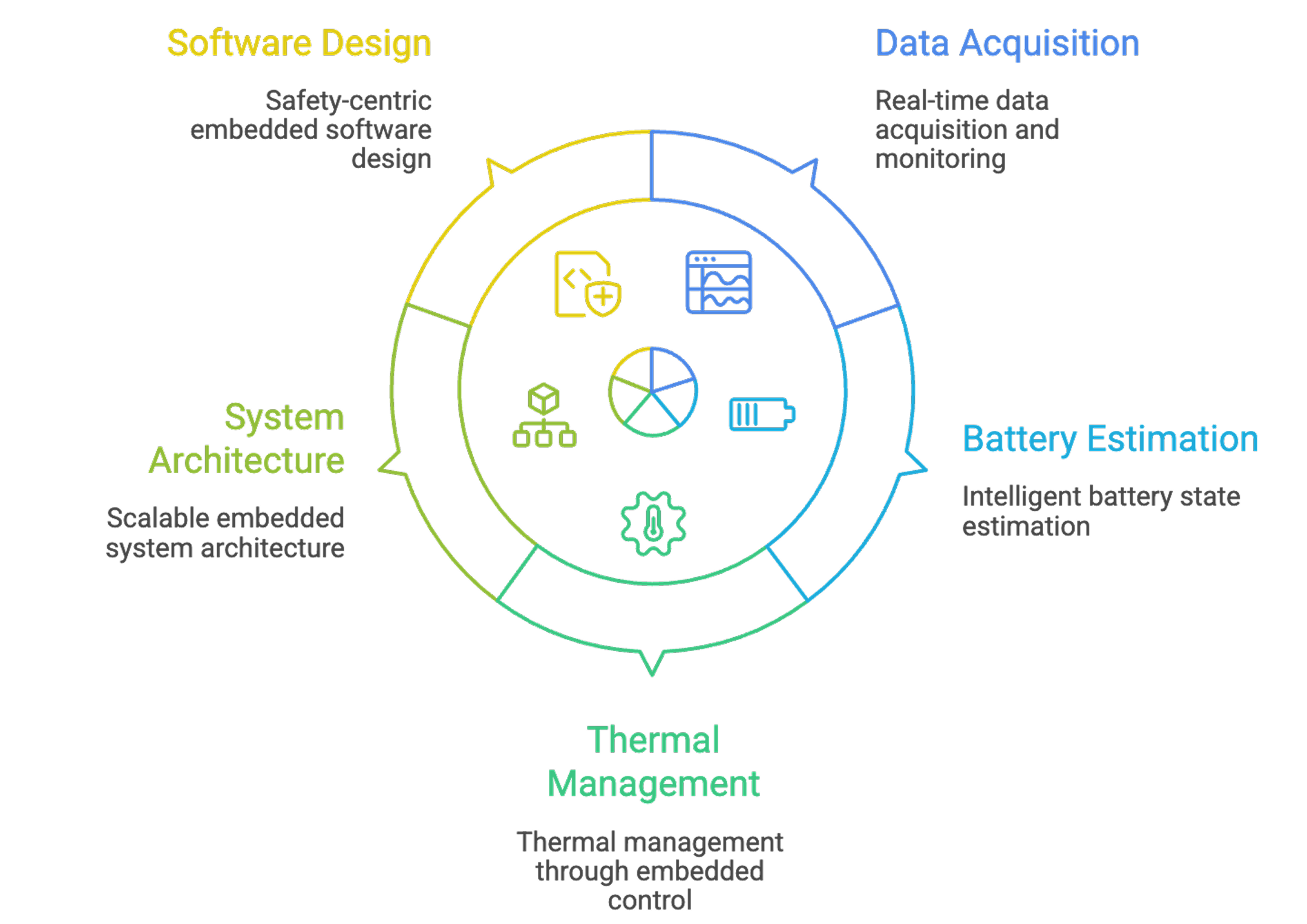
Check out the visual below to see how these five essential embedded engineering strategies are visualized to drive battery management intelligence:
Advanced Embedded Engineering for EV Battery Systems
As electric vehicle technology evolves, battery management systems are becoming more sophisticated and intelligent. Manufacturers now require integrated engineering solutions that combine electronics design, firmware development, and system validation into a unified development process.
Delivering these capabilities requires an advanced design solution approach that integrates multiple engineering disciplines. Hardware designers must develop precise sensing circuits and control electronics, while firmware engineers implement algorithms that manage battery behavior in real time. System validation teams must then verify that the BMS performs reliably under real-world operating conditions.
Future EV platforms will continue to increase battery capacity and complexity. To support these advancements, BMS platforms must rely on scalable embedded architectures that can adapt to new vehicle designs and battery technologies. Strong expertise in embedded system design helps ensure that battery management systems remain reliable, efficient, and safe as EV technology continues to progress.
Supporting EV Innovation with Embedded System Expertise
Developing high-performance Battery Management Systems requires deep expertise in electronics, software engineering, and automotive system integration. Tessolve supports EV innovation by providing advanced engineering services that address the complex challenges of battery system development.
With extensive experience in embedded system design, Tessolve helps organizations develop robust BMS platforms that support modern EV architectures. Our engineering teams provide support across system architecture planning, hardware design, firmware development, and validation testing. This comprehensive approach ensures that battery systems operate efficiently and meet strict automotive safety standards.
As a trusted embedded system company, Tessolve delivers integrated engineering solutions that help manufacturers build reliable and scalable EV electronics. By combining technical expertise with proven development methodologies, Tessolve provides advanced design solution frameworks that support the next generation of electric vehicle technologies.
FAQs
1. What is the role of a Battery Management System in electric vehicles?
A Battery Management System (BMS) monitors and controls battery pack operations in electric vehicles. It tracks voltage, current, and temperature of individual cells, manages charging and discharging, balances cells, and protects against faults. By maintaining safe operating conditions, the BMS helps improve battery efficiency, reliability, and overall vehicle performance.
2. Why is embedded system design important for EV battery management?
Embedded system design enables real-time monitoring and control of EV battery systems. It integrates sensors, microcontrollers, and firmware that continuously process battery data and execute control algorithms. This architecture ensures accurate state estimation, rapid fault detection, and reliable communication with vehicle systems, helping maintain battery safety, efficiency, and long-term operational stability.
3. What are the main components of a BMS architecture?
A typical BMS architecture includes battery monitoring units, control and processing units, communication interfaces, and protection mechanisms. Monitoring units measure cell voltage, current, and temperature, while processors run battery management algorithms. Communication modules exchange data with vehicle systems, and safety mechanisms protect batteries from overcharge, overheating, short circuits, and abnormal operating conditions.
4. How do embedded systems improve battery safety and performance?
Embedded systems enable precise monitoring, intelligent control algorithms, and rapid response to abnormal battery conditions. By analyzing real-time data, embedded controllers detect faults early, regulate charging behavior, and manage temperature levels. This improves battery safety, optimizes energy usage, enhances vehicle performance, and extends the overall lifespan of electric vehicle battery systems.
6. How does a Battery Management System estimate battery health and charge levels?
A BMS uses algorithms to estimate State of Charge and State of Health by analyzing voltage, current, temperature, and usage patterns. Embedded processors process this data in real time to determine remaining battery capacity and performance trends, helping optimize energy usage while preventing battery stress or premature degradation during vehicle operation.


