

Artificial Intelligence is no longer limited to cloud data centers. Today, intelligence is moving closer to where data is created, such as inside vehicles, industrial machines, medical devices, cameras, and smart consumer products. This shift toward Edge AI is transforming how connected devices operate by enabling them to make decisions instantly without depending on constant cloud connectivity, making a robust embedded system more important than ever.
At Tessolve, we are helping businesses embrace this transformation by engineering intelligent embedded platforms that combine advanced hardware, optimized software, and AI acceleration into a unified solution. Rather than simply deploying AI models, we focus on building complete platforms that deliver real-time performance, energy efficiency, scalability, and long-term reliability.
Here’s how we are making Edge AI smarter across industries.
Understanding the Foundation of Edge AI
Edge AI refers to running artificial intelligence algorithms directly on physical devices instead of sending data to remote servers for processing. In other words, data is processed locally at the edge rather than in the cloud. This approach significantly reduces latency, optimizes bandwidth, improves privacy by keeping sensitive information on the device, and enables faster decision-making.
However, achieving this is far from simple. AI models often require considerable computing resources, while embedded devices operate within strict limitations related to processing power, memory, thermal performance, and energy consumption.
This is where an optimized embedded system becomes the foundation of successful Edge AI deployment.
Embedded System | 9 Main Concepts About Embedded Engineering
We Build Hardware and AI Together
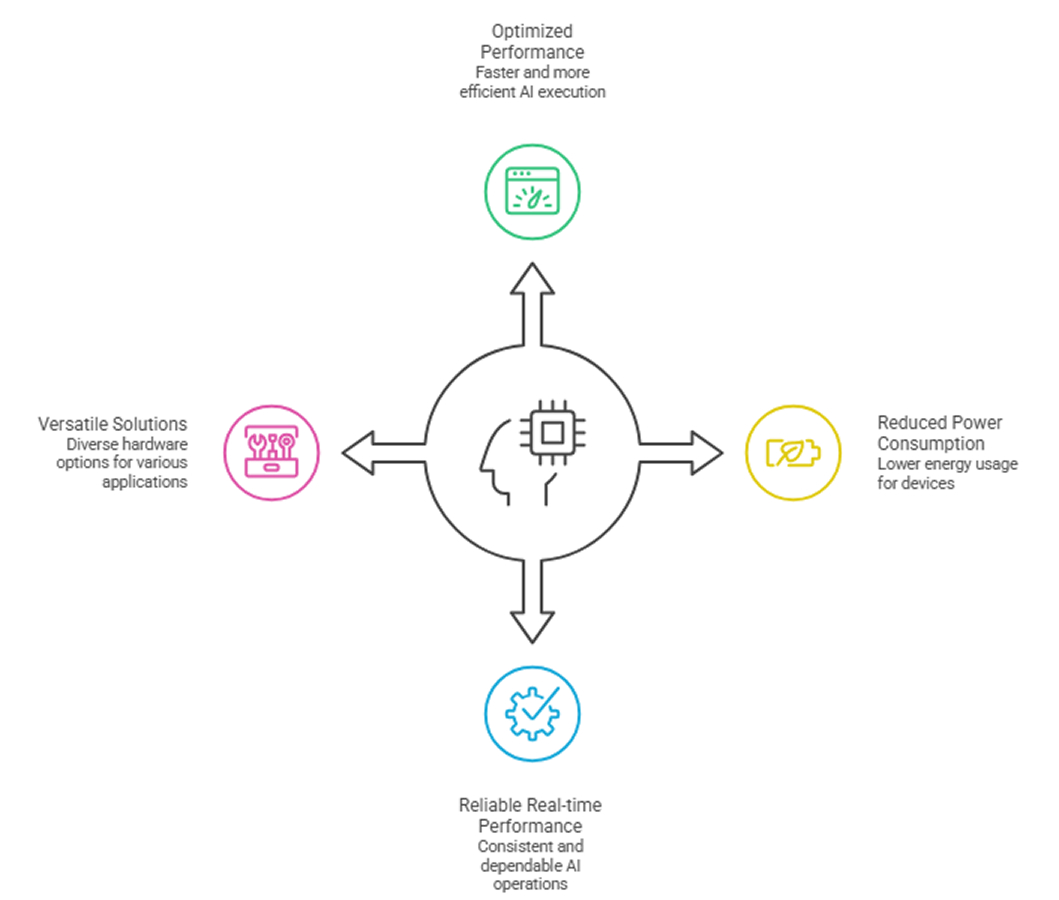
One of the biggest challenges in Edge AI is ensuring that hardware and AI software complement each other. Designing them independently often results in performance bottlenecks, unnecessary power consumption, or underutilized computing resources.
At Tessolve, we address this through a hardware-software co-design approach by:
- Selecting the right MCU/processor based on application requirements.
- Designing solutions with ASICs, custom PCBs, System-on-Modules (SoMs), GPUs, or Neural Processing Units (NPUs).
- Achieving true hardware-AI synergy for efficient AI execution.
- Applying our expertise in embedded design to maximize performance while minimizing power consumption.
This balanced engineering approach enables Edge AI devices to deliver faster, more efficient, and more reliable real-time performance.
Optimizing AI Models for Resource-Constrained Devices
Many AI models developed for cloud environments are simply too large to operate efficiently on embedded hardware. Running them without optimization can lead to excessive memory usage, slow inference, and higher energy consumption.
We solve this challenge through neural network optimization by tailoring AI models for deployment on resource-constrained devices. Our engineers use techniques such as model compression, quantization, and pruning, along with framework optimization and hardware-aware deployment, to improve inference speed while preserving model accuracy.
By tailoring AI models to the target hardware, we help customers achieve faster real-time analytics even on compact computing platforms.
Delivering Complete Embedded Platforms
Building Edge AI products involves much more than selecting processors or deploying software. Every layer of the platform must work together seamlessly.
Our embedded system design expertise includes:
- Hardware architecture and PCB design for Edge AI devices.
- Firmware, BSP, Linux, and RTOS development for reliable performance.
- AI integration, security, and system validation for production readiness.
- Turnkey product design, from MCU/processor selection to deployment with seamless hardware, firmware, and software integration.
Instead of working with multiple engineering vendors, customers gain an integrated development approach that accelerates product realization while reducing technical risks.
Engineering Platforms for High-Performance Industries
Edge AI requirements vary significantly across industries. A medical device has different priorities than an industrial robot or an automotive control unit.
We develop customized platforms for diverse applications, including:
- Automotive systems supporting ADAS, lane-keeping, driver monitoring, intelligent sensing, and autonomous features.
- Industry 4.0 and manufacturing solutions for predictive maintenance, machine vision, smart cameras, defect detection, and equipment monitoring.
- Smart Home & IoT devices are capable of local voice processing, intelligent security monitoring, and environmental sensing.
- Healthcare devices require reliable, secure, and real-time data processing.
- Consumer electronics demand responsive AI experiences with low power consumption.
By tailoring every solution to application-specific requirements, we help organizations deploy Edge AI that performs reliably in real-world operating environments.
Accelerating Product Development Through End-to-End Engineering
Successful Edge AI products require expertise across multiple engineering disciplines. Hardware, firmware, software, validation, and manufacturing must all align to ensure a successful product launch.
As an experienced embedded systems company, we combine our strengths in silicon engineering, electronics design, embedded software, semiconductor testing, product validation, and manufacturing support to streamline the entire development journey.
This integrated engineering ecosystem enables faster prototyping, reduced development cycles, simplified system integration, and smoother transition from concept to production.
Building Platforms That Are Ready for the Future
Edge AI continues to evolve as applications demand greater intelligence with lower power consumption. Devices must support increasingly complex AI workloads while remaining compact, secure, and connected.
At Tessolve, we build scalable embedded platforms that adapt to evolving technologies and product requirements. From integrating advanced AI accelerators and secure over-the-air firmware updates to optimizing power efficiency, our engineering approach focuses on long-term performance and scalability.
This future-ready mindset helps customers extend product lifecycles while staying competitive in rapidly evolving markets.
Let’s Sum Up!
The future of AI depends on intelligent devices that can process information where it matters most, at the edge. Building these platforms requires much more than deploying AI models; it demands deep expertise across hardware architecture, firmware, software optimization, validation, and system integration.
At Tessolve, we bring all these capabilities together to develop intelligent Edge AI platforms that are efficient, scalable, and production-ready. By combining silicon expertise with complete embedded engineering services, we help organizations transform innovative AI ideas into reliable products that deliver real-world performance across automotive, industrial, healthcare, consumer electronics, and IoT applications.
FAQs
1. What is an embedded platform for Edge AI?
An embedded platform combines hardware, firmware, and software to run AI models locally, enabling faster, secure, and low-latency decision-making.
2. How does Tessolve optimize AI for embedded devices?
Tessolve optimizes AI models using compression, quantization, pruning, and hardware-aware deployment to improve performance on resource-constrained devices.
3. Which industries benefit from Tessolve’s Edge AI solutions?
Automotive, manufacturing, healthcare, consumer electronics, and IoT industries benefit from scalable, reliable, and high-performance Edge AI platforms.
4. Why is hardware-software co-design important for Edge AI?
It ensures hardware and software work efficiently together, improving AI performance, reducing power consumption, and accelerating product development.
5. How does Tessolve accelerate Edge AI product development?
Tessolve provides end-to-end engineering, from hardware design and firmware development to validation, integration, and production-ready deployment.


