


Modern vehicles are no longer just mechanical machines; they are complex computing platforms powered by high-performance System-on-Chips (SoCs). From Advanced Driver Assistance Systems (ADAS) to infotainment, multiple workloads must coexist on a single chip. This convergence creates a critical challenge: how do you ensure that safety-critical functions remain isolated from non-safety applications?
That’s where embedded hypervisors come into play.
In this blog, we’ll explore how embedded hypervisors enable safe workload isolation in automotive SoCs, why they are essential, and how they fit into modern embedded system design.
Understanding Automotive SoCs and Workload Diversity
Automotive SoCs integrate multiple computing domains into a single platform. These domains typically include:
- Safety-critical systems (e.g., braking, ADAS, airbag control)
- Real-time systems (e.g., digital instrument clusters)
- Non-safety systems (e.g., infotainment, navigation, Android apps)
Traditionally, these functions were handled by separate Electronic Control Units (ECUs). However, to reduce cost, weight, and power consumption, OEMs are consolidating them onto centralized SoCs.
This shift demands a robust embedded system design approach that ensures strict separation between workloads with different safety requirements.
What is an Embedded Hypervisor?
An embedded hypervisor is a lightweight virtualization layer that allows multiple operating systems (OS) to run independently on the same hardware platform.
Think of it as a traffic controller that ensures:
- Each OS gets dedicated resources (CPU, memory, I/O)
- No system interferes with another
- Safety-critical processes remain protected
In automotive systems, hypervisors often enable configurations like:
- RTOS for safety-critical tasks
- Linux/Android for infotainment
All are running simultaneously on the same SoC without compromising safety.
Why Isolation is Critical in Automotive Systems
Safety is non-negotiable in automotive applications. A failure in a non-critical system should never impact a safety-critical function.
For example:
- A crash in an infotainment app must not affect braking systems
- Malware in a connected system must not compromise ADAS
Embedded hypervisors enforce strong isolation through:
- Memory partitioning
- CPU core allocation
- Secure communication channels
This concept aligns with safety standards like ISO 26262, which demand strict separation of safety domains.
Key Benefits of Embedded Hypervisors
1. Functional Safety Assurance
Hypervisors ensure that safety-critical applications operate independently, reducing the risk of cross-domain failures.
2. Hardware Consolidation
Instead of multiple ECUs, a single SoC can handle multiple functions, reducing system complexity and cost.
3. Mixed-Criticality Support
Different workloads with varying safety levels can coexist seamlessly.
4. Scalability and Flexibility
OEMs can add new features (like AI-based assistants) without redesigning hardware.
5. Improved Resource Utilization
Efficient allocation of CPU, GPU, and memory improves overall system performance.
Architecture of Embedded Hypervisors in Automotive SoCs
A typical hypervisor-based architecture includes:
- Type-1 Hypervisor (bare-metal): Runs directly on hardware
- Guest OS instances: RTOS, Linux, Android
- Virtualized hardware resources
The hypervisor manages:
- Scheduling
- Resource allocation
- Inter-VM communication
This layered architecture is a cornerstone of modern embedded design, especially for software-defined vehicles.
Challenges in Implementing Embedded Hypervisors
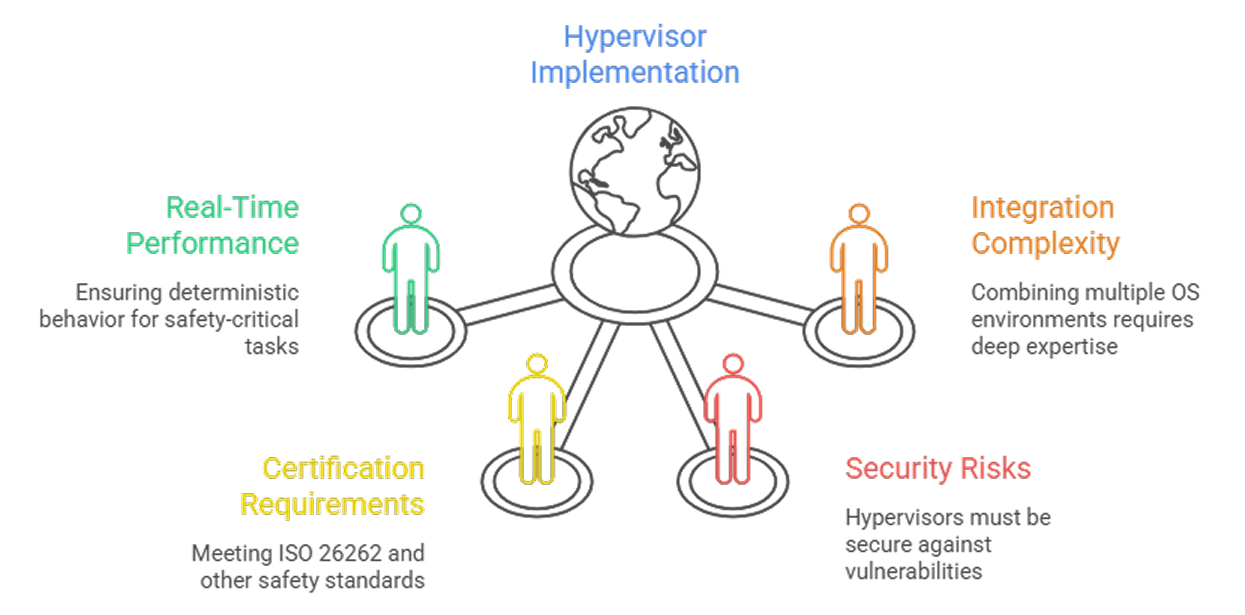
While hypervisors offer many benefits, they also introduce complexities:
1. Real-Time Performance
Ensuring deterministic behavior for safety-critical tasks is challenging.
2. Certification Requirements
Meeting ISO 26262 and other safety standards requires rigorous validation.
3. Security Risks
Hypervisors themselves must be secure against vulnerabilities. Research shows virtualization can introduce new attack surfaces if not properly managed.
4. Integration Complexity
Combining multiple OS environments requires deep expertise in embedded design and system-level integration.
How Thermal Cycling Impacts Long-Term Automotive Electronics Reliability
Use Cases in Modern Vehicles
Embedded hypervisors are already widely used in:
- Digital Cockpits: Running cluster + infotainment together
- ADAS Systems: Isolating perception, planning, and control modules
- Connected Vehicles: Separating communication stacks from core vehicle controls
- Autonomous Driving Platforms: Managing multiple AI workloads safely
As vehicles evolve into software-defined platforms, hypervisors are becoming indispensable.
Future Trends: Software-Defined Vehicles and Beyond
The automotive industry is moving toward centralized computing architectures and software-defined vehicles (SDVs). In this future:
- Fewer, more powerful SoCs will replace distributed ECUs
- Over-the-air (OTA) updates will become standard
- AI and machine learning workloads will increase
Embedded hypervisors will play a key role in enabling this transformation by:
- Supporting dynamic workload management
- Ensuring safety in increasingly complex systems
- Enabling seamless updates without disrupting critical functions
Best Practices for Implementing Embedded Hypervisors
To successfully deploy hypervisors in automotive SoCs:
- Choose a Type-1 hypervisor for better performance and control
- Ensure compliance with functional safety standards
- Use hardware-assisted virtualization features
- Implement robust security mechanisms
- Conduct extensive testing and validation
Partnering with an experienced embedded system company can significantly reduce risks and accelerate development.
Accelerate Your Automotive Innovation with Tessolve
At Tessolve, we bring deep expertise in automotive SoCs, virtualization, and end-to-end embedded solutions to help you build future-ready systems. From architecture and embedded system design to validation and production, our teams deliver high-performance, safety-compliant solutions tailored to your needs. With over two decades of experience and strong capabilities in hardware, software, and system integration, we enable faster development cycles and reliable product deployment. Whether you’re building ADAS, infotainment, or connected vehicle platforms, Tessolve is your trusted partner in transforming innovative ideas into production-ready automotive solutions.
FAQs
1. What is an embedded hypervisor in automotive systems?
An embedded hypervisor is a virtualization layer enabling multiple operating systems to run safely and independently on a single automotive SoC.
2. Why is workload isolation important in vehicles?
Isolation ensures safety-critical functions like braking remain unaffected by failures or crashes in non-critical systems such as infotainment applications.
3. How do hypervisors support functional safety standards?
They enforce memory, CPU, and resource separation, helping systems comply with ISO 26262 requirements for safety-critical automotive applications.
4. What types of operating systems run on automotive hypervisors?
Typically, RTOS handles safety-critical tasks, while Linux or Android manages infotainment and user-facing applications on the same hardware.
5. What are the challenges of using embedded hypervisors?
Key challenges include real-time performance, system complexity, security vulnerabilities, and achieving compliance with strict automotive safety certification standards.


