


Modern vehicles are rapidly transforming into software-defined machines packed with intelligent electronics. From Advanced Driver Assistance Systems (ADAS) and infotainment to powertrain control and autonomous driving, automotive platforms rely heavily on real-time processing. At the heart of these systems lies one critical component: the Real-Time Operating System (RTOS).
Selecting the right RTOS for automotive embedded systems is not a simple checkbox decision. It directly impacts safety, performance, scalability, cybersecurity, and long-term product reliability. With increasing software complexity in vehicles, choosing the appropriate RTOS has become a strategic engineering decision.
In this blog, we’ll explore the key factors automotive companies should consider when selecting an RTOS and how it influences modern embedded system design.
What is an RTOS?
A Real-Time Operating System is an operating system designed to process data and execute tasks within strict timing constraints.
Unlike general-purpose operating systems, an RTOS guarantees deterministic behavior. This means critical tasks execute within predictable time limits—something extremely important in automotive systems where delays can compromise safety.
For example:
- Airbag deployment
- Brake-by-wire systems
- Adaptive cruise control
- Steering control systems
All require immediate and reliable responses.
This deterministic execution forms the foundation of advanced embedded design in automotive applications.
Why RTOS Matters in Automotive Systems
Modern automotive electronics involve multiple sensors, ECUs, communication protocols, and AI-driven decision-making systems. These systems generate massive volumes of real-time data that must be processed instantly.
How Car Gateway Modules Are Driving the Future of Smart Cars
An RTOS helps by:
- Managing task scheduling efficiently
- Ensuring low-latency processing
- Supporting multitasking environments
- Maintaining system stability
- Enabling safety-critical operations
As automotive architectures evolve toward centralized computing and software-defined vehicles, RTOS platforms are becoming even more important.
Key Factors to Consider When Selecting an RTOS
1. Real-Time Performance
The most important characteristic of any RTOS is deterministic performance.
Automotive systems often operate under strict latency requirements. A delay of even a few milliseconds can lead to serious safety risks.
When evaluating an RTOS, engineers should assess:
- Interrupt latency
- Context-switching speed
- Scheduling efficiency
- Jitter control
Reliable timing performance is a critical requirement for modern embedded system design.
2. Functional Safety Compliance
Safety standards are non-negotiable in automotive systems.
The RTOS should support compliance with:
- ISO 26262
- ASIL certifications
- Functional safety documentation
Many automotive-grade RTOS platforms provide:
- Safety-certified kernels
- Memory protection
- Error detection mechanisms
- Fault isolation
These features help reduce development complexity while simplifying certification processes.
Tessolve highlights its ISO 26262-focused automotive development expertise across embedded automotive platforms and ADAS solutions.
3. Scalability and Flexibility
Automotive software stacks continue growing in complexity.
An RTOS must support:
- Multi-core processors
- Mixed-criticality workloads
- Hypervisor integration
- Future software expansion
Scalable RTOS architectures allow OEMs to reuse software across multiple vehicle platforms while reducing development effort.
This flexibility is becoming increasingly important in large-scale embedded design projects.
4. Hardware Compatibility
Automotive SoCs vary significantly in architecture and capabilities.
The chosen RTOS should provide:
- Broad microcontroller support
- Compatibility with automotive chipsets
- BSP (Board Support Package) availability
- Driver ecosystem support
Compatibility with ARM-based SoCs, DSPs, and AI accelerators is especially valuable for next-generation automotive applications.
Tessolve’s embedded hardware and software engineering services support a wide range of processors, SoCs, FPGA platforms, and automotive systems.
5. Cybersecurity Support
Connected vehicles are increasingly vulnerable to cyber threats.
A modern RTOS should support:
- Secure boot
- Trusted execution environments
- Encryption frameworks
- Memory isolation
- Secure OTA updates
Automotive cybersecurity has become essential as vehicles integrate cloud connectivity, V2X communication, and edge AI systems.
6. Middleware and AUTOSAR Support
AUTOSAR compatibility is often a major requirement in automotive development.
RTOS platforms with strong AUTOSAR support simplify:
- ECU integration
- Middleware deployment
- Software portability
- Standardized communication
Additional middleware support for:
- CAN
- Ethernet
- LIN
- FlexRay
- OTA frameworks
can significantly accelerate development timelines.
Tessolve provides AUTOSAR integration, MCAL development, middleware engineering, and automotive software validation services.
7. Resource Efficiency
Automotive embedded systems often operate within strict power and memory constraints.
The RTOS should offer:
- Low memory footprint
- Efficient CPU utilization
- Power management optimization
- Fast boot times
Efficient resource management improves system reliability while lowering hardware costs.
This is particularly important for EV platforms and battery-powered automotive electronics.
8. Development Ecosystem and Toolchain
A strong development ecosystem can dramatically improve productivity.
Engineers should evaluate:
- Debugging tools
- Trace analysis support
- IDE integration
- Simulation capabilities
- Documentation quality
An RTOS with mature tooling reduces debugging effort and shortens time-to-market.
Collaborating with an experienced embedded system company can also help teams streamline integration and validation activities.
9. Long-Term Support and Vendor Stability
Automotive product life cycles often exceed 10 years.
Choosing an RTOS vendor with:
- Long-term maintenance support
- Active updates
- Security patches
- Proven automotive experience
is critical for sustained product reliability.
Vendor ecosystem strength matters just as much as technical capabilities.
Popular RTOS Options in Automotive Systems
Several RTOS platforms are widely used in automotive applications, including:
- QNX
- AUTOSAR OS
- FreeRTOS
- Green Hills INTEGRITY
- VxWorks
- Embedded Linux with PREEMPT_RT
Each RTOS offers different advantages depending on:
- Safety requirements
- Cost constraints
- Compute performance
- Software complexity
Selecting the right platform requires balancing performance, safety, scalability, and integration requirements.
Future Trends in Automotive RTOS
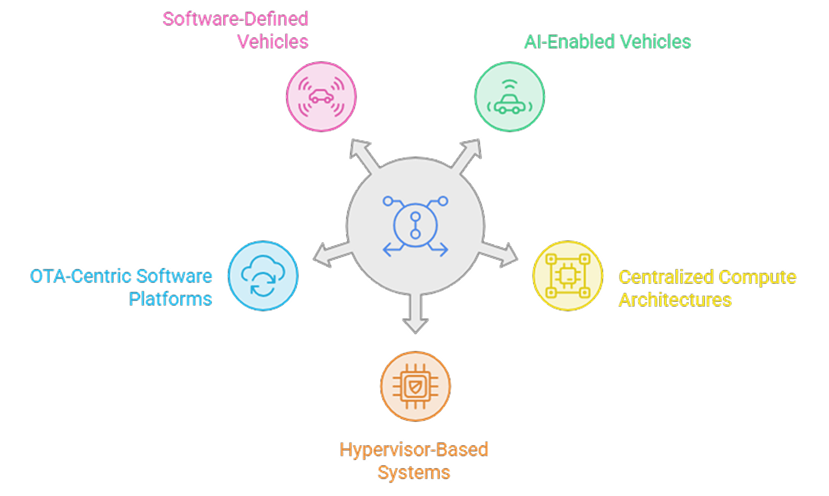
Automotive RTOS platforms are evolving rapidly to support next-generation technologies such as:
AI-Enabled Vehicles
Supporting edge AI and machine learning workloads.
Centralized Compute Architectures
Managing multiple domains on unified SoCs.
Hypervisor-Based Systems
Running mixed-criticality workloads safely.
OTA-Centric Software Platforms
Enabling continuous software updates.
Software-Defined Vehicles
Separating hardware from software innovation cycles.
As vehicles become more intelligent, RTOS platforms will continue serving as the backbone of automotive computing systems.
Accelerate Automotive Innovation with Tessolve
At Tessolve, we deliver end-to-end automotive embedded engineering solutions that help OEMs and Tier-1 suppliers build reliable, future-ready platforms. From RTOS integration and AUTOSAR development to embedded software, hardware engineering, validation, and SoC design, our teams support the complete product lifecycle. With strong expertise in ADAS, connected vehicles, AI-enabled systems, FPGA engineering, and functional safety compliance, we help businesses accelerate development while maintaining performance and reliability. Backed by advanced labs, global engineering talent, and deep automotive domain expertise, Tessolve empowers customers to transform innovative concepts into production-ready automotive solutions.
FAQs
1. What is an RTOS in automotive embedded systems?
An RTOS is a real-time operating system designed to process automotive tasks predictably within strict timing and safety requirements.
2. Why is RTOS important for automotive applications?
RTOS ensures low-latency responses, deterministic behavior, multitasking support, and reliable execution of safety-critical automotive system functions.
3. Which factors matter most when selecting an automotive RTOS?
Key factors include real-time performance, functional safety compliance, scalability, cybersecurity support, hardware compatibility, and long-term vendor support.
4. How does RTOS support functional safety in vehicles?
RTOS platforms provide memory protection, fault isolation, deterministic scheduling, and safety-certified kernels required for ISO 26262 compliance.
5. What are common RTOS platforms used in automotive systems?
Popular automotive RTOS platforms include QNX, FreeRTOS, AUTOSAR OS, VxWorks, Green Hills INTEGRITY, and Embedded Linux variants.


