


Electric vehicles are rapidly evolving, featuring faster charging, smarter dashboards, and longer ranges. Yet one question still pops up in almost every EV conversation: “How far can it really go?”
That answer depends heavily on one critical component working quietly behind the scenes, the Battery Management System (BMS). While battery chemistry gets much of the spotlight, it’s the intelligence inside the BMS that often determines how efficiently that energy is used. And today, embedded intelligence is transforming BMS from a monitoring tool into a strategic performance engine.
Let’s explore how smart BMS optimization can genuinely extend EV range, not just on paper, but on the road.
The Real Role of a BMS in EV Performance
At a basic level, a BMS monitors voltage, current, temperature, State of Charge (SoC), and State of Health (SoH). It ensures cells don’t overcharge, overheat, or degrade unevenly. That’s the safety foundation.
But here’s the interesting part: modern BMS systems don’t just protect the battery, they actively optimize it.
By continuously analyzing cell behavior, usage patterns, and environmental conditions, an intelligent BMS can make micro-decisions every second. Those micro-decisions add up to something drivers care deeply about: a, more usable range.
And enabling that level of sophistication starts with strong embedded system design principles. The BMS controller must process real-time data, respond instantly, and operate reliably under automotive constraints. There’s no room for delay, and certainly no room for failure.
Embedded Intelligence: From Monitoring to Decision-Making
Traditional BMS units followed predefined rules. If the temperature rises above a threshold, trigger cooling. If the voltage drops below a limit, restrict discharge. Functional, but reactive.
Modern systems go further.
By integrating predictive algorithms and adaptive logic, today’s BMS platforms anticipate issues before they occur. They forecast thermal spikes, estimate degradation patterns, and adjust power delivery based on driving behavior.
This is where designing embedded system architectures becomes crucial. Engineers must build systems that handle complex computations while remaining energy efficient themselves. After all, the BMS cannot consume excessive power while trying to save it.
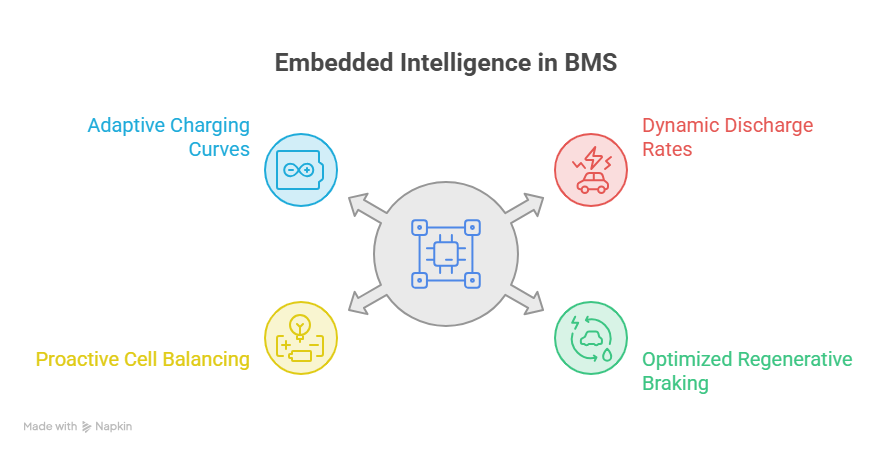
With embedded intelligence, BMS can:
- Adjust discharge rates dynamically during aggressive acceleration
- Optimize regenerative braking efficiency
- Balance cells proactively rather than reactively
- Adapt charging curves based on battery health
Each improvement might seem small individually, but together they can significantly extend real-world driving range.
Thermal Management: The Silent Range Multiplier
Heat is one of the biggest enemies of battery efficiency. When temperatures climb too high or drop too low, chemical reactions inside the battery slow down or degrade faster.
An optimized BMS ensures the battery operates within its ideal thermal window. Instead of running cooling systems at fixed levels, intelligent algorithms activate cooling only when necessary and distribute heat evenly across cells.
Achieving this balance requires a carefully crafted advanced design solution that integrates sensors, control algorithms, and communication protocols into one cohesive system.
In high-performance EVs, thermal optimization can mean the difference between sustained power delivery and reduced output. And in everyday commuting, it translates directly into improved efficiency and longer battery lifespan.
Thermal Management Strategies for High-Performance PCBs
Cell Balancing: Unlocking Hidden Energy
Inside an EV battery pack, no two cells behave the same. Over time, some degrade faster. Others may store slightly less charge. Without intervention, the weakest cell limits the entire pack.
That’s where intelligent cell balancing comes in.
Active balancing redistributes energy between cells to maintain uniformity. Instead of letting one weaker cell reduce overall capacity, the BMS optimizes energy flow across the pack.
This isn’t a simple hardware function; it requires precise firmware logic and constant evaluation. Implementing such balancing strategies effectively demands collaboration with an experienced embedded system company capable of integrating hardware precision with intelligent control algorithms.
When done right, cell balancing can recover usable energy that would otherwise go untapped, effectively extending range without increasing battery size.
Connectivity and Continuous Optimization
Another powerful evolution in BMS technology is connectivity. With vehicle telematics and cloud integration, BMS firmware can receive over-the-air updates that refine algorithms over time.
Imagine your EV improving its range efficiency months after purchase, not because the battery changed, but because smarter control logic was deployed.
Fleet operators particularly benefit from connected BMS systems. Data analytics reveal usage patterns, charging habits, and environmental impacts. This feedback loop informs future updates and optimization strategies.
To support such dynamic improvements, robust embedded system design becomes even more critical. Systems must be secure, update-ready, and capable of scaling with new software capabilities.
Safety First, Always
While optimization is important, safety remains non-negotiable.
A sophisticated BMS must include fault detection, redundant monitoring, predictive diagnostics, and secure shutdown protocols. The challenge lies in maximizing usable energy while maintaining strict safety margins.
Engineers working on designing embedded system architectures for automotive applications must balance aggressive performance goals with conservative safety controls. This dual focus ensures drivers get an extended range without compromising reliability.
When safety frameworks are deeply integrated into the advanced design solution, EV manufacturers can confidently unlock higher usable battery capacity, increasing practical range while maintaining compliance with automotive standards.
Why Intelligent BMS Optimization Is the Future
As EV competition intensifies, simply increasing battery size is no longer the smartest path. Bigger batteries mean higher cost, more weight, and longer charging times.
Optimization, however, delivers smarter gains.
By enhancing efficiency at the system level, manufacturers can:
- Extract more kilometers from the same battery
- Improve long-term battery health
- Reduce warranty risks
- Enhance driver confidence
And this shift is powered by expertise from a capable embedded system company that understands both electronics and real-world automotive demands.
In the coming years, embedded intelligence will become one of the strongest differentiators in EV performance. The vehicles that go farther won’t just have bigger batteries, they’ll have smarter ones.
Tessolve: Powering Intelligent BMS Innovation
At Tessolve, we specialize in delivering cutting-edge embedded and system engineering solutions that enable next-generation automotive performance. From silicon-level expertise to complete product realization, we provide end-to-end support across hardware design, firmware development, validation, and testing.
Our deep experience in automotive electronics, safety-compliant architectures, and high-reliability embedded platforms allows us to build intelligent Battery Management Systems that optimize efficiency, thermal performance, and safety. With advanced labs, global engineering teams, and proven collaboration with leading semiconductor and automotive players, Tessolve accelerates innovation while ensuring scalability and compliance.
When it comes to transforming EV range through intelligent embedded systems, Tessolve helps turn complex engineering challenges into robust, production-ready solutions.
FAQs
1. How does a BMS help extend EV range?
A BMS optimizes charging, balancing, and thermal management, ensuring maximum usable energy and reducing unnecessary battery stress or power losses.
2. What is cell balancing in an EV battery?
Cell balancing equalizes charge levels across battery cells, preventing weaker cells from limiting performance and improving overall pack efficiency.
3. Why is thermal management important in EV batteries?
Proper thermal management maintains optimal battery temperature, improving efficiency, extending lifespan, and preventing overheating-related performance degradation.
4. Can software updates improve EV battery performance?
Yes, over-the-air updates refine BMS algorithms, enhancing efficiency, optimizing charging strategies, and potentially increasing real-world driving range.
5. Is embedded intelligence necessary for modern EVs?
Absolutely. Embedded intelligence enables real-time decision-making, predictive diagnostics, and adaptive energy management, significantly improving EV efficiency and reliability.


