

If you’ve ever wondered how engineers confidently release complex embedded systems into the real world, especially in safety-critical industries, the answer often lies in Hardware-in-the-Loop (HiL) testing.
HiL is where simulation meets reality. It allows teams to push physical embedded hardware to its limits without waiting for full system prototypes or risking expensive field failures. In industries like automotive, aerospace, and industrial automation, this approach has become indispensable.
Let’s explore how HiL works, why it matters, and how it helps engineering teams validate embedded systems at scale.
What Exactly Is Hardware-in-the-Loop?
At its core, Hardware-in-the-Loop testing connects real embedded hardware, such as an ECU or control board, to a real-time simulation environment. The physical device runs its firmware just as it would in production. However, instead of interacting with real sensors, motors, or vehicles, it communicates with a simulator that mimics those elements in real time.
For example, imagine validating a vehicle’s braking ECU. Instead of mounting it in a car and driving thousands of test miles, engineers connect it to a simulator that emulates vehicle speed, road friction, wheel slip, and sensor inputs. The ECU processes these signals and outputs control commands exactly as it would in real driving conditions.
The difference? Every scenario can be repeated, adjusted, stressed, and automated, safely and efficiently.
Why HiL Has Become Essential
Modern embedded systems are more complex than ever. They handle real-time processing, safety checks, network communication, and power management, often simultaneously.
Traditional testing methods leave gaps:
- Pure software simulations don’t capture real hardware timing behavior.
- Field tests are expensive and limited in scenario coverage.
- Manual validation doesn’t scale for large regression cycles.
HiL fills these gaps by enabling:
- Real hardware validation under controlled conditions
- High-volume automated testing across thousands of scenarios
- Safe fault injection for rare or extreme cases
- Early detection of integration issues
For safety-critical systems, especially those governed by standards like ISO-26262, HiL isn’t optional; it’s foundational.
Where HiL Fits in the Development Cycle
HiL typically follows earlier simulation phases:
- Model-in-the-Loop (MiL): Algorithm validation using abstract models
- Software-in-the-Loop (SiL): Testing compiled software without hardware
- Hardware-in-the-Loop (HiL): Real hardware with simulated environment
- Full system or field testing
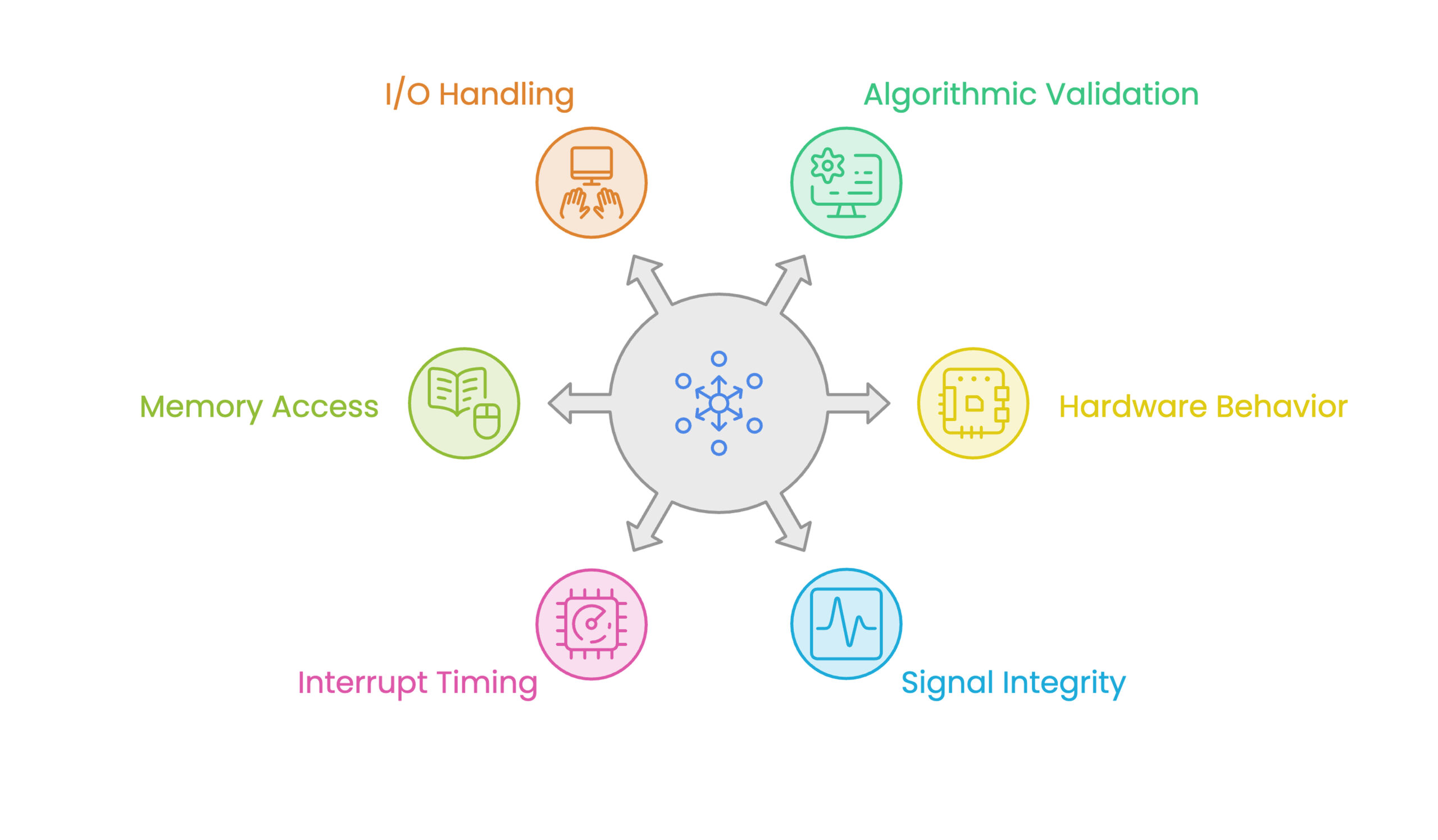
By the time a product reaches HiL, much of the algorithmic logic is validated. Now, engineers focus on how the real hardware behaves, including signal integrity, interrupt timing, memory access, and I/O handling.
This stage significantly strengthens embedded system design decisions by exposing practical performance boundaries before production.
Inside a HiL Setup
A HiL environment typically includes:
- A real-time simulator capable of microsecond-level execution
- Signal conditioning hardware to emulate sensors and actuators
- Communication interfaces (CAN, LIN, Ethernet, etc.)
- Fault injection modules
- Automated test software and reporting tools
The simulator continuously feeds dynamic input signals to the hardware under test. In response, the embedded device generates outputs, which are measured and evaluated against expected behavior.
When properly configured, this setup enables large-scale stress testing without physical prototypes.
Stress-Testing in Action
One of HiL’s biggest advantages is repeatability. Engineers can recreate extreme or unlikely conditions, over and over again.
Examples include:
- Sudden sensor failures
- Voltage drops or spikes
- Network latency or message corruption
- Overheating scenarios
- Mechanical load fluctuations
By systematically injecting these conditions, teams verify fault detection logic and fallback mechanisms. This level of scrutiny directly improves reliability and safety documentation.
When designing embedded system architectures, insights from HiL testing often drive refinements in timing margins, watchdog configurations, and error-handling routines.
Automation: Scaling Validation Efforts
Embedded systems evolve rapidly through firmware updates and iterative improvements. Without automation, regression testing becomes a bottleneck.
Modern HiL platforms integrate with CI/CD pipelines to:
- Execute thousands of test cases automatically
- Compare outputs against baseline results
- Flag regressions instantly
- Generate detailed compliance reports
This automation transforms validation from a periodic milestone into a continuous engineering process. It also supports traceability, critical for regulatory compliance.
Organizations that invest in a scalable, advanced design solution for HiL often see faster development cycles and reduced field defect rates.
Beyond Automotive: Expanding Applications
While automotive remains a major adopter of HiL, its relevance spans multiple industries. Aerospace teams use it to validate flight control responses, industrial automation engineers test PLC logic, renewable energy providers evaluate grid controllers, and medical device manufacturers verify embedded safety functions. Across these domains, the objective remains consistent: validate real hardware performance in a controlled, high-coverage environment before real-world deployment.
Choosing the Right Expertise
Setting up HiL infrastructure requires more than acquiring simulation tools. It involves accurate system modeling, high-fidelity real-time simulation, reliable interface configuration, structured test case development, and automation framework integration. Partnering with an experienced embedded system company ensures HiL implementation aligns with long-term product and compliance goals. The right partner not only configures the test bench but also integrates it seamlessly into the overall product lifecycle.
Tessolve: Engineering Confidence Through HiL Excellence
At Tessolve, we bring deep expertise in semiconductor validation, embedded software development, system integration, and advanced testing frameworks. Our HiL services are designed to support complex validation requirements across automotive and other safety-critical industries.
As a global embedded system company, we provide comprehensive support, from simulation model development and real-time integration to automated regression testing and fault injection strategies. Our strength in embedded system design enables us to align HiL infrastructure with the overall product architecture.
Leveraging scalable labs and a proven advanced design solution approach, Tessolve helps clients reduce risk, accelerate validation cycles, and confidently move from development to production. When precision, reliability, and scalability matter, we deliver engineering excellence at every stage.
FAQs
1. What is Hardware-in-the-Loop (HiL) testing?
Hardware-in-the-Loop testing connects real embedded hardware to real-time simulations for controlled, repeatable, and scalable system validation.
2. Why is HiL important for embedded systems?
HiL detects hardware-software issues early, improves reliability, ensures safety compliance, and reduces costly real-world testing failures.
3. When should HiL testing be introduced in development?
HiL is typically implemented after software validation but before full system integration or field-level testing.
4. Can HiL testing simulate fault conditions?
Yes, HiL safely injects faults like sensor failures, voltage drops, and communication errors to validate robustness.
5. Does HiL reduce overall development time?
Yes, automated HiL testing accelerates regression cycles, improves coverage, and minimizes late-stage redesign risks.


