


Modern vehicles are no longer just mechanical machines; they’re intelligent, connected systems running on complex electronics. At the heart of this transformation lies the Electronic Control Unit (ECU). From controlling engine timing to enabling advanced driver-assistance systems (ADAS), ECUs are the silent workhorses of today’s automotive innovation.
But what does it actually take to move an ECU from post-silicon validation to a production-ready automotive product? The journey is layered, technical, and deeply collaborative. Let’s walk through it, step by step.
Understanding the Role of an Automotive ECU
An ECU is essentially a purpose-built computer embedded within a vehicle. Each ECU is designed to monitor inputs, process data in real time, and control specific vehicle functions. Modern cars can contain 50 to 100 ECUs, all communicating across vehicle networks like CAN, LIN, or Automotive Ethernet.
And unlike consumer electronics, these systems must operate flawlessly in extreme temperatures, vibration-heavy environments, and safety-critical scenarios. There’s no room for error, which is why the journey from silicon to product demands precision engineering at every stage.
The Post-Silicon Reality Check
Once chip fabrication is complete, theory meets reality.
Post-silicon validation is where engineers test actual silicon samples outside simulation environments. Even with extensive pre-silicon verification, subtle issues may only surface when hardware runs in real conditions.
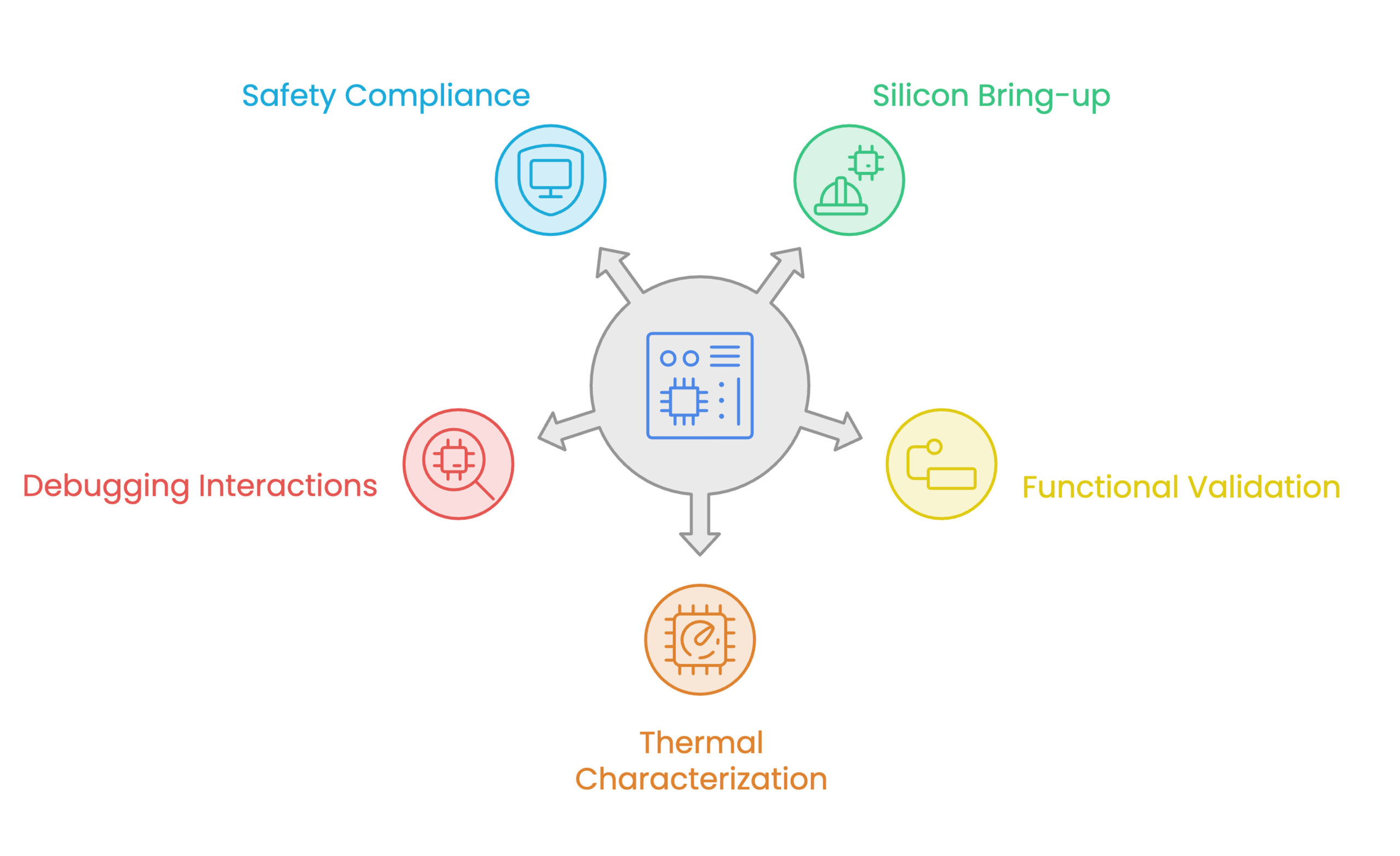
This phase includes:
- Silicon bring-up and initial firmware loading
- Functional validation of peripherals and interfaces
- Thermal and voltage characterization
- Debugging hardware-software interactions
- Safety compliance testing
Engineers carefully monitor timing behavior, bus communication accuracy, and interrupt handling. Every anomaly is investigated because in automotive systems, even a millisecond delay can have serious consequences.
This stage sets the tone for everything that follows.
Prototyping: Turning Silicon into a Working System
After validation, the silicon is integrated into prototype boards. Now the ECU begins to resemble its final form.
Prototyping involves assembling:
- The processor and memory subsystems
- Power management circuitry
- Sensor interfaces
- Communication buses
- Debug and calibration ports
This is where software engineers and hardware teams collaborate closely. Firmware is tested under real network traffic conditions. Signal integrity is measured. Thermal profiles are analyzed.
It’s also the stage where real-world behavior often reveals optimization opportunities. Engineers refine performance, reduce latency, and fine-tune power efficiency.
Embedded System Design: Building Intelligence into the ECU
At the core of every ECU lies a robust software architecture. This is where embedded system design plays a pivotal role.
Engineers must ensure that:
- Real-time operating systems meet strict deadlines
- Memory constraints are efficiently managed
- Interrupt handling is predictable and deterministic
- Communication protocols remain reliable under load
Efficient designing embedded system architectures requires balancing performance, safety, and resource utilization. Automotive systems cannot afford instability or unpredictability. Code must comply with MISRA standards. Functional safety mechanisms must detect and mitigate faults automatically.
In essence, this phase transforms raw silicon into intelligent automotive logic.
Safety and Compliance: Non-Negotiable Milestones
Automotive electronics operate under strict regulatory frameworks. ISO-26262 governs functional safety, while AUTOSAR provides a standardized software architecture.
Compliance isn’t an afterthought; it’s woven into every design layer.
During integration, engineers validate:
- Fault tolerance mechanisms
- Redundancy systems
- Diagnostic coverage
- Fail-safe behaviors
Every signal path, control algorithm, and communication interface must pass validation checks. The ECU must demonstrate predictable behavior, even in failure conditions.
This level of rigor ensures reliability on the road, not just in the lab.
System Integration: Making the ECU a Team Player
An ECU doesn’t operate in isolation. It must seamlessly integrate into the vehicle’s broader electronic ecosystem.
This means:
- Validating multi-ECU communication
- Ensuring compatibility with gateways and cloud systems
- Supporting OTA (Over-The-Air) updates
- Maintaining cybersecurity safeguards
Here, an advanced design solution approach becomes critical. Integration teams ensure that hardware, software, network protocols, and security layers operate as a unified system.
As vehicles become software-defined and more connected, system-level engineering becomes a key differentiator.
From Prototype to Production
Engineering excellence means little if the product can’t scale.
Transitioning from prototype to mass production requires:
- Design for Manufacturability (DFM)
- Automated test strategies (ATE & SLT)
- Component traceability and supply chain validation
- Calibration tools for different vehicle variants
Each ECU unit rolling off the production line must meet the same strict performance and safety benchmarks validated during development.
Manufacturing readiness ensures consistency, quality, and long-term reliability.
The Bigger Picture: Enabling the Future of Mobility
The ECU journey isn’t just about one module; it’s about enabling electrification, autonomous driving, connectivity, and smarter vehicles.
From silicon characterization to embedded software, from compliance validation to system integration, every phase contributes to building vehicles that are safer, smarter, and more efficient.
And as complexity grows, partnering with the right engineering experts becomes essential.
Powering Automotive Innovation: The Tessolve Advantage
At Tessolve, we don’t just support ECU development; we enable complete post-silicon to product journeys. As a global embedded system company, we bring deep expertise in semiconductor validation, hardware design, embedded software engineering, system integration, and production support.
Our teams specialize in automotive post-silicon validation, ISO-26262 functional safety compliance, AUTOSAR development, board design, and system-level testing. With advanced validation labs, turnkey manufacturing solutions, and strong partnerships across the semiconductor ecosystem, we help OEMs and Tier-1 suppliers accelerate time-to-market without compromising quality.
From silicon bring-up to scalable production, our advanced design solution capabilities ensure your ECU is not just functional, but future-ready. At Tessolve, we transform complexity into confidence, powering the next generation of intelligent mobility.
FAQs
1. What is the role of an automotive ECU?
An automotive ECU controls specific vehicle functions by processing sensor inputs and managing outputs in real time reliably.
2. Why is post-silicon validation important for ECUs?
Post-silicon validation ensures actual hardware performs correctly under real conditions before integration into vehicles.
3. How does embedded software impact ECU performance?
Embedded software determines timing accuracy, communication reliability, safety compliance, and overall real-time system responsiveness.
4. What standards must automotive ECUs comply with?
Automotive ECUs typically follow ISO-26262 for safety, AUTOSAR frameworks, and MISRA coding standards.
5. Why choose an experienced engineering partner for ECU development?
Experienced partners ensure faster development, regulatory compliance, optimized performance, and smooth transition from prototype to production.


