

Smart metering has become one of the biggest drivers of digital transformation in the utility sector. As utilities look for smarter ways to monitor energy consumption, reduce operational costs, and improve customer service, reliable communication technology has become just as important as the meter itself. This is where LoRaWAN comes into the picture.
LoRaWAN (Long Range Wide Area Network) is changing how smart meters connect, communicate, and operate. Unlike conventional communication technologies that may consume more power or require extensive infrastructure, LoRaWAN offers long-range connectivity, low power consumption, and cost-effective deployment, making it an ideal choice for large-scale smart metering projects.
But what exactly makes LoRaWAN such a game-changer? Let’s explore how this technology is accelerating the global smart metering industry.
What is LoRaWAN?
LoRaWAN is a Low Power Wide Area Network (LPWAN) protocol designed specifically for IoT devices that need to send small amounts of data over long distances while consuming minimal energy.
Instead of relying on continuous high-bandwidth communication, LoRaWAN enables connected devices, such as electricity, water, and gas meters, to transmit data periodically and securely to centralized servers.
This makes it particularly suitable for utility applications where reliability, battery life, and wide-area coverage matter more than high-speed data transfer.
How LoRaWAN is Accelerating the Smart Metering Industry
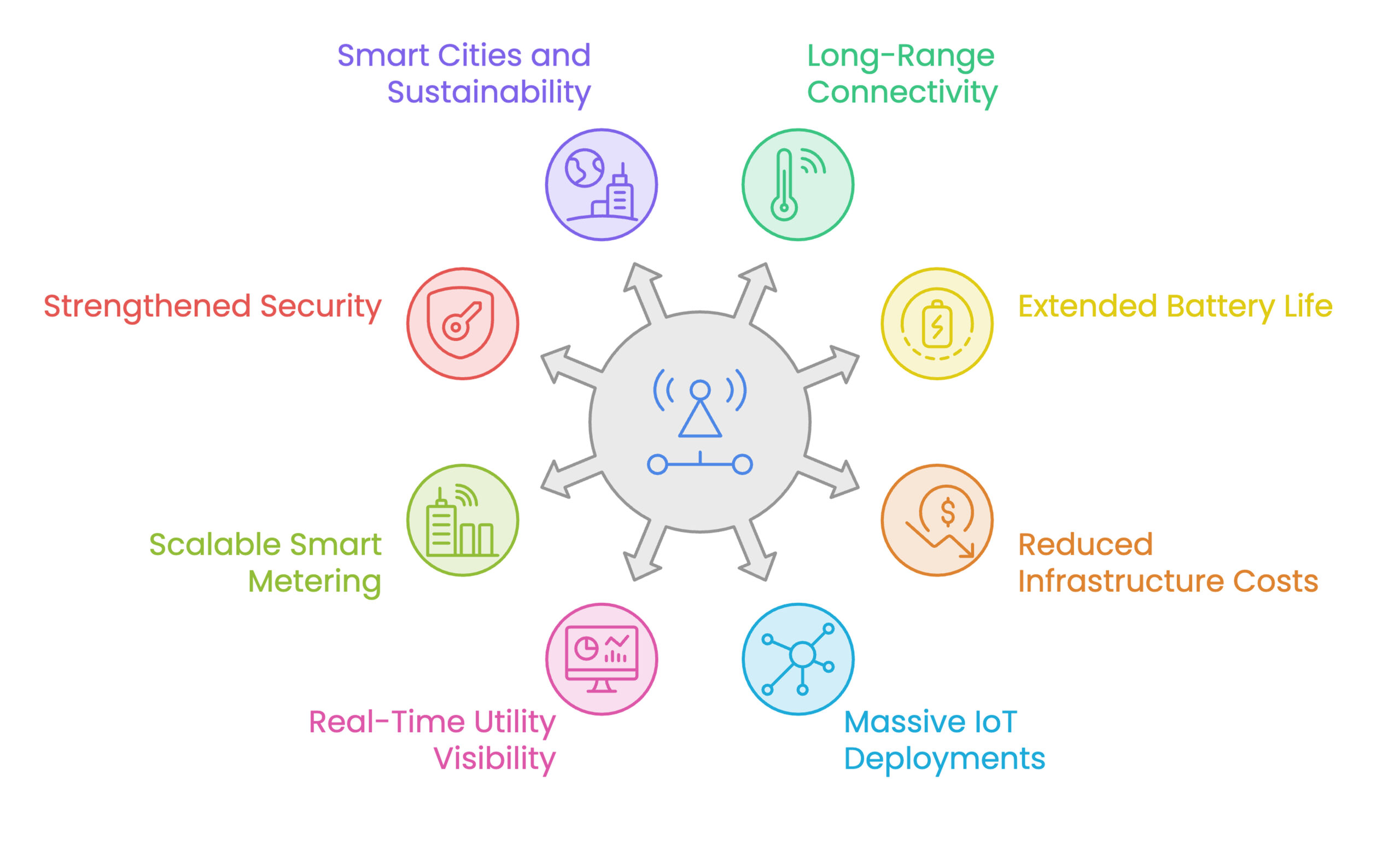
1. Enabling Long-Range Connectivity
One of the biggest challenges in smart meter deployment is maintaining reliable communication across cities, rural communities, industrial zones, and remote locations. LoRaWAN solves this by providing communication over several kilometers with relatively few gateways.This reduces the need for complex network infrastructure while allowing utilities to connect thousands of smart meters through a single network. The result is faster deployment and lower implementation costs.
2. Extending Smart Meter Battery Life
Replacing batteries across millions of smart meters is both expensive and time-consuming. LoRaWAN is specifically designed for ultra-low-power IoT devices, allowing smart meters to operate efficiently for many years on a single battery. This dramatically reduces maintenance costs while improving overall operational reliability. Behind this long battery life is a carefully optimized embedded system that manages communication cycles, sleep modes, and energy consumption with remarkable efficiency.
India’s utility sector is undergoing one of the world’s largest smart meter transformation initiatives. Distribution companies (DISCOMs) are increasingly replacing conventional meters with smart meters to improve operational efficiency and reduce Aggregate Technical and Commercial (AT&C) losses.
Low-Power SoC Chip Design: Strategies for Mobile and IoT Devices
3. Reducing Infrastructure Costs
Traditional communication technologies often require expensive infrastructure investments. LoRaWAN minimizes these requirements by covering large geographical areas with fewer gateways.
For utilities rolling out millions of smart meters, this translates into:
- Lower network deployment costs
- Faster implementation
- Simplified maintenance
- Better return on investment
This cost efficiency is one of the primary reasons utilities worldwide are increasingly considering LoRaWAN-based smart metering solutions.
4. Supporting Massive IoT Deployments
Modern utilities are no longer deploying hundreds of devices; they are deploying millions. LoRaWAN networks are built to support massive IoT ecosystems where thousands of connected devices communicate simultaneously. Whether monitoring electricity, gas, or water consumption, utilities can efficiently scale their networks without significantly increasing operational complexity. Reliable embedded system design plays a critical role here by ensuring every connected meter can process, store, and securely transmit data while maintaining long-term stability.
5. Improving Real-Time Utility Visibility
Although smart meters do not always transmit data continuously, LoRaWAN enables frequent and reliable communication that provides utilities with timely operational insights.
This helps utilities:
- Detect outages faster
- Monitor consumption patterns
- Identify abnormal energy usage
- Reduce non-technical losses
- Improve billing accuracy
Better visibility ultimately leads to faster decision-making and improved customer service.
6. Making Smart Metering More Scalable
Large-scale utility projects demand communication technologies that can grow without requiring complete infrastructure redesign.
LoRaWAN offers this flexibility. Utilities can gradually expand their smart meter deployments by simply adding more devices to existing networks, making future expansion both practical and cost-effective.
This scalability also encourages manufacturers to invest in advanced embedded designing techniques that improve firmware flexibility, communication efficiency, and long-term device performance.
7. Strengthening Security
Security remains one of the most important concerns in connected utility infrastructure. LoRaWAN includes built-in encryption, authentication, and secure device communication mechanisms that help protect sensitive energy consumption data. When combined with secure firmware architecture and modern hardware security features, utilities can confidently deploy connected smart meters across large service areas.
Strong cybersecurity also depends on careful embedded system design, where secure boot, encrypted firmware updates, and authentication mechanisms are integrated directly into the product architecture.
8. Supporting Smart Cities and Sustainable Utilities
Smart metering is only one part of the broader smart city ecosystem.
The same LoRaWAN infrastructure can support additional connected applications, including:
- Street lighting
- Water management
- Environmental monitoring
- Waste management
- Parking management
This allows municipalities and utilities to maximize infrastructure investments while creating a more connected urban environment.
Why LoRaWAN is a Perfect Fit for India’s Smart Metering Growth
India’s smart metering initiatives are expanding rapidly, with utilities deploying millions of connected meters to modernize electricity distribution.
LoRaWAN offers several advantages that align well with India’s requirements:
- Wide coverage across urban and rural regions
- Low operating costs
- Long battery life
- Scalable deployments
- Secure communication
- Reliable performance in challenging environments
These advantages make LoRaWAN particularly attractive for large utility networks where affordability and reliability are equally important.
Engineering Innovation Behind LoRaWAN Smart Meters
While LoRaWAN provides the communication layer, the real intelligence lies inside the smart meter itself. Developing these devices requires expertise across hardware engineering, firmware development, PCB design, wireless connectivity, testing, validation, and system integration.
Every embedded system company involved in smart metering must balance power efficiency, security, connectivity, regulatory compliance, and long-term reliability. Likewise, modern embedded design practices focus on optimizing processor performance, memory usage, firmware architecture, and communication efficiency to deliver future-ready smart metering solutions.
As smart utilities continue evolving, the integration of intelligent hardware with robust communication technologies like LoRaWAN will remain central to building reliable digital energy infrastructure.
Why Tessolve for LoRaWAN-Based Smart Metering Solutions?
Building reliable LoRaWAN-enabled smart meters requires expertise across embedded engineering, hardware design, wireless connectivity, testing, and product development. Tessolve brings these capabilities together through its end-to-end silicon-to-systems engineering services, helping customers accelerate the development of secure and scalable connected devices. Reinforcing its commitment to next-generation IoT innovation, Tessolve has officially joined the LoRa Alliance®, enabling complete LoRaWAN solutions for Smart Metering, Industrial IoT, Smart Cities, and connected infrastructure. By combining semiconductor expertise, wireless engineering, embedded systems, testing, cloud integration, PCB and system hardware design, SOM & EVK development, and manufacturing support, Tessolve helps customers accelerate IoT product development from concept to deployment while building high-performance, future-ready LoRaWAN-enabled smart metering solutions.
FAQs
1. What is LoRaWAN, and why is it used in smart metering?
LoRaWAN is a low-power wireless communication protocol that enables secure, long-range connectivity for smart meters with minimal energy consumption.
2. How does LoRaWAN improve smart meter performance?
LoRaWAN enables reliable long-distance communication, reduces power consumption, lowers maintenance costs, and supports efficient data transmission for smart meters.
3. Is LoRaWAN suitable for large-scale utility deployments?
Yes, LoRaWAN supports thousands of connected devices, making it highly scalable for nationwide electricity, water, and gas smart metering projects.
4. How secure is LoRaWAN for smart metering applications?
LoRaWAN uses end-to-end encryption, secure authentication, and protected communication protocols to safeguard utility data and connected smart meter networks.
5. Why is LoRaWAN gaining popularity in India’s smart metering sector?
Its long-range coverage, low deployment costs, energy efficiency, and scalability make LoRaWAN ideal for India’s expanding smart utility infrastructure.


