

The way electricity is generated, distributed, and consumed is changing rapidly across the world. Utilities are moving beyond traditional manual meter readings toward intelligent, connected infrastructure that delivers real-time insights, improves operational efficiency, and enhances customer experience. At the center of this transformation is smart metering.
Countries across Europe, North America, Asia-Pacific, and the Middle East are investing heavily in smart grid modernization. India has also emerged as one of the fastest-growing markets for smart meter deployments, driven by large-scale utility modernization programs and the need to improve billing accuracy, reduce power losses, and create a more reliable power distribution network. These developments are also creating significant demand for advanced electronics, communication technologies, and embedded system engineering that power modern smart meters.
Understanding the Global Smart Metering Market
Unlike conventional electricity meters, smart meters automatically record energy consumption and securely transmit the information to utilities. This two-way communication enables utilities to monitor consumption patterns, detect outages quickly, manage peak loads, and offer more flexible pricing models.
Globally, utilities are increasingly adopting Advanced Metering Infrastructure (AMI), where connected devices continuously exchange information between consumers and energy providers. Smart metering has become a key building block of digital utility networks because it improves operational visibility while supporting sustainability goals.
Modern smart meters rely on secure communication technologies such as RF Mesh, NB-IoT, LTE, and 5G, combined with cloud analytics and IoT platforms to provide actionable insights for utilities. As renewable energy integration grows, these intelligent metering systems will become even more critical for balancing demand and supply efficiently.
Why India Is Becoming a Smart Metering Leader
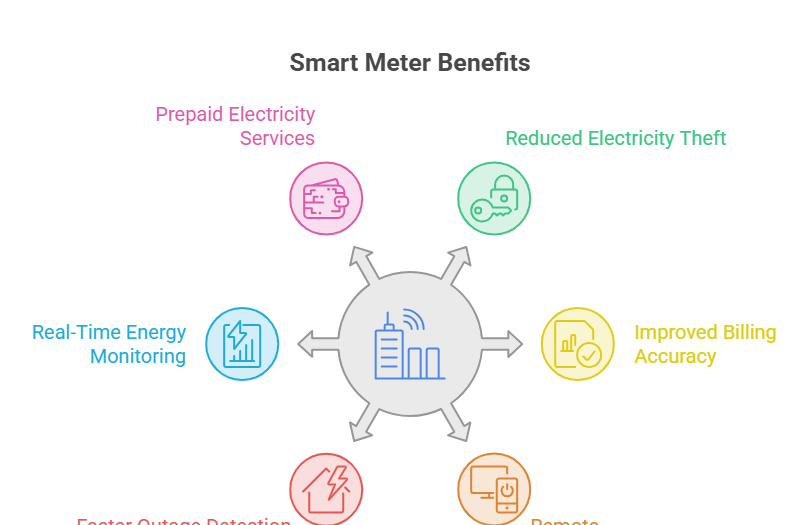
India’s utility sector is undergoing one of the world’s largest smart meter transformation initiatives. Distribution companies (DISCOMs) are increasingly replacing conventional meters with smart meters to improve operational efficiency and reduce Aggregate Technical and Commercial (AT&C) losses.
Technology Driving Modern Smart Meters
A smart meter is much more than a digital counter. It is a sophisticated computing device capable of sensing, processing, storing, and communicating critical information.
Every smart meter depends on a robust embedded system that controls measurement functions, communication protocols, security features, and firmware updates. Without reliable embedded intelligence, the meter cannot perform accurate real-time monitoring.
Equally important is embedded system design, which ensures the hardware and software operate efficiently under demanding environmental conditions while maintaining low power consumption. Since smart meters are expected to remain operational for many years, reliability becomes one of the most important design considerations.
Manufacturers also invest significantly in embedded design to optimize processor selection, communication interfaces, memory architecture, cybersecurity, and long-term maintainability. As utilities demand increasingly intelligent devices, engineering complexity continues to grow.
Low-Power SoC Chip Design: Strategies for Mobile and IoT Devices
Key Challenges Facing the Industry
Although the opportunities are enormous, smart metering deployments also introduce several technical and operational challenges.
Cybersecurity
Connected devices become potential entry points for cyberattacks. Secure boot, encrypted communication, firmware authentication, and hardware-based security are now essential requirements rather than optional features.
Scalability
Managing millions of connected devices simultaneously requires highly scalable backend infrastructure capable of processing enormous amounts of data without compromising performance.
Network Reliability
Smart meters often operate in locations with varying communication quality. Reliable connectivity across urban, semi-urban, and rural environments remains an important consideration.
Long Product Lifecycles
Unlike consumer electronics, utility equipment remains in service for many years. This places significant emphasis on robust embedded system design, allowing products to receive secure firmware updates while maintaining long-term reliability.
Opportunities for Engineering Innovation
The future of smart metering goes far beyond automated billing. Artificial intelligence, edge computing, predictive analytics, and cloud-native utility platforms are enabling smarter energy management than ever before. Future smart meters are expected to support distributed energy resources, renewable energy integration, and advanced demand-response programs.
This evolution requires increasingly sophisticated embedded design methodologies that balance processing power, security, connectivity, and energy efficiency within compact hardware platforms.
At the same time, every embedded system company supporting utility innovation must address regulatory compliance, interoperability standards, functional safety, and cybersecurity requirements while reducing product development timelines.
India’s Road Ahead
India’s growing investment in digital infrastructure positions the country as one of the most promising smart metering markets globally. Government-led modernization programs, expanding renewable energy capacity, and rising electricity demand are accelerating the adoption of intelligent utility technologies.
As deployment scales further, innovation will increasingly depend on close collaboration between utilities, semiconductor companies, hardware designers, software developers, and every capable embedded system company contributing to next-generation energy solutions.
The organizations that successfully combine advanced electronics, secure software, reliable communication technologies, and scalable product engineering will help shape the future of India’s smart utility ecosystem.
Why Tessolve for Smart Metering Product Development?
If you’re developing next-generation smart metering solutions, Tessolve brings together the engineering capabilities needed to accelerate innovation from concept to production. As part of its silicon-to-systems expertise, Tessolve delivers end-to-end embedded design services, advanced embedded product development, PCB design, system hardware engineering, SOM & EVK development, and turnkey product development.
Strengthening its commitment to connected IoT innovation, Tessolve has also joined the LoRa Alliance, enabling customers to leverage industry-leading LoRaWAN® technologies for secure, low-power, and long-range IoT applications such as smart metering and smart utilities. Combined with deep expertise in embedded system integration, semiconductor engineering, validation, and manufacturing support, Tessolve helps organizations build reliable, scalable, and future-ready connected devices while accelerating time to market.
FAQs
1. What is a smart meter, and how is it different from a traditional energy meter?
A smart meter automatically records energy usage and securely shares real-time data with utilities, unlike traditional meters requiring manual readings.
2. Why is India investing heavily in smart metering?
India is adopting smart meters to reduce losses, improve billing accuracy, enhance grid reliability, and enable efficient energy management nationwide.
3. How do embedded systems contribute to smart metering?
Embedded systems control measurement, communication, security, and data processing, ensuring smart meters operate accurately, reliably, and efficiently throughout their lifecycle.
4. What communication technologies are commonly used in smart meters?
Smart meters commonly use RF Mesh, NB-IoT, LoRaWAN®, LTE, and 5G to securely transmit energy consumption data between utilities and consumers.


