


As vehicles evolve into software-defined systems, validation has become more complex, time-intensive, and critical than ever. Modern automotive platforms rely on multiple electronic control units, interconnected networks, and safety-critical software that must perform flawlessly under all conditions.
Traditional validation methods dependent on physical labs often struggle with scalability and accessibility, slowing development cycles and limiting testing efficiency.
This is where Lab-as-a-Service is redefining validation. By offering remote, scalable, and automated testing environments, it enables faster and more efficient validation.
For organizations working with an embedded system company, adopting an embedded solution approach through Lab-as-a-Service ensures agility, scalability, and improved validation outcomes.
Understanding Lab-as-a-Service in Automotive Validation
Lab-as-a-Service is a modern validation framework that provides on-demand, remote access to testing infrastructure, tools, and hardware environments. Instead of relying on fixed, location-bound lab setups, engineering teams can access validation platforms through centralized systems, enabling continuous and flexible testing workflows.
In automotive software validation, this approach plays a crucial role in managing complexity. Vehicles today integrate multiple embedded systems that must be validated across different scenarios, configurations, and operating conditions. Lab-as-a-Service allows teams to perform validation at scale, run parallel test cycles, and simulate real-world environments without physical constraints.
By aligning with an advanced design solution methodology, this model ensures that validation is integrated into the development lifecycle, improving efficiency while maintaining high-quality standards.
How Lab-as-a-Service Accelerates Automotive Software Validation
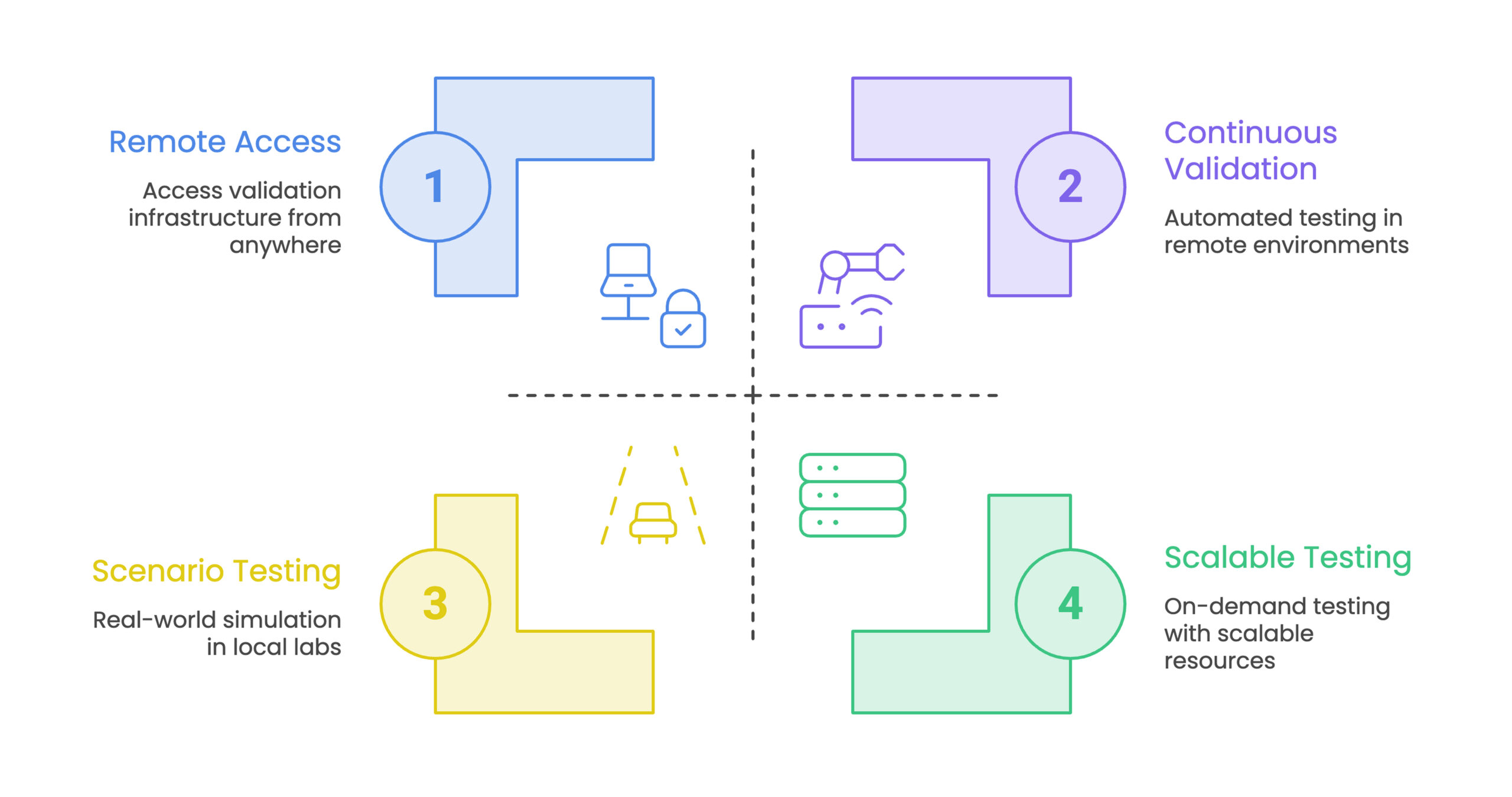
Lab-as-a-Service transforms validation by enabling scalable, flexible, and automated testing environments. It allows engineering teams to overcome traditional limitations and adopt more agile validation strategies. Below are the key ways it accelerates automotive software validation.
1. Remote Access to Validation Infrastructure
Lab-as-a-Service enables engineers to access validation setups remotely, removing the need for physical lab presence and enabling continuous testing across global teams. This improves accessibility and ensures that validation processes are not restricted by location or infrastructure availability.
- Access to hardware test benches from any location
- Reduced dependency on physical lab scheduling
- Improved collaboration across distributed engineering teams
- Better utilization of existing validation infrastructure
2. Scalable and On-Demand Testing
One of the biggest advantages of Lab-as-a-Service is its ability to scale validation environments based on project requirements. Teams can allocate resources dynamically, ensuring that testing is not delayed due to limited infrastructure.
- Parallel testing across multiple configurations and scenarios
- On-demand provisioning of validation resources
- Support for diverse hardware and software environments
- Elimination of bottlenecks in validation cycles
3. Automated Testing and Continuous Validation
Automation is a key enabler of faster validation. Lab-as-a-Service integrates automated testing frameworks that allow continuous execution of test cases, reducing manual effort and improving accuracy.
- Automated regression and functional testing
- Continuous integration and validation workflows
- Faster defect detection and resolution
- Reduced human intervention and operational errors
4. Real-World Simulation and Scenario Testing
Validating automotive software requires testing under realistic conditions. Lab-as-a-Service enables simulation of various driving scenarios, environmental conditions, and system behaviors to ensure robustness.
- Simulation of real-world driving conditions and edge cases
- Testing of communication protocols and network behavior
- Validation under different environmental parameters
- Improved reliability through comprehensive scenario coverage
Key Advantages of Lab-as-a-Service in Automotive Software Validation
Lab-as-a-Service enhances validation efficiency by replacing traditional lab dependencies with flexible and scalable testing environments. This shift allows organizations to streamline validation workflows and adapt quickly to evolving automotive software requirements.
One of the key benefits is faster development cycles. Remote access and automation enable continuous validation, helping teams identify and resolve issues early while reducing time-to-market and minimizing costly redesign efforts.
It also improves cost efficiency and collaboration. By reducing reliance on physical infrastructure and enabling shared environments, organizations optimize resources while ensuring seamless coordination between teams through an integrated, embedded solution approach.
Driving Smarter Validation Workflows with Modern Engineering Practices
As automotive systems become increasingly software-driven, validation workflows must evolve to handle growing complexity. Lab-as-a-Service enables organizations to adopt modern engineering practices focused on agility, scalability, and continuous improvement, ensuring validation keeps pace with rapid development cycles.
A key shift is integrating validation directly into the development lifecycle, allowing teams to detect issues early and improve reliability while accelerating product readiness. Data-driven validation strategies further enhance test coverage and optimization.
Accelerating Automotive Software Validation with Tessolve
Tessolve brings deep expertise in automotive embedded systems and validation engineering, helping organizations accelerate their software validation processes through Lab-as-a-Service models. By enabling remote access to advanced validation environments, Tessolve supports faster, more efficient testing across complex automotive platforms.
As a trusted embedded system company, Tessolve provides comprehensive validation capabilities, including automated testing frameworks, system-level validation, and scalable infrastructure support. Its approach focuses on integrating validation into the development lifecycle, ensuring continuous testing and improved product quality.
By leveraging an advanced design solution framework and a strong embedded solution approach, Tessolve helps organizations overcome traditional validation challenges and build robust automotive systems. This enables faster development cycles, improved system reliability, and a more efficient path to production.
Designing Embedded Systems for Time-Sensitive Automotive Networking
Frequently Asked Questions (FAQs)
1. What is Lab-as-a-Service in automotive software validation?
Lab-as-a-Service is a model that provides remote, on-demand access to validation infrastructure, tools, and hardware environments. It enables engineering teams to perform testing without relying on physical labs, improving flexibility, scalability, and efficiency in automotive software validation.
2. How does Lab-as-a-Service accelerate validation processes?
It enables parallel testing, remote access, and automation, allowing teams to execute multiple test cases simultaneously. This reduces delays, improves efficiency, and helps identify issues earlier in the development cycle, leading to faster validation outcomes.
3. Why is scalability important in automotive validation?
Automotive systems require testing across multiple configurations and scenarios. Scalable validation environments ensure that resources can be adjusted based on project needs, preventing bottlenecks and enabling efficient testing across complex systems.
4. How does automation improve software validation?
Automation reduces manual effort, improves accuracy, and enables continuous testing. It allows teams to run repeated test cycles efficiently, detect defects early, and maintain consistent validation standards throughout the development process.
5. How can an embedded system company support Lab-as-a-Service?
An embedded system company provides expertise in system architecture, validation frameworks, and automation tools. It helps organizations build scalable validation environments, integrate testing workflows, and ensure reliable performance of automotive software systems.


