

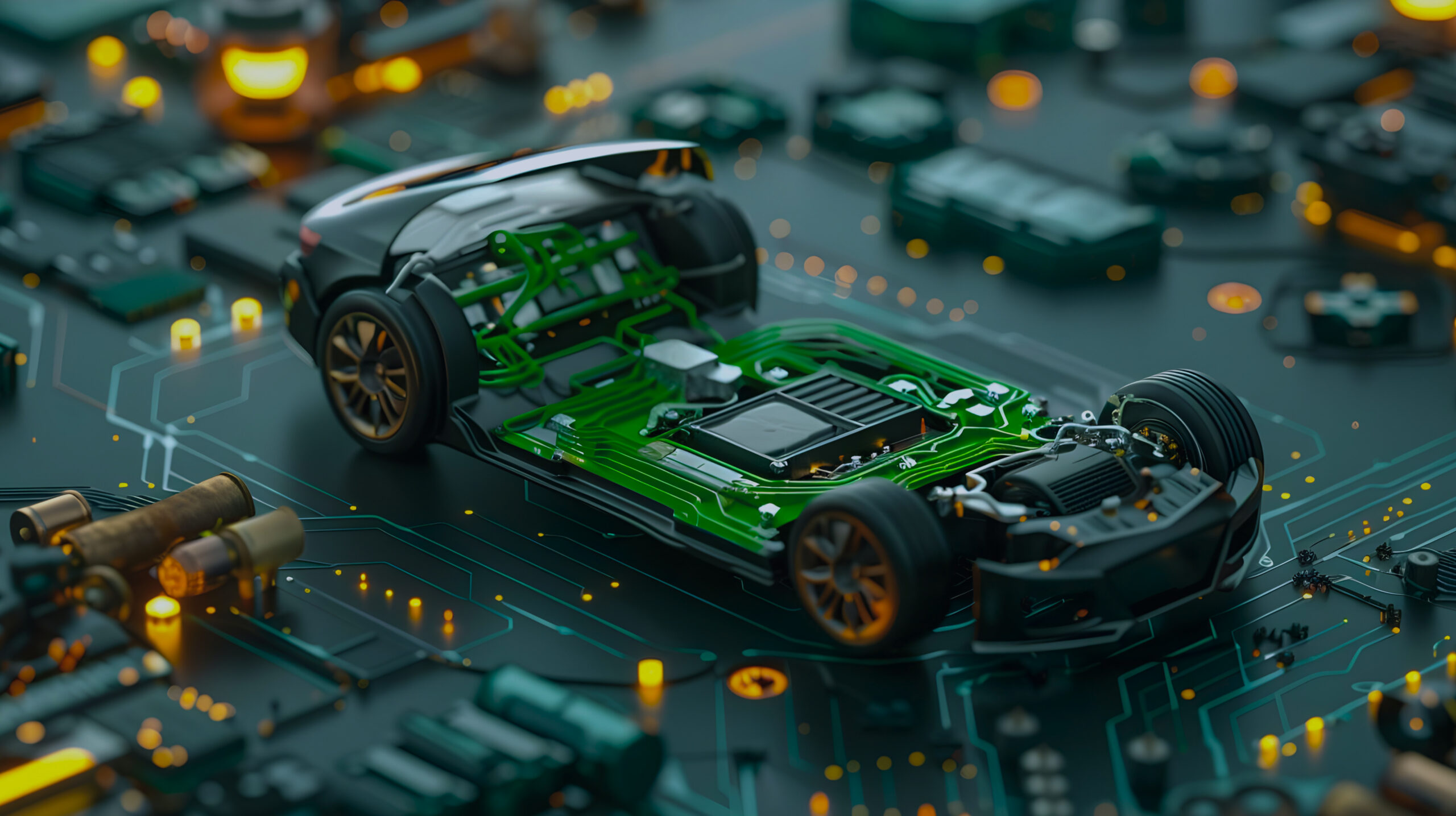
The automotive industry is steadily replacing mechanical systems with intelligent electronic controls. Among the most transformative examples are brake-by-wire and steer-by-wire technologies. These systems remove traditional mechanical linkages and rely entirely on sensors, actuators, processors, and software to control critical vehicle functions.
While this shift enables better integration with ADAS, autonomy, and electric vehicle platforms, it introduces one of the toughest engineering challenges in automotive design: meeting strict real-time constraints in safety-critical embedded environments.
From Mechanical Linkages to Electronic Control
In conventional vehicles:
- The brake pedal is connected to the calipers through hydraulic lines.
- The steering wheel is physically connected to the wheels through a steering column
In brake-by-wire and steer-by-wire systems:
- Pedal and steering inputs are converted into electrical signals.
- Control units process these inputs.
- Actuators execute the commands precisely and instantly.
This architecture provides flexibility and efficiency, but it also means the system must never miss a timing deadline.
Why Real-Time Behavior Is Non-Negotiable
In general computing, a delay of a few milliseconds is harmless. In steering or braking, that delay can affect vehicle stability and passenger safety.
Real-time performance here means:
- The system must respond within a guaranteed time window.
- The response time must be consistent across all operating conditions.
- Timing must remain predictable even under system load or partial failures.
This is where strong embedded system design principles become essential.
Challenges in Brake-by-Wire and Steer-by-Wire
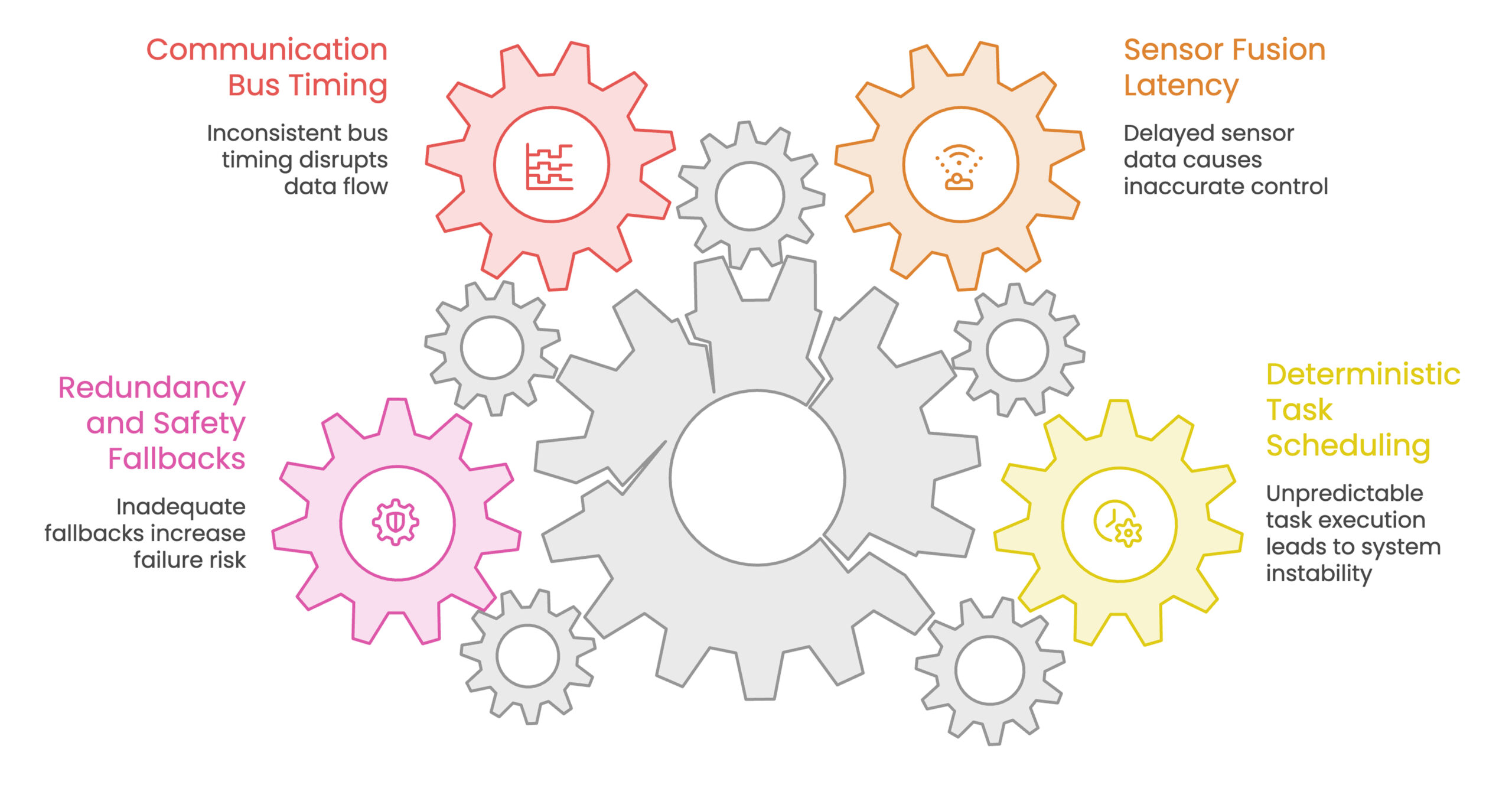
Let’s break down the most common hurdles engineers face when building these systems:
1. Deterministic Task Scheduling
Real-time systems often use an RTOS (Real-Time Operating System) to manage tasks like:
- Reading sensors
- Running control algorithms
- Sending commands to actuators
Unlike general-purpose OSes, an RTOS ensures high-priority tasks always get CPU time on schedule, even under load.
2. Sensor Fusion Latency
Modern vehicles gather data from multiple sensors:
- Steering angle encoders
- Wheel speed sensors
- Gyroscopes
- Brake pressure sensors
To make real-time decisions, these data streams must be processed quickly and reliably, something engineers prioritize when designing embedded system software.
3. Communication Bus Timing
Real-time systems depend on reliable messaging across vehicle networks:
- CAN – robust but limited bandwidth
- FlexRay – deterministic but costly
- Automotive Ethernet – high speed, emerging standards
To maintain real-time constraints:
- Messages must be prioritized
- Bandwidth must be reserved
- Jitter must be minimized
All of which require careful planning and implementation.
4. Redundancy and Safety Fallbacks
Safety-critical systems need backup plans. If a sensor fails or a communication link drops, the system must switch to a safe mode instantly. This demands:
- Hardware redundancy
- Fail-over logic implemented in real-time
- Continuous monitoring and diagnostics
Fail-safe logic must not only work; it must work on time.
Software Architecture for Real-Time Automotive Systems
Building reliable brake-by-wire and steer-by-wire systems requires a layered software approach:
1. Firmware & Low-Level Drivers
These interface directly with hardware and must handle interrupts quickly and efficiently.
2. Control Algorithms
These compute the appropriate response based on sensor data. They must be:
- Optimized for speed
- Predictable in execution time
- Free of unnecessary computational complexity
3. Diagnostics & Monitoring
Real-time health checks ensure the system is functioning safely. But they also add load. Engineers must balance thorough monitoring with timing requirements.
Verifying Real-Time Performance
Real-time constraints must be proven, not assumed. Engineers use:
- Hardware-in-the-Loop (HIL) simulations
- Trace and timing analysis tools
- Stress testing under worst-case scenarios
- Fault injection to test system behavior under failures
Such validation ensures compliance with standards like ISO 26262 while preserving timing integrity.
Increasing Complexity with Autonomous Systems
As vehicles move toward autonomy:
- More sensors are added
- AI-driven decisions are introduced
- Communication loads increase
Despite this complexity, the requirement remains the same: deterministic, predictable timing. This pushes the industry toward multicore real-time scheduling, hardware acceleration, and smarter validation platforms, true advanced design solution approaches for modern automotive challenges.
Best Practices for Meeting Real-Time Constraints
Engineers working on brake-by-wire and steer-by-wire systems typically follow these principles:
- Use RTOS features for task prioritization
- Design control loops for minimal computational overhead
- Reserve bandwidth on communication buses
- Implement hardware and software redundancy
- Continuously validate timing through trace tools and HIL setups
These systems demand both theoretical expertise and hands-on engineering discipline.
AI-Enabled Control Loops for Autonomous Embedded Devices
Tessolve: Enabling Reliable Real-Time Automotive Systems
At Tessolve, we specialize in helping automotive OEMs and Tier-1 suppliers overcome the real-time challenges inherent in brake-by-wire and steer-by-wire technologies. As an experienced embedded system company, we bring deep expertise across hardware design, real-time embedded software, system integration, and automotive validation.
Our teams work on complex automotive programs that demand precise embedded system design, rigorous testing, and compliance with safety standards like ISO 26262. With dedicated labs, HIL setups, and certified validation practices, we support customers in building dependable real-time control architectures from concept to production.
By combining domain knowledge with proven advanced design solution methodologies, Tessolve enables organizations to accelerate development while maintaining the highest standards of safety, performance, and reliability in next-generation automotive systems.
Frequently Asked Questions (FAQs)
1. How are brake-by-wire and steer-by-wire different from mechanical systems?
They replace physical linkages with electronic controls, allowing smarter integration with ADAS, autonomy, and adaptive vehicle responses.
2. Why are real-time constraints critical in these control systems?
Because even tiny delays in braking or steering responses can affect vehicle stability, safety, and overall driving performance.
3. How do engineers ensure timing predictability in embedded systems?
They use RTOS scheduling, optimized control algorithms, prioritized communication, and rigorous timing validation through testing tools.
4. What role do vehicle networks play in real-time control?
Networks like CAN and Ethernet carry critical messages that must arrive on time without jitter or congestion.
5. How are these systems tested for real-time and safety compliance?
Through HIL simulations, stress testing, trace analysis, and fault injection to validate behavior under extreme conditions.


