

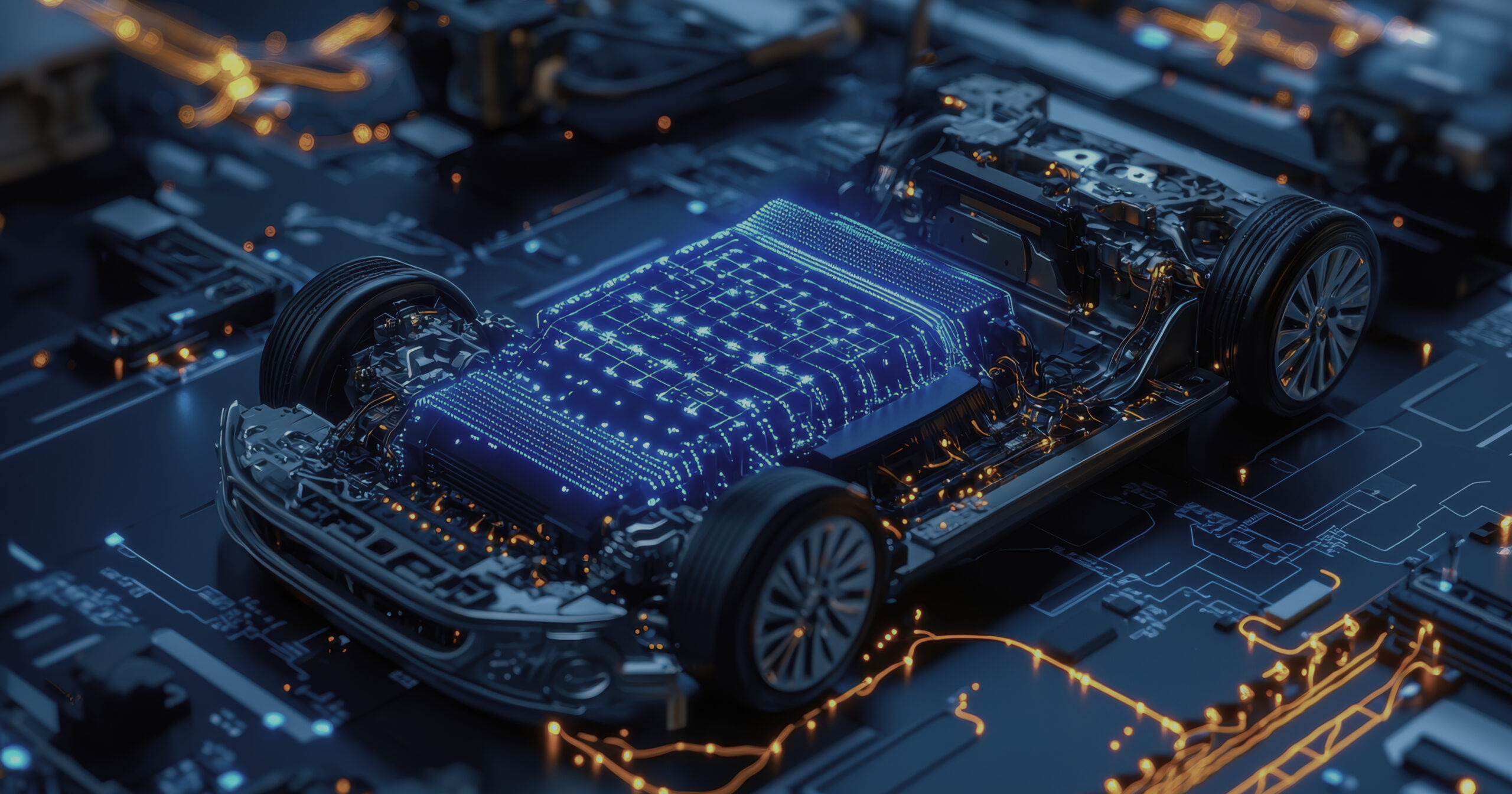
Battery performance is the backbone of any Electric Vehicle (EV). Range, safety, charging speed, and long-term reliability all depend on how effectively the battery is managed. While battery chemistry often takes the spotlight, the real optimization happens at a deeper level, through embedded controllers that govern how the battery behaves in real-world conditions.
In EV platforms, embedded controllers act as decision-makers, continuously analyzing data and executing control strategies that protect the battery while extracting maximum performance. Let’s explore how these controllers optimize battery management, step by step.
What Is a Battery Management System (BMS)?
At its simplest, a battery management system in an EV monitors and controls the battery pack. The job sounds straightforward but involves handling dozens or even hundreds of cells, each with its own voltage and temperature profile. The BMS must:
- Track the state of charge (SoC) to estimate how much energy is available
- Monitor temperature and health to prevent problems like thermal runaway
- Balance the charge between cells so the whole pack ages uniformly
- Optimize charging and discharging to extend overall life
All of this happens in real time, and the core of this real-time decision-making is the embedded controller.
Key Ways Embedded Controllers Optimize EV Battery Performance
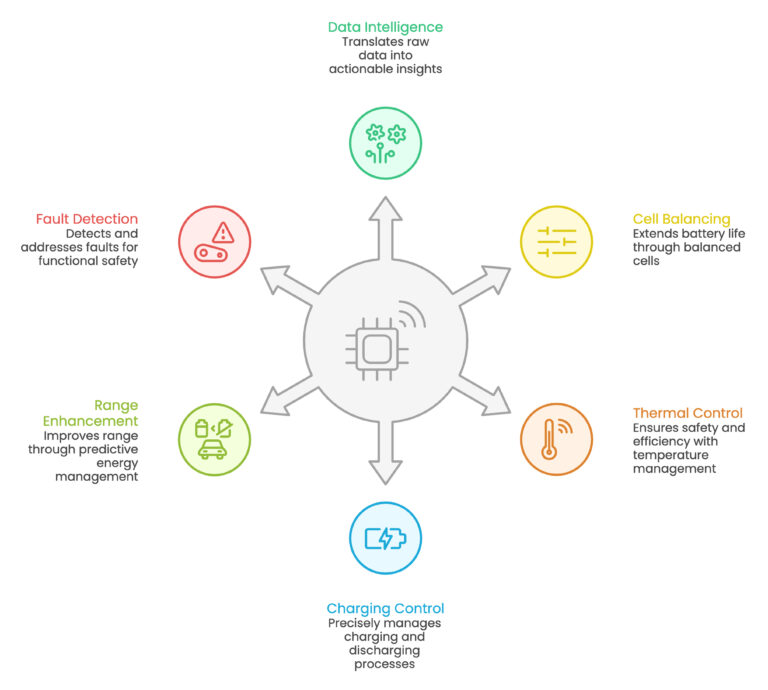
1. Translating Raw Battery Data into Actionable Intelligence
At the core of battery optimization is data. EV battery packs generate massive volumes of information, such as cell voltages, temperatures, current flow, and insulation resistance. Embedded controllers sit at the center of this data ecosystem.
Using carefully planned embedded system design, controllers sample sensor data at high frequencies and filter out noise to ensure accuracy. This enables the system to react instantly to changes such as rapid acceleration, regenerative braking, or fast charging.
Rather than simply displaying data, controllers convert raw inputs into meaningful insights like:
- State of Charge (SoC)
- State of Health (SoH)
- Available power limits under current conditions
This real-time intelligence is what allows the EV to make precise, informed decisions every second.
2. Optimizing Cell Balancing to Extend Battery Life
One of the most critical ways embedded controllers optimize battery performance is through intelligent cell balancing. In a battery pack, no two cells age or behave exactly the same. Over time, imbalances can reduce usable capacity and accelerate degradation.
Embedded controllers:
- Detect voltage differences across cells
- Identify underperforming or stressed cells
- Actively redistribute charge using passive or active balancing techniques
By executing optimized balancing algorithms, developed during the design of embedded system workflows, controllers ensure that all cells age uniformly. The result is improved range consistency and longer battery lifespan.
3. Dynamic Thermal Control for Safety and Efficiency
Temperature control is non-negotiable in EV battery systems. Excessive heat reduces efficiency and creates safety risks, while low temperatures limit power output and charging speed.
Embedded controllers optimize thermal behavior by:
- Continuously monitoring temperature gradients across modules
- Predicting thermal buildup under load
- Coordinating cooling or heating systems in advance
Rather than reacting after temperatures spike, controllers use predictive models to regulate thermal conditions proactively. This approach not only enhances safety but also enables faster charging and more stable power delivery.
4. Precision Control of Charging and Discharging
Charging an EV battery is not a one-size-fits-all process. Fast charging, regenerative braking, and high-load driving all stress the battery differently.
Embedded controllers optimize these processes by:
- Adjusting charge current based on temperature and SoC
- Preventing overvoltage and deep discharge scenarios
- Dynamically limiting power during extreme conditions
These control strategies are implemented through tightly integrated firmware logic, often part of an advanced design solution that aligns hardware capabilities with intelligent software control. The outcome is safer fast charging, improved regenerative efficiency, and reduced long-term wear.
5. Enhancing Range Through Predictive Energy Management
Modern EVs don’t just react; they anticipate. Embedded controllers play a crucial role in predictive battery management by using historical data, driving patterns, and real-time vehicle inputs.
Controllers can:
- Estimate the remaining range more accurately
- Adjust power availability based on terrain or driving behavior
- Optimize energy flow between propulsion, HVAC, and auxiliary systems
This predictive optimization ensures that energy is used where it matters most, improving both driving confidence and real-world range accuracy.
6. Enabling Fault Detection and Functional Safety
Battery systems must meet strict automotive safety standards. Embedded controllers continuously scan for abnormal conditions that could indicate faults or failures.
They optimize safety by:
- Detecting overcurrent, short circuits, and insulation faults
- Triggering controlled shutdowns when necessary
- Communicating fault states to vehicle control units
By embedding diagnostics and fail-safe logic at the controller level, EV platforms achieve higher functional safety without compromising performance.
How Domain Controllers Are Reshaping Automotive Embedded Architectures
Why Specialized Engineering Expertise Matters
The sophistication of battery optimization strategies highlights why EV manufacturers rely on specialized engineering partners. Developing controllers that balance performance, safety, efficiency, and scalability requires deep cross-domain expertise.
This is where a seasoned embedded system company adds value, by translating complex requirements into production-ready, automotive-compliant systems that perform reliably in the field.
Tessolve’s Role in Advancing EV Battery Intelligence
At Tessolve, we specialize in building intelligent embedded solutions that power next-generation EV platforms. From battery management controllers to system-level validation, our teams deliver end-to-end embedded engineering services tailored for automotive applications.
With strong expertise in real-time firmware, power electronics integration, functional safety, and system validation, we help EV innovators transform complex battery challenges into reliable, scalable solutions. Our automotive-grade processes and deep domain knowledge enable faster development cycles without compromising quality or safety.
By combining proven methodologies with innovation-driven execution, Tessolve empowers EV manufacturers to deploy smarter battery management systems that enhance performance, longevity, and safety, right from the controller level.
Frequently Asked Questions (FAQs)
1. What role do embedded controllers play in EV battery management?
Embedded controllers monitor, analyze, and optimize battery performance in real time, ensuring safety, efficiency, and extended battery lifespan.
2. How does cell balancing improve EV battery life?
Cell balancing evens out voltage differences, preventing premature degradation and ensuring all cells age uniformly for a consistent range.
3. Can embedded controllers enhance EV charging and discharging efficiency?
Yes, they dynamically regulate charge rates, prevent overvoltage, and optimize regenerative braking to reduce wear and improve energy use.
4. Why is predictive energy management important in EVs?
Predictive management anticipates driving conditions, adjusts power flow, and maximizes range, giving drivers accurate energy availability and confidence.


