

Automotive electronics live a tough life. Unlike consumer devices that sit comfortably indoors, vehicle electronics are exposed to extreme, repeated temperature changes every day. From cold mornings to high under-hood heat, from traffic jams to highway cruising, electronic systems constantly heat up and cool down. This repeated temperature fluctuation, known as thermal cycling, plays a major role in determining how reliable automotive electronics remain over time.
Understanding how thermal cycling affects long-term reliability isn’t just helpful; it’s essential for engineers designing systems that must operate reliably for years. Let’s explore the key ways thermal cycling affects automotive electronics and the strategies used to counter these effects.
Why Thermal Cycling Is a Critical Reliability Challenge
Thermal cycling is not a one-time stress event; it is a continuous reliability challenge that automotive electronics face throughout their operational life. Every rise and drop in temperature causes materials to expand and contract, slowly weakening solder joints, connectors, and internal structures. Over thousands of cycles, this repeated stress accelerates wear, introduces micro-level damage, and increases the likelihood of latent failures. Understanding these effects early helps engineers design electronics that remain stable, predictable, and reliable under real-world driving conditions.
Key Ways Thermal Cycling Affects Automotive Electronics Reliability
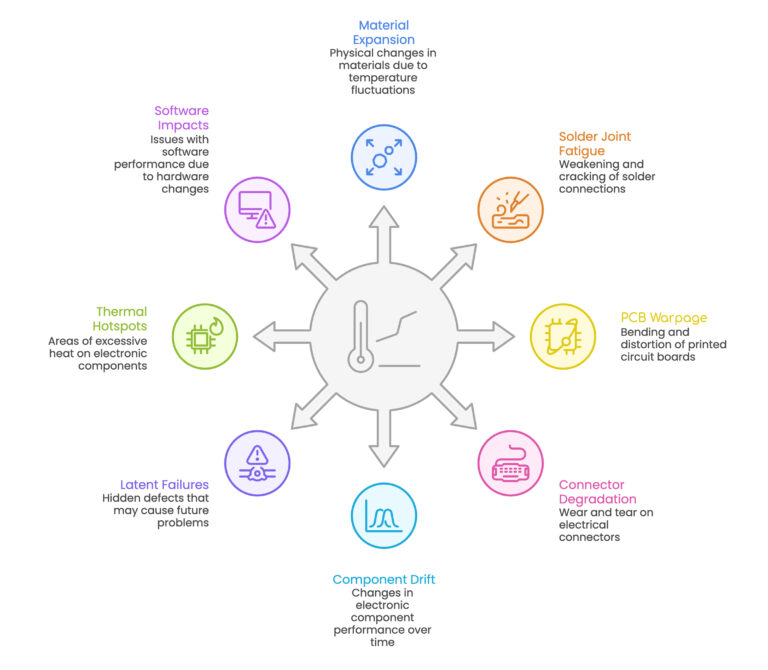
1. Material Expansion and Contraction: The Root of Stress
One of the most fundamental ways thermal cycling impacts reliability is through material expansion and contraction. Every material used in automotive electronics, such as PCBs, solder, silicon chips, and connectors, expands when heated and contracts when cooled. The problem is that they don’t all expand at the same rate.
Over thousands of thermal cycles, this mismatch creates mechanical stress at interfaces, especially solder joints and component leads. In embedded system design, this is one of the earliest considerations because ignoring material behavior almost guarantees premature failures.
Strategy:
Engineers reduce this stress by carefully selecting materials with compatible thermal expansion coefficients and designing layouts that distribute stress more evenly across the board.
2. Solder Joint Fatigue and Micro-Cracking
Solder joints are among the most vulnerable points in automotive electronics. Thermal cycling repeatedly stretches and compresses these joints, eventually leading to fatigue. Micro-cracks form first, often invisible during normal inspection, and then grow with continued cycling until electrical connections fail.
This failure mode is especially common in power electronics, engine control units, and battery management systems where temperature swings are severe.
Strategy:
To improve reliability, teams use automotive-grade solder alloys, optimized joint geometries, and controlled reflow profiles. During the design of embedded system architectures, component placement is also optimized to minimize localized stress on critical joints.
3. PCB Warpage and Delamination
Thermal cycling affects not only individual components but also the entire PCB structure. Repeated heating and cooling can cause PCB warpage, layer separation, or delamination. Over time, this leads to broken vias, intermittent connections, or signal integrity issues. High-density boards are particularly susceptible because multiple layers respond differently to temperature changes.
Strategy:
Using reinforced PCB materials, balanced layer stack-ups, and controlled copper distribution helps maintain structural stability. These design practices are often validated through accelerated thermal cycling tests before production release.
4. Connector and Interconnect Degradation
Connectors are critical for linking sensors, actuators, and control units across the vehicle. Thermal cycling causes gradual loosening of contacts, oxidation, and contact resistance drift. While failures may not be immediate, performance degrades over time, leading to intermittent faults that are difficult to diagnose.
Strategy:
Automotive-grade connectors, protective coatings, and redundancy planning are widely used. Engineers also design systems to tolerate small changes in resistance without affecting performance.
5. Component Parameter Drift Over Time
Thermal cycling impacts not only mechanical reliability but also electrical behavior. Repeated exposure to temperature extremes can cause parameter drift in resistors, capacitors, and semiconductor devices. Over long durations, this affects timing accuracy, voltage regulation, and sensor precision. In safety-critical systems, even small deviations can lead to incorrect system responses.
Strategy:
Design margins are increased, temperature-compensation algorithms are implemented in firmware, and extensive validation ensures that components remain within acceptable limits throughout their lifecycle.
6. Increased Risk of Latent Failures
One of the most dangerous impacts of thermal cycling is the creation of latent defects. These failures don’t show up immediately; they appear months or years later in the field. A micro-crack formed early may pass initial testing but eventually cause a complete system failure under real-world conditions.
Strategy:
Highly Accelerated Life Testing (HALT) and thermal cycling stress tests are applied early in development to expose these hidden weaknesses before mass production.
7. Thermal Hotspots and Uneven Heating
Not all parts of an electronic system heat and cool evenly. Power devices, processors, and regulators generate localized heat, creating thermal gradients across the board. During cycling, these gradients amplify stress in specific areas, accelerating wear and tear.
Strategy:
Effective thermal management, including heat sinks, thermal vias, airflow planning, and intelligent component placement, helps reduce temperature differences and slow down failure mechanisms.
8. Software and System-Level Impacts
Thermal cycling indirectly affects embedded software reliability. Temperature changes can alter timing behavior, clock stability, and sensor feedback. Without proper safeguards, software may misinterpret hardware behavior, leading to faults or degraded performance.
This is where a holistic approach becomes essential: blending hardware robustness with intelligent software design to deliver an advanced design solution.
Strategy:
System-level validation, thermal monitoring, adaptive control algorithms, and hardware-in-the-loop testing ensure software responds safely to temperature-induced variations.
Why Expertise Matters in Automotive Electronics Reliability
Managing thermal cycling effects is not a single-step task; it requires coordination across materials, mechanical design, electronics, firmware, and validation. That’s why partnering with an experienced embedded system company often makes the difference between long-term success and costly field failures.
How Automotive Embedded Systems Are Transforming In-Vehicle Infotainment
Tessolve: Engineering Reliability Into Automotive Electronics
At Tessolve, we engineer automotive electronics with long-term reliability at the core, not as an afterthought. From concept to production, our teams focus on identifying how environmental stresses, such as thermal cycling, affect real-world performance and addressing them early.
We deliver end-to-end solutions covering system architecture, hardware, and software development, validation, and compliance. Our state-of-the-art labs support environmental testing, thermal cycling, vibration analysis, and accelerated life testing to uncover latent defects before they reach the field. With strong expertise in automotive standards such as ISO 26262, AUTOSAR, and ASPICE, Tessolve helps OEMs and Tier-1 suppliers build electronics that survive years of thermal stress while maintaining performance and safety.
By combining deep domain knowledge with rigorous testing and proven methodologies, Tessolve enables automotive electronics that last, mile after mile, cycle after cycle.
Frequently Asked Questions (FAQs)
1. Why is thermal cycling a major concern for automotive electronics?
Thermal cycling repeatedly stresses the material, leading to solder fatigue, component drift, and long-term reliability failures.
2. Which automotive components are most affected by thermal cycling?
Solder joints, PCBs, connectors, power modules, and sensors experience the highest stress during repeated temperature changes.
3. How do engineers reduce thermal cycling-related failures?
Engineers use compatible materials, optimized layouts, thermal management techniques, and extensive environmental stress testing.
4. Can software reliability be impacted by thermal cycling?
Yes, temperature changes can affect timing, sensor accuracy, and system behavior without proper monitoring and adaptive software controls.
5. Why is thermal cycling testing important before mass production?
It reveals latent defects early, ensuring automotive electronics survive real-world temperature extremes throughout their operational lifespan.


