

The automotive industry is undergoing a massive transformation. Vehicles are no longer just mechanical systems; they are evolving into intelligent, interconnected platforms capable of making decisions on the move. At the heart of this transformation lies the vehicle electrical architecture, which integrates sensors, processors, and actuators to enable autonomous driving.
And driving this integration? Embedded systems, the silent intelligence powering every critical function. Let’s explore how embedded system design is revolutionizing the electrical architecture of autonomous vehicles and setting new benchmarks for safety, efficiency, and intelligence.
The Shift Toward Smarter Vehicle Architectures
Traditional vehicles relied on dozens of Electronic Control Units (ECUs), each responsible for a single function such as braking, lighting, or steering. As autonomous driving grows more complex, this approach has become outdated.
Modern vehicles now use domain-based and zonal architectures, centralizing multiple functions into powerful computing nodes. This allows for:
- Faster data processing
- Reduced wiring complexity
- Easier software updates
- Improved system scalability
These intelligent architectures are made possible through precision-driven designing embedded system strategies that integrate sensors, real-time processors, and communication buses seamlessly.
Why Embedded Systems Are the Backbone of Autonomy
Every autonomous vehicle operates like a distributed computer network. Cameras, LiDARs, radars, and ultrasonic sensors collect massive volumes of data every second. Processing and acting on that data in real-time requires a highly efficient embedded system design.
Key responsibilities of embedded systems in autonomous vehicles include:
- Sensor Fusion: Combining inputs from multiple sensors to create a unified view of the environment.
- Real-Time Decision-Making: Processing data instantly to make driving decisions, such as braking or steering corrections.
- Safety Monitoring: Ensuring compliance with automotive standards like ISO 26262 for functional safety.
- Secure Communication: Protecting data between vehicle nodes through encryption and secure gateways.
This intricate orchestration of hardware and software is only possible through systematic designing embedded system workflows that ensure reliability, security, and performance.
Technical Challenges in Modern Vehicle Electrical Architecture
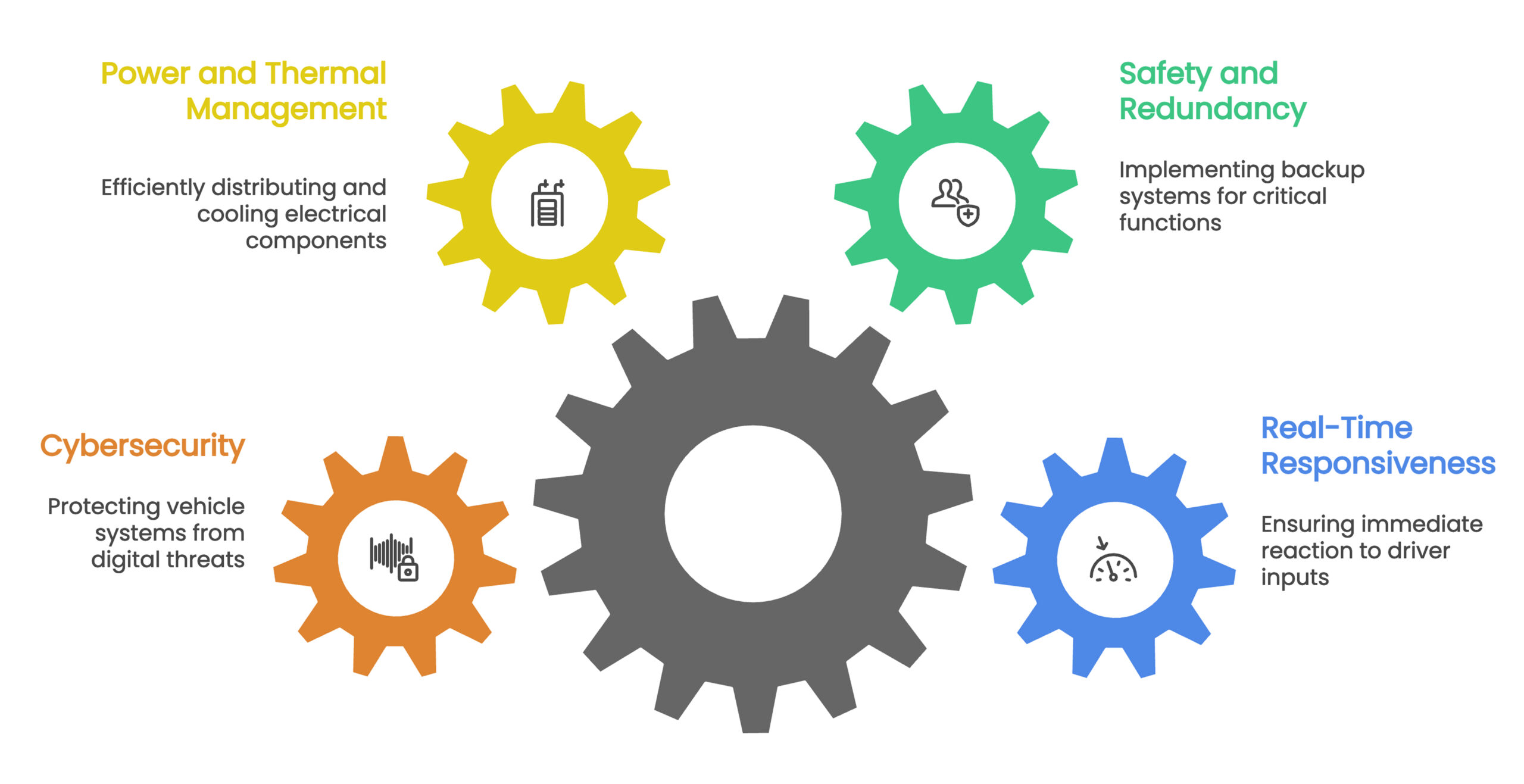
Building the electrical backbone for autonomous vehicles is not simple. Engineers face multiple challenges that demand advanced design solutions and cross-domain expertise:
1. Real-Time Responsiveness
Driving decisions like obstacle avoidance require ultra-low latency. This demands deterministic communication protocols such as CAN-FD and Time-Sensitive Networking (TSN).
2. Safety and Redundancy
Fail-operational systems are crucial for autonomy. Engineers must integrate redundancy across power supply, communication buses, and processing units, a key aspect of embedded system design.
3. Power and Thermal Management
As vehicles pack in high-performance computing systems, managing power consumption and heat dissipation becomes a major concern.
4. Cybersecurity
With vehicles connected to the cloud and other vehicles, embedded systems must incorporate robust cybersecurity layers to prevent breaches.
Design Patterns Driving the Future
Leading automotive engineers now follow well-defined design patterns that form the foundation of modern architectures:
- Zonal Control Units: Simplify wiring and improve fault isolation.
- Heterogeneous Compute Platforms: Combine CPUs, GPUs, and AI accelerators for perception and decision-making.
- Modular Firmware Design: Enables over-the-air (OTA) updates and rapid software deployment.
- Hardware-in-the-Loop (HIL) Testing: Validates embedded systems in real-world conditions before deployment.
These approaches, supported by robust designing embedded system, make it possible to handle the complexity of autonomous driving safely and efficiently.
Importance of Verification and Validation
Validation is one of the most time-consuming yet critical phases of automotive development. Embedded systems must be tested under millions of driving scenarios to ensure reliability.
Automotive labs now use simulation environments, HIL frameworks, and real-world stress testing to ensure every embedded controller behaves predictably. Only a well-executed advanced design solution, combining testing, software integration, and safety compliance, can ensure consistent performance across all environmental and operational conditions.
How System Integrators Add Value
OEMs and Tier-1 suppliers often collaborate with engineering solution providers for end-to-end embedded services. These partners bridge the gap between chip-level design and full vehicle integration by providing:
- Hardware and PCB design
- Firmware and software development
- Automotive safety compliance
- System-level validation
Through holistic embedded system design, these engineering firms enable faster development cycles and ensure that autonomous systems meet both technical and regulatory standards.
Designing for the Future of Mobility
The future of vehicles is software-defined. As AI and connectivity become central to automotive functionality, designing architectures that can evolve over time is crucial.
Adopting flexible frameworks, open standards like AUTOSAR, and robust security foundations during embedded system design ensures long-term scalability. Future vehicles will continuously receive updates, integrate new sensors, and even learn through AI, all powered by intelligently designing embedded system strategies.
Embedded Systems Integration in Vehicle Electrical Networks
- Centralized Control Units: Modern architectures use powerful domain controllers built on optimized embedded system design for handling multiple vehicle functions simultaneously.
- High-Speed Communication: Protocols like Ethernet, CAN-FD, and LIN are integrated through designing embedded system frameworks to ensure real-time data flow between sensors and processors.
- Edge Intelligence: Vehicles employ AI-driven ECUs powered by advanced design solutions. That enables autonomous perception, motion control, and predictive maintenance, enhancing reliability, safety, and efficiency on the road.
Embedded Systems in Autonomous Vehicles: Architecture, Safety & Validation
Tessolve: Empowering the Next Generation of Automotive Embedded Systems
At Tessolve, we are at the forefront of redefining automotive innovation through intelligent engineering. Our expertise spans embedded system design, firmware development, hardware validation, and software testing, enabling OEMs and Tier-1 suppliers to accelerate product development for the autonomous era.
With state-of-the-art labs, silicon-to-system validation facilities, and a proven track record in automotive and semiconductor domains, Tessolve delivers advanced design solutions tailored to modern mobility needs. From concept to deployment, our engineers specialize in designing embedded system architectures that meet global automotive safety standards, ensure reliability, and drive innovation.
Partner with Tessolve to bring intelligence, safety, and scalability to your next-generation vehicle platforms, because the future of mobility starts with smarter design.
Frequently Asked Questions
What is vehicle electrical architecture in autonomous vehicles?
It’s the integrated network of sensors, processors, and actuators enabling autonomous driving through real-time data processing and control.
Why are embedded systems crucial for autonomous driving?
They process sensor data, make real-time decisions, ensure safety, and manage secure communication across the vehicle’s electrical network.
What are the main challenges in modern vehicle electrical design?
Engineers face real-time responsiveness, safety redundancy, power and thermal management, and cybersecurity in embedded system design.
How do system integrators support automotive embedded system design?
They provide hardware, firmware, safety compliance, and validation services, enabling OEMs to deploy reliable and scalable autonomous systems efficiently.


