


Industrial IoT (IIoT) is revolutionizing industries like manufacturing, energy, logistics, and robotics. At the core of these next-gen systems is a Real-Time Operating System (RTOS), a critical software component that allows smart devices to operate reliably and predictably. Unlike general-purpose operating systems, an RTOS is purpose-built to handle precise timing, safety, and performance requirements in real-time environments.
In this blog, we’ll explain the major reasons why an RTOS is indispensable for modern Industrial IoT systems. Additionally, how it ties into embedded system design and applying advanced design solution techniques.
Why RTOS Matters for Industrial IoT: Key Reasons
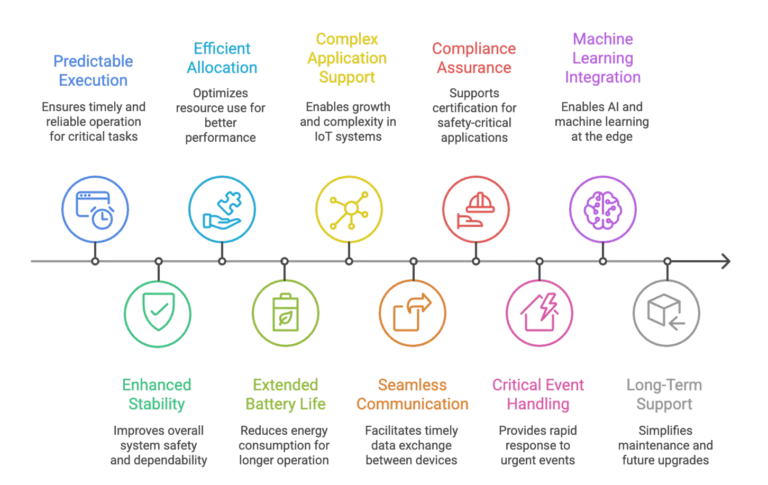
1. Deterministic Timing and Predictable Behavior
An RTOS ensures that tasks are executed in a predictable, time-bound manner, critical for industrial processes that involve motion control, real-time sensing, or rapid feedback loops. Timing determinism eliminates delays and jitter, ensuring consistent and reliable operation.
When you’re involved in designing embedded system architectures for industrial automation, even microsecond-level delay can disrupt a production line. RTOS allows engineers to define task priorities and timing constraints so that high-priority operations never get delayed by less critical processes.
2. Improved System Safety and Reliability
Many industrial environments require functional safety to protect machinery, workers, and systems. Real-Time Operating Systems offer key features such as memory protection, task isolation, watchdog timers, and fail-safe mechanisms to ensure a fault in one component doesn’t crash the entire system.
In embedded system design, safety features provided by RTOS platforms can be integrated early on to comply with standards like ISO 26262 or IEC 61508. This is particularly critical for industries like automotive, avionics, and medical devices, where failure is not an option.
3. Efficient Resource Management
IIoT devices are typically resource-constrained, with limited CPU power, memory, and energy. A Real-Time OS is optimized for such environments, using minimal overhead and efficient scheduling to maintain performance within tight limits.
An innovative, advanced design solution involves selecting an RTOS that supports these constraints while still delivering on real-time performance. This allows designers to use lower-cost hardware and still meet high-performance requirements.
4. Power Efficiency and Battery Life
Power efficiency is key for IIoT devices, especially those deployed in remote or mobile environments. RTOS platforms support advanced power management techniques like tickless idle, sleep modes, and scheduled wake-ups, essential for long battery life.
In designing embedded system platforms for battery-powered sensors or controllers, using RTOS helps developers finely control power states and transitions, optimizing energy usage without sacrificing responsiveness.
5. Scalability for Complex Applications
Modern IIoT systems are growing in complexity. Devices are no longer just sensors; they often include edge computing, local analytics, multi-protocol connectivity, and AI inference. A Real-Time OS provides a scalable architecture that allows multiple software components to coexist with well-defined priorities and interactions.
Scalable embedded system design is essential for devices that may need future upgrades or expanded capabilities. RTOS enables modular development, where new features can be added without disrupting existing critical operations.
6. Real-Time Networking and Communication
Industrial protocols like Modbus, EtherCAT, PROFINET, or MQTT require low-latency, real-time handling of data packets. RTOS platforms support prioritized communication stacks and deterministic networking that ensure critical messages are never delayed.
An advanced design solution includes integrating time-sensitive networking (TSN) and managing bandwidth allocation for real-time and non-real-time traffic. RTOS makes this easier and more reliable.
7. Support for Functional Safety Certification
Many industrial systems must comply with strict safety and reliability standards. Real-Time OS vendors often provide pre-certified kernels or components for standards like ISO 26262 (automotive), DO-178C (aerospace), or IEC 61508 (industrial).
This reduces development time and certification cost in designing embedded system projects, especially in regulated industries where documentation and testing are as important as the hardware.
8. Faster Response to Critical Events
In systems like predictive maintenance, robotics, or energy control, detecting and responding to an event in real-time can prevent damage or downtime. RTOS platforms enable faster interrupt handling, preemptive task switching, and rapid control response.
Whether you’re managing a robotic arm or monitoring a transformer, the ability to react in microseconds is built into the foundation of an RTOS-based embedded system design.
9. Edge AI and Machine Learning Compatibility
As IIoT devices become more intelligent, there’s a growing need to run AI algorithms at the edge. Real-Time OS platforms now support integration with lightweight ML libraries such as TensorFlow Lite Micro, Edge Impulse, etc.
Combining AI with real-time processing enables next-level functionality, like detecting anomalies in sensor readings or making predictive decisions on the device. This kind of advanced design solution helps reduce cloud dependence, lowers latency, and improves reliability.
10. Long-Term Maintainability and Modularity
RTOS-based systems are easier to maintain because they enforce structure and modularity. Software components like communication stacks, UI interfaces, and data loggers can be developed independently, tested in isolation, and updated without affecting core logic.
Modularity is a key best practice in designing embedded system software that will scale, update, or be reused across product lines.
Learn More: Real-Time Operating Systems (RTOS): Choosing the Right One for Your Application
Why RTOS Matters to Developers and Designers
For developers and designers, using a Real-Time OS streamlines development, increases reliability, and simplifies complexity. Some of the practical benefits include:
- Deterministic scheduling: Critical tasks always execute within guaranteed time frames.
- Modular architecture: Easier code maintenance and feature isolation.
- Built-in safety mechanisms: Memory protection, priority inheritance, and watchdog timers.
- Support for industry certifications: Faster compliance with safety standards.
- Low overhead: Ideal for resource-limited hardware.
- Integration ease: Real-time networking, edge AI, and communication stacks can be implemented cleanly.
These advantages make an RTOS a core enabler of reliable, scalable, and safe embedded system design. For engineers working on next-gen IIoT solutions, embracing real-time software architecture is no longer optional; it’s essential.
Tessolve: Enabling Next-Gen Industrial IoT from the Inside
Tessolve doesn’t just support innovation; we build it from the ground up. As a global engineering services company, we specialize in embedded system design, firmware development, hardware engineering, and full product validation. Our expertise spans across automotive, industrial, medical, and semiconductor industries, providing end-to-end solutions that combine system-level thinking with execution excellence.
Our real-time OS expertise ensures that your IIoT devices are safe, scalable, and certification-ready. With years of experience in designing embedded system architectures and implementing advanced design solution frameworks, Tessolve is your ideal partner to accelerate development and reduce time-to-market for next-gen industrial products. Partner with us to bring your industrial IoT vision to life.


